Get Full Government Meeting Transcripts, Videos, & Alerts Forever!
Get email alerts on the Immigration Coercion Workplace topic
No spam. Unsubscribe anytime.
Bill would penalize employers who coerce employees over immigration status; committee hears support and concerns about clarity
Summary
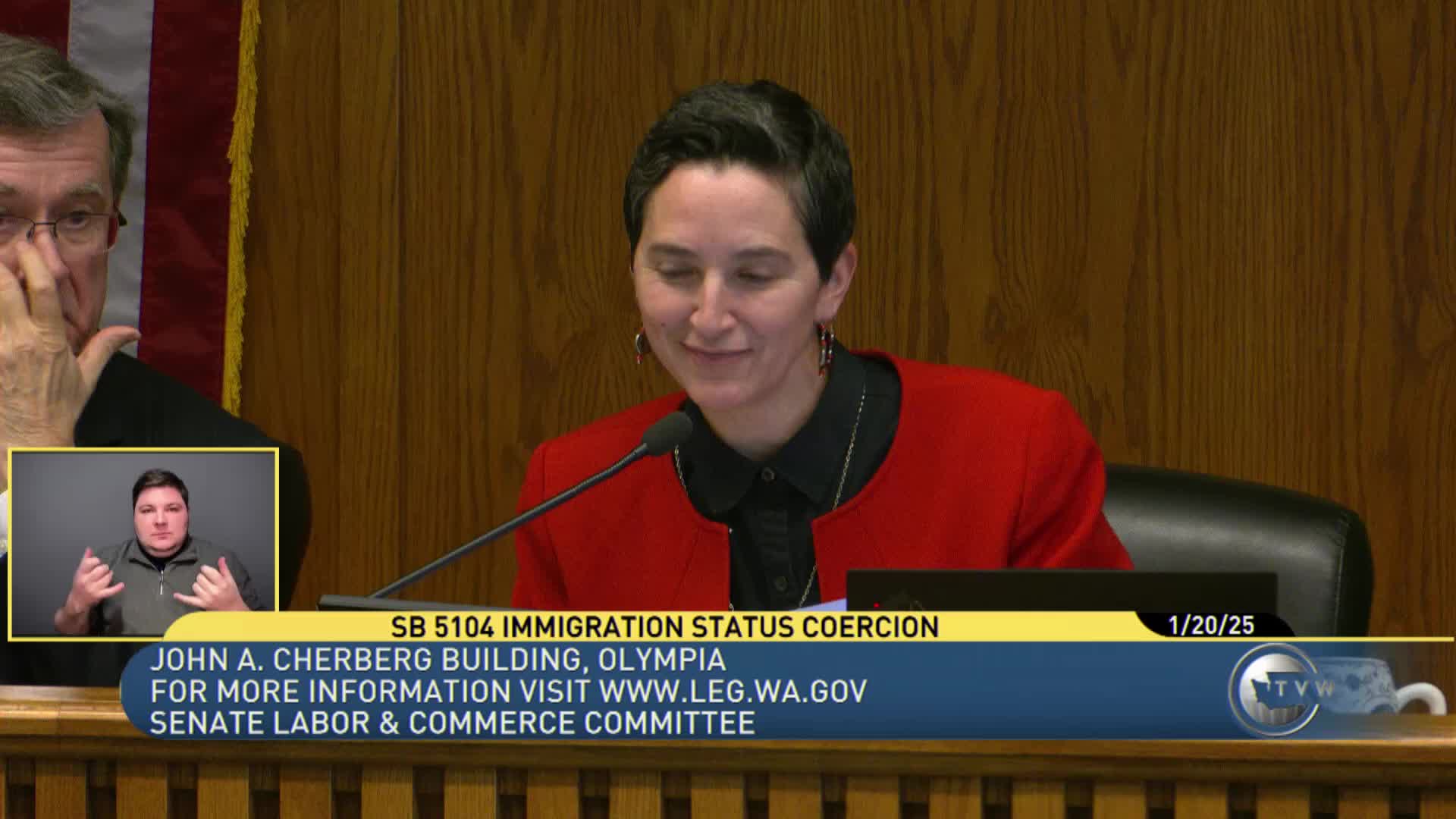
Senate Bill 5104 would allow the Washington Department of Labor & Industries to impose civil penalties on employers who coerce employees on the basis of immigration status while violating wage or labor‑condition laws, the Labor & Commerce Committee heard.
The committee heard Senate Bill 5104, which would add a specific civil‑penalty enforcement tool for employers who coerce employees on the basis of immigration status while violating wage payment or condition‑of‑labor requirements.
Staff to the committee, Marlon Ioannis, summarized current law and the change in SB 5104. Ioannis said Washington currently allows a person owed wages to file a complaint with L&I; under the bill L&I must investigate allegations that an employer both violated a wage payment or condition‑of‑labor requirement and coerced the worker based on immigration status or the immigration status of a family member. Each coercive act would be a separate violation; L&I determinations would be appealable. The bill’s effective date was listed as July 1, 2026, and a fiscal note was requested.
Supporters said the bill fills an enforcement gap. Yasmin Hamoud described a client who worked four months with only one paycheck and said the employer threatened immigration enforcement when the worker sought wages; she urged the committee to pass a deterrent. Law students and worker advocates from the Fair Work Center said the measure gives L&I an explicit tool to impose penalties in coercion cases, streamlining enforcement where immigration threats accompany wage violations.
At least one witness urged clearer statutory language and implementation guardrails. Rose Gunderson, speaking from a victim‑services and anti‑trafficking perspective, said terms such as “implicit” and “communication” should be clarified to avoid chilling lawful employer speech and to ensure criminal trafficking investigations are referred appropriately rather than undermined by premature civil processes.
Ending: The committee closed the hearing after testimony; sponsors and staff indicated they would consider clarifying language and implementation details.