Get Full Government Meeting Transcripts, Videos, & Alerts Forever!
Get email alerts on the Wildlife Damage Compensation topic
No spam. Unsubscribe anytime.
Bill would reserve 20% of deer/elk-damage funds for frontier counties; sponsor seeks more work with staff
Summary
Senate Bill 5,165 would reserve 20% of available state funds for commercial crop damage by deer and elk to claims arising in frontier counties (those with fewer than 50 people per square mile). Sponsor and committee staff said the concept needs refinement and the bill will be revised.
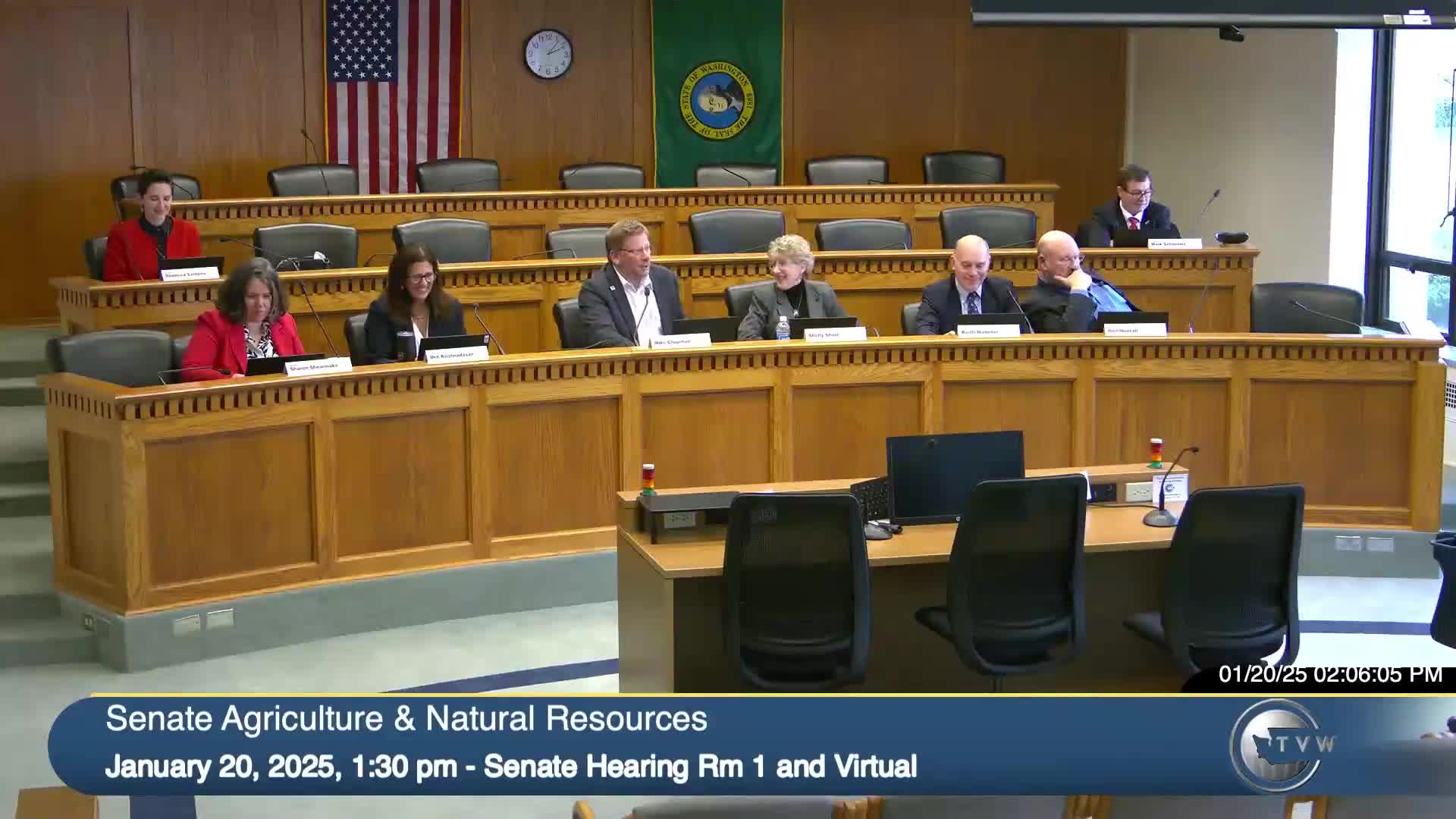
Elena Becker, committee staff, told the Senate Agriculture, Water, Natural Resources & Parks Committee that proposed substitute Senate Bill 5,165 would reserve 20% of available payments for damage to commercial crops caused by deer and elk to claims originating in frontier counties, a statutory class defined as counties with fewer than 50 people per square mile.
Sponsor Sen. Shelley Short (7th District) told the committee that crop and ranch producers in some areas are seeing increasing deer and elk damage and that reserving funds for frontier counties could help address payment gaps for smaller producers. "We are seeing a lot of change in the deer and elk population," Short said, adding that producers have described difficulties with appraisal and funding availability.
Committee staff explained that eligible claims currently require producers to show prevention efforts and either more than $10,000 in product grown in the previous year or first-year status; the proposed bill would set aside a 20% allocation of the available fund for frontier-county claims. A staff fiscal note indicated no fiscal impact for implementing the allocation.
Public testimony from northeastern Washington ranchers and from the Department of Fish and Wildlife focused on clarifying mechanics: Mick Cope, wildlife program director for the Department of Fish and Wildlife, asked how the bill would handle situations when frontier-county claims exceed the 20% allocation, whether remaining funds would be available to other counties, and whether frontier designation should be based on crop location or claimant business location. "We would like to express our desire to work together to get some clarity on a few issues within the bill," Cope said.
John Hudspeth, a fourth-generation cattle rancher from northeastern Washington, described livestock losses and depredation concerns and urged workable tools for small producers. The sponsor and staff signaled willingness to continue drafting and to take stakeholder feedback; no committee vote was taken at the hearing.
Ending: Senator Short said she will continue work with staff and stakeholders to refine the bill text before further committee action.