Get Full Government Meeting Transcripts, Videos, & Alerts Forever!
Get email alerts on the Legal Education topic
No spam. Unsubscribe anytime.
Senate hearing: bill would encourage pre‑law and ABA‑approved paralegal programs at community colleges
Summary
Senate staff and the bill sponsor briefed the committee on Senate Bill 5087, which would direct state support (subject to appropriation) for pre‑law associate degrees and incentives for ABA‑approved paralegal programs at community and technical colleges, with emphasis on access in Central and Eastern Washington.
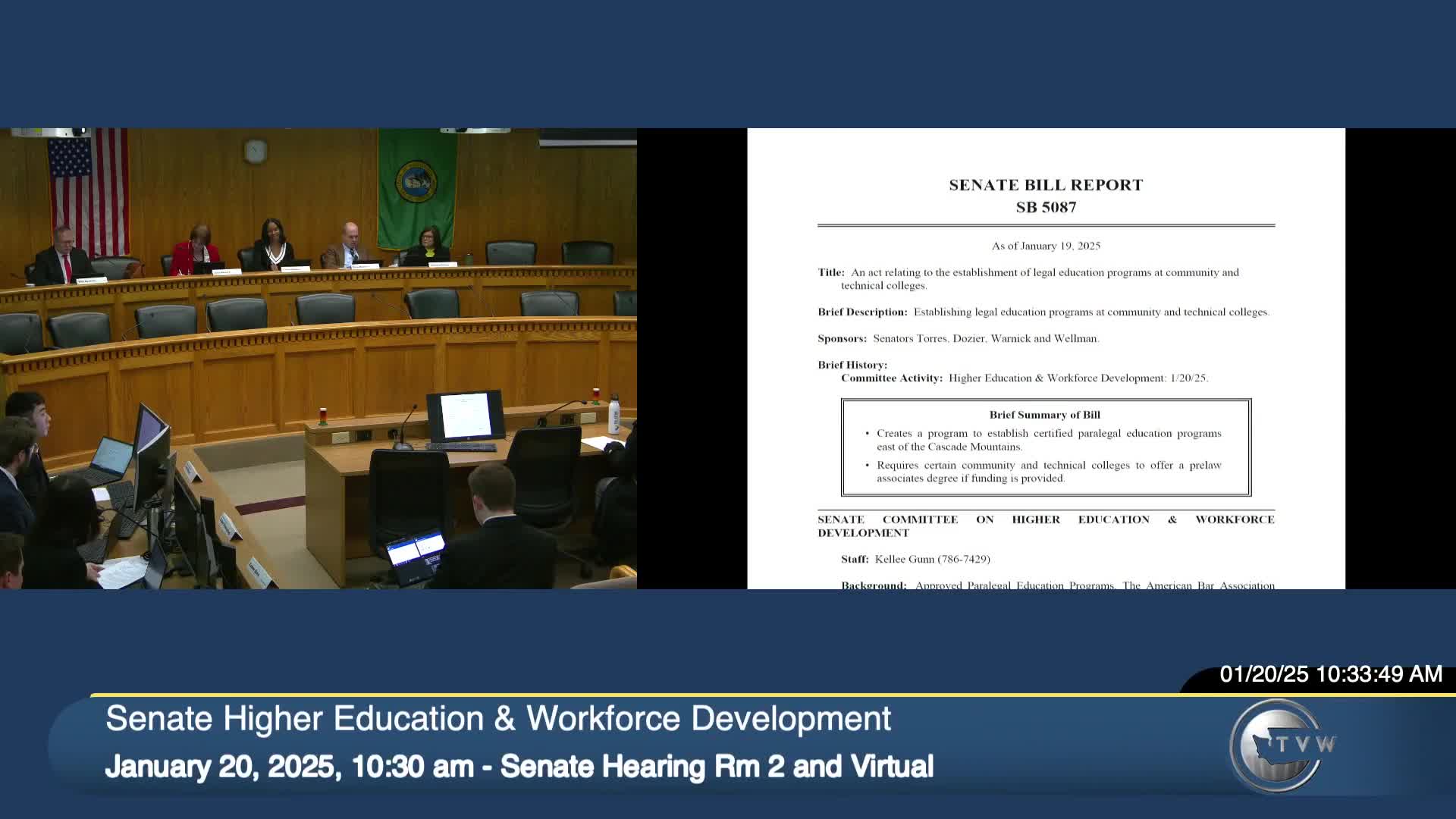
A staff briefing and sponsor remarks at the Senate Higher Education & Workforce Development Committee on Jan. 20 outlined Senate Bill 5087, legislation that would require, subject to appropriation, development of community‑college pre‑law associate degrees and incentives to expand American Bar Association–approved paralegal programs into Central and Eastern Washington.
Kelly Gunn, committee staff, told the committee the bill has two components: one that would require a pre‑law associate degree program at three named community and technical colleges (Columbia Basin College, Yakima Valley College, and Walla Walla College) subject to appropriation, and a second that directs the State Board for Community and Technical Colleges to develop an incentive program to encourage and financially support colleges to offer ABA‑approved paralegal programs where they do not currently exist, with a goal of establishing one in Central Washington and one in Eastern Washington.
Nut graf: Sponsor testimony framed the bill as a workforce and access measure for legal careers outside Western Washington, with sponsors arguing the proposal responds to gaps in public defense and prosecutorial staffing in counties east of the Cascades.
Senator Nikki Torres, the bill’s prime sponsor, told the committee she initially listed specific colleges for context but planned to amend the bill to allow any community or technical college in Central or Eastern Washington to offer a pre‑law associate degree “subject to appropriation” so colleges without capacity would not be forced to adopt programs. Torres said few pre‑law programs currently exist east of the Cascades and noted local shortages in public defense and prosecuting attorneys in Franklin and Yakima counties.
Arlen Harris of the State Board for Community and Technical Colleges testified in support but cautioned the legislature about prescribing specific academic offerings to individual colleges. He said colleges are embedded in their communities and typically consult local demand when setting programs; he suggested the bill’s second section, which provides incentives, is a better approach and recommended replacing a strict ABA‑approval requirement with language encouraging consultation with the bar because community colleges have their own accreditation processes.
Local officials and criminal justice stakeholders also testified in support. Yakima County Commissioner LaDon Linde said trial‑backlog pressures in Yakima are severe and described instances when charges had to be dismissed or defendants released for lack of timely trials; he told the committee certified paralegal programs could help process cases more quickly. Russell Brown, executive director of the Washington Association of Prosecuting Attorneys, said the bill would help attract students earlier to legal careers and support prosecution and public defense staffing.
Ending: The committee set aside the public hearing after testimony and did not take formal action at the Jan. 20 session. Staff noted a fiscal note had been requested but was not available for the hearing, and several witnesses asked the committee to consider appropriation language and to consult with colleges and the bar on implementation.