Get Full Government Meeting Transcripts, Videos, & Alerts Forever!
Get email alerts on the College Affordability topic
No spam. Unsubscribe anytime.
WASAC warns state financial aid gains face new shortfalls as college participation rises
Summary
Student Achievement Council officials told the Senate Higher Education & Workforce Development Committee that Washington’s Washington College Grant has expanded access but several targeted programs face funding shortfalls as participation grows, notably bridge grants and Passport to Careers.
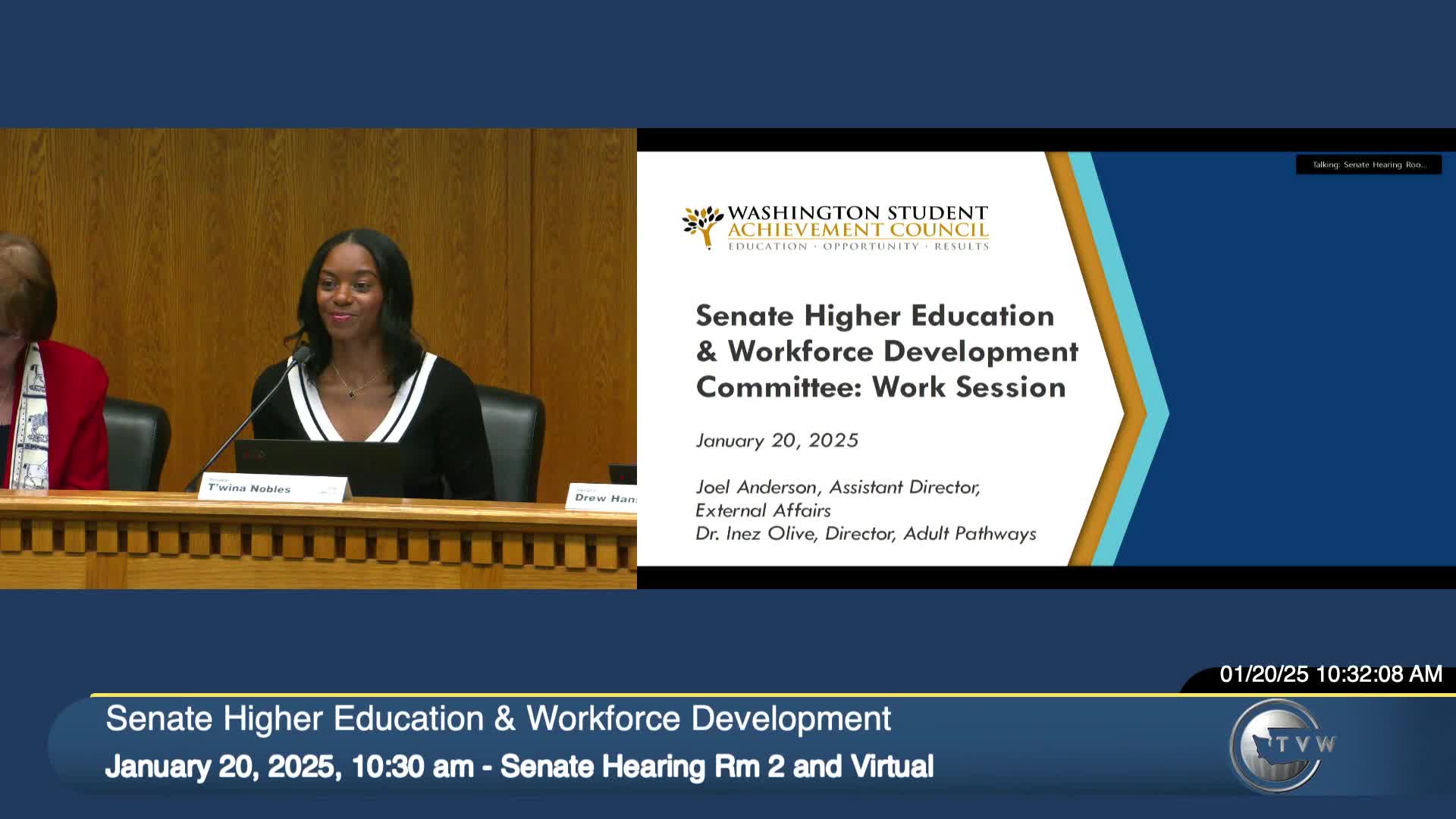
The Washington Student Achievement Council told the Senate Higher Education and Workforce Development Committee on Jan. 20 that the Washington College Grant has reached more students than its predecessor and is restoring eligibility for many low‑income learners, but several narrowly targeted aid programs are now underfunded as participation grows.
WASAC Assistant Director Joel Anderson and Director for Adult Pathways Inez Olive presented the committee with enrollment and award data and flagged two immediate shortfalls: the bridge grant stipend and the Passport to Careers scholarship for students formerly in foster care or experiencing unaccompanied homelessness.
The Washington College Grant, Anderson said, has served “significantly more students each year” than the state need grant that preceded it, and during the 2023–24 academic year more than 79,000 students received the maximum Washington College Grant award. Anderson told the committee the state now invests more per full‑time‑equivalent undergraduate in need‑based aid than any other state, citing WASAC figures showing an average of more than $2,200 per FTE undergraduate in 2022–23 compared with a national average of $865.
Nut graf: The council said that as eligibility and participation have expanded — including into registered apprenticeships — the fixed, non‑forecasted funding streams that support some add‑ons are straining. WASAC asked the committee to note where a lack of caseload‑linked funding is creating gaps and to consider budget language or appropriations that would tie those supplements to the overall caseload forecast.
WASAC staff described bridge grants as a $500 stipend available to students who receive a full Washington College Grant award but are not enrolled in the College Bound Scholarship. Unlike the core college grant, which is caseload‑forecasted, the bridge grant allocation is a fixed proviso in the biennial budget. Anderson said current carryforward funding for the bridge grant is a little over $55 million per biennium and projected unmet need for 2024–25 could be as much as $3 million, rising to as much as $5 million in 2025–26 if participation keeps growing.
Committee members pressed WASAC staff on the technical difference: Anderson explained the college grant is statutorily tied to the caseload forecast and budgeted to meet forecasted need, while bridge grants are not automatically adjusted and therefore require a manual budget decision or statutory change to scale with demand.
Passport to Careers, a scholarship and campus‑support program for students formerly in foster care or experiencing unaccompanied homelessness, is funded primarily by the state and is noted by WASAC as a national model in part because of automated data sharing that reduces administrative burden for students. Anderson said participation in Passport has risen more than 300% since unaccompanied homeless youth were made eligible in 2019 and that the program’s rising caseload led WASAC to reduce the scholarship award in the most recent academic year. (The presentation stated the award was reduced from $5,000 to an amount recorded in the transcript as “28100”; the transcript rendering is unclear and WASAC staff reported the reduction occurred to reflect appropriated funds and increased caseloads.) Anderson said the typical Passport student still has more than $12,000 in unmet need after stacking Pell and Washington College Grant awards and the Passport scholarship.
WASAC also reported rapid growth in Washington College Grant participation for registered apprenticeships after program approval processes were simplified and minimum related instruction requirements were better aligned with federal standards. Anderson said more than 15 apprenticeship sponsors are active in the college grant program, another 12 are in intake, and the agency expects to add more than 600 apprentices in the near term.
On workforce‑focused programs, Director Inez Olive reviewed the Washington Health Corps portfolio, which includes federal and state loan repayment, a nurse educator loan repayment, and behavioral health programs. She said the Health Corps drew its largest applicant pool in 2024; WASAC was able to award roughly 43% of the 2024 applicants based on budget and eligibility. The council also described a new Behavioral Health Conditional Scholarship (authorized by House Bill 1946, 2024) that will prioritize graduate students in clinical mental health counseling, social work and marriage and family therapy, with the first application cycle opening in March. Olive said awards will range up to $51,000 for multi‑year programs and up to $25,000 for one‑year programs, paired with service obligations.
WASAC is also piloting a behavioral health apprenticeship stipend (up to $3,000 per apprentice to cover basic needs) and is administering a Health Care Authority block grant to community and technical colleges to support substance use disorder programs (students to receive up to $500 each under the pilot).
Finally, Anderson briefed the committee on the Washington student loan program, a state‑backed loan vehicle first authorized in 2022 that was restructured and reduced from earlier proposals. Under the current statutory framework, WASAC expects to begin loan originations in fall 2025, offering graduate loans to students in high‑demand or shortage fields with a maximum annual borrowing limit (statute calls for up to $20,000 per year) and a maximum statutory interest rate (recently set at no more than 2.5%). Anderson said the program’s initial capital is limited and would likely support roughly 400–500 borrowers per year; final terms including income‑based repayment and forgiveness rules are still being developed and WASAC has issued RFPs to secure origination and servicing partners.
Committee members asked about outreach, repeat applications for loan‑repayment and workforce programs, and the relationship between Passport and other grants. WASAC said it communicates application cycles and that applicants who are not selected may reapply in later cycles but must resubmit updated materials; recipients who accepted state loan‑repayment awards are not routinely re‑awarded in the program’s current structure because of budget and program timeline constraints.
Ending: WASAC asked the committee to note growing caseloads across several targeted programs and to consider whether current budget structures — fixed provisos for bridge grants and the once‑only nature of some pilot funding — need adjustment to match rising demand. Anderson and Olive said they will provide additional technical follow‑up on forecast assumptions, apprenticeship sponsor lists, and items flagged in committee questions.