Get Full Government Meeting Transcripts, Videos, & Alerts Forever!
Get email alerts on the Childcare Workforce Standards topic
No spam. Unsubscribe anytime.
Senate hearing on SB 5062 probes proposed childcare workforce standards board; supporters cite workforce strain, opponents warn of cost
Summary
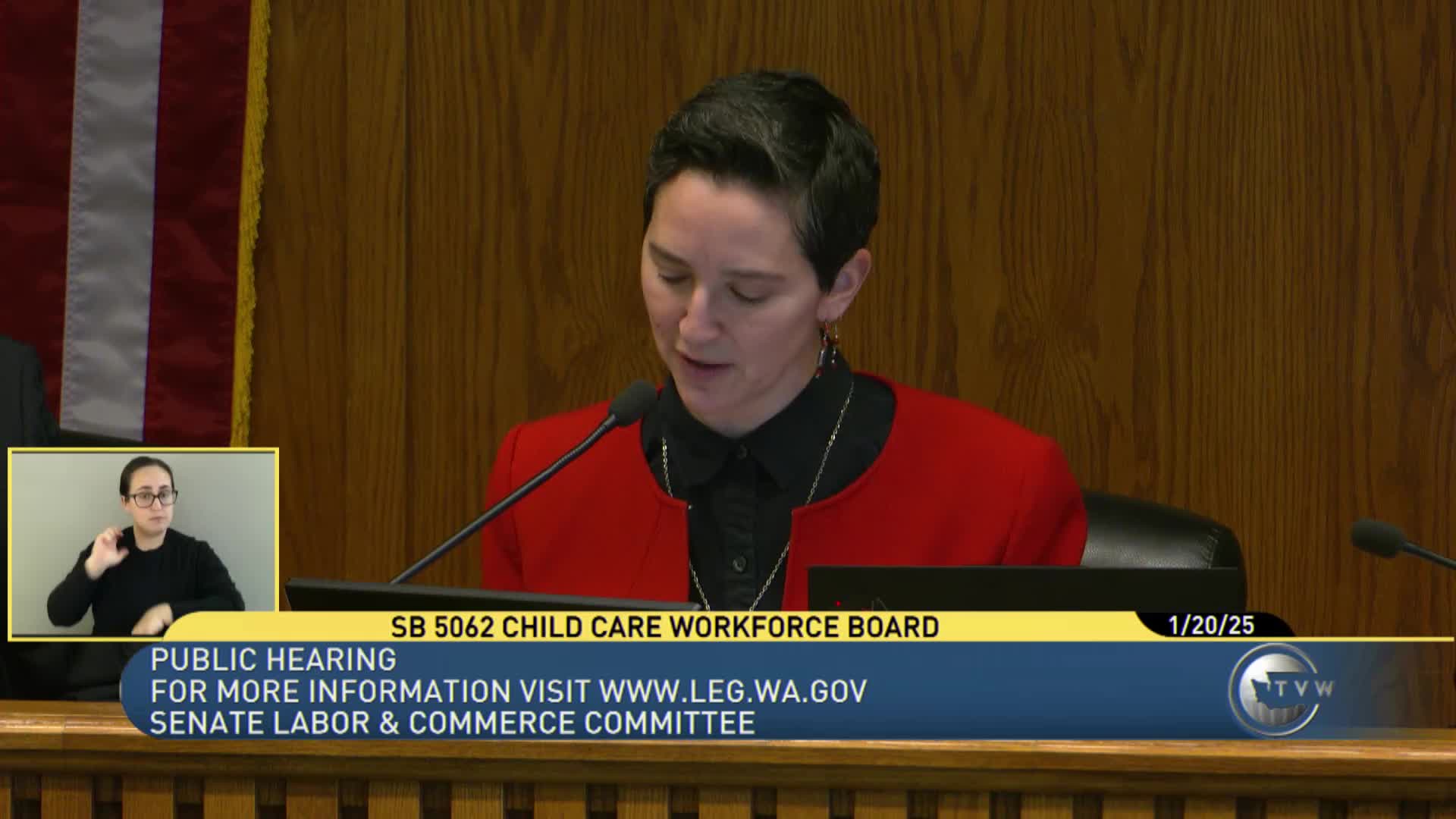
The Washington Senate Labor & Commerce Committee heard testimony on Senate Bill 5062, which would create a Child Care Workforce Standards Board to set minimum employment standards, training requirements and worker protections for child care employees.
The Washington Senate Labor & Commerce Committee heard testimony on Senate Bill 5062, a proposal to establish a Child Care Workforce Standards Board to set minimum employment standards, curriculum requirements and worker protections for the child care industry.
Committee staff described the bill’s structure and timeline. Jarrett Sachs, staff to the committee, said the board would be appointed by the governor and include three representatives of child care workers, three representing employers, one representing professional development programs, one parent representative and two agency members (one from L&I and one from DCYF). Sachs said initial appointments must be made by Sept. 1, 2025; the board must adopt initial ‘‘waive’’ standards by Aug. 1, 2026, and employment standards would take effect Jan. 1, 2027. The board would investigate market conditions by geography and occupation, recommend WISHA (Washington Industrial Safety and Health Act) rules to L&I where appropriate, establish certified training curricula, and prohibit retaliation against workers who exercise rights under the law.
Supporters at the hearing said the industry needs systemic change. Wren Schmidt, a child care teacher, described the physical and emotional toll of the work and said low pay forced teachers out of the field. Carol Gilmore, a Tacoma center director of more than 40 years, said equal representation of workers, employers, parents and state agencies could produce solutions grounded in daily operations rather than distant policymaking. Maggie Humphreys of MomsRising called the board a needed step to sustain the workforce and cited parents’ reliance on early educators.
Opponents warned about costs and added regulation. Dana Christensen, who operates two centers, said the board could inflate operating costs and risk closures among small community providers. Lindsey Huer of the Association of Washington Business said similar efforts elsewhere carried large start‑up costs and that new standards without funding could push costs onto families or providers. Several center associations and large providers (Kindercare, Learning Care Group) testified they support higher compensation in principle but raised questions about whether center‑based providers would receive public funding to meet any new standards and warned of added regulatory complexity.
Committee staff said a fiscal note had been requested but was not yet available. No formal vote occurred during the hearing.
Ending: The committee closed testimony on SB 5062 and moved to other bills; sponsors and staff indicated interest in follow‑up discussions on funding and technical implementation before any further action.