Get Full Government Meeting Transcripts, Videos, & Alerts Forever!
Get email alerts on the Small Forest Management topic
No spam. Unsubscribe anytime.
Small forest landowners urge policy fixes to keep family forests intact, boost fire resilience
Summary
Washington Farm Forestry Association members described how small forest landowners manage for multiple public benefits, outlined climate-driven species shifts and wildfire concerns, and urged legislative fixes including air-curtain burner/biomass rules, maple-syrup processing regulation changes, and funding for an AI carbon-aggregation tool.
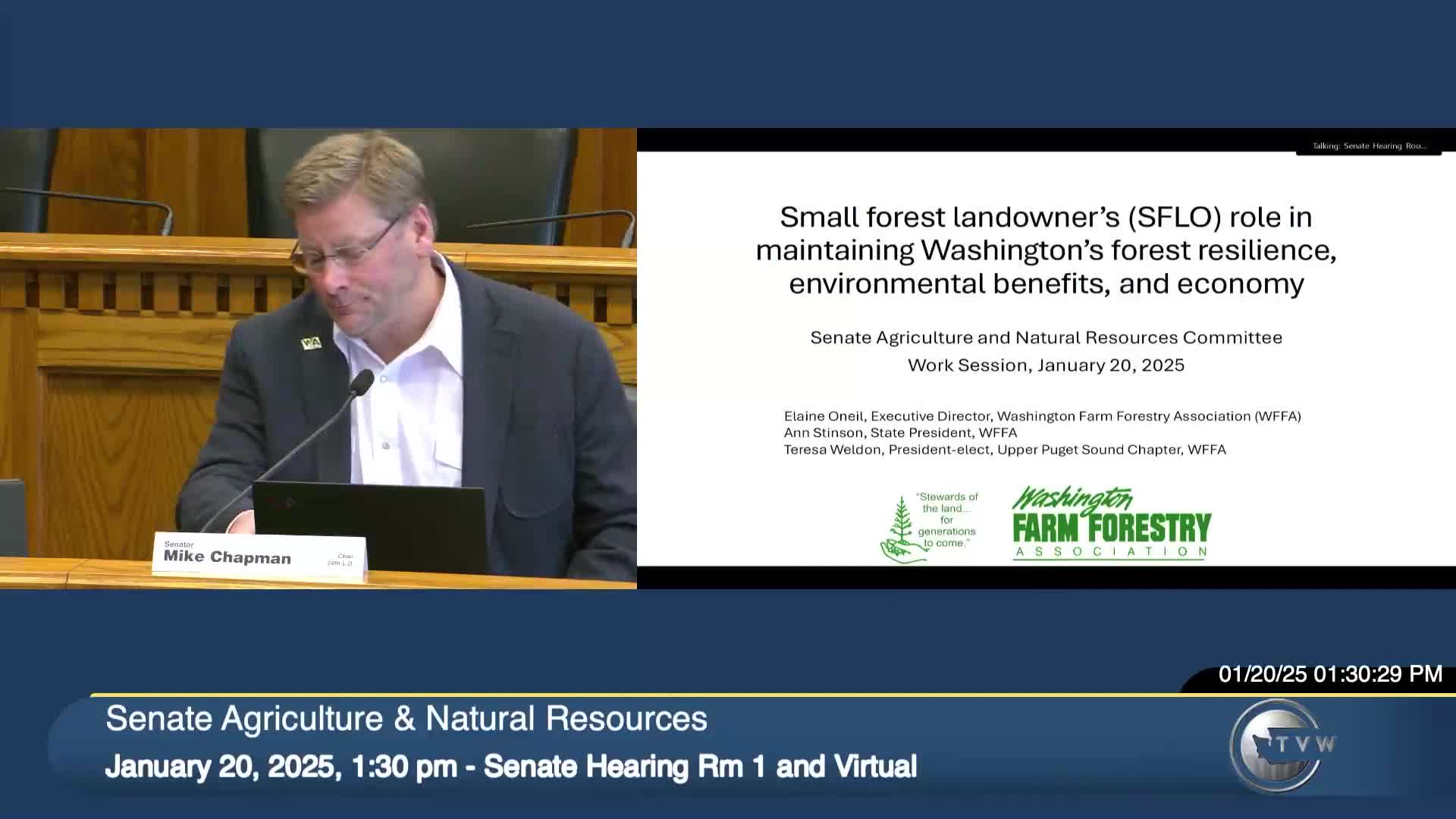
Nora Burns, speaking for the Washington Farm Forestry Association, told the Senate Agriculture, Water, Natural Resources & Parks Committee on Oct. 12 that "Washington's 218,000 small forest landowners own nearly 15% of Washington's forests," and that many sit lower in watersheds and inside the wildland-urban interface.
The association used a committee work session to highlight two family-owned tree farms and to map policy needs that members say would help small forest landowners keep property in forestry use. "Development pressure, wildfire, and other natural disasters and taxes are top concerns for small forest landowners," Burns said, summarizing findings from University of Washington research cited to the committee.
Why it matters: small family forests provide drinking-water protection, wildlife habitat, recreation and local economic activity, but landowners say climate stressors and regulatory gaps are increasing the risk that parcels will be converted to non-forest uses.
Anne Stinson, a second-generation owner of the 320-acre Cowlitz Ridge Tree Farm in South Lewis County, described field-level changes since the 2021 heat dome: older western red cedar are "dying top down," newly planted cedar are turning brown, and Douglas fir on thin, gravelly soils is suffering from laminated root rot. Stinson said the family has shifted plantings to more drought-tolerant species: incense cedar and Port Orford cedar, and two pines — Willamette Valley ponderosa and western white pine. "We've heard from mills that the incense and Port Orford will be equally accepted for the same kind of products," she said.
Teresa Weldon, president of the Washington Farm Forestry Association's Upper Puget Sound chapter and a third-generation owner of a 40-acre "Mountain Tree Farm" near Arlington and Granite Falls, described wildlife monitoring, updated management plans, and a family memorial tree-planting program they use to provide stream shading for coho salmon habitat. Weldon said DNR cost-share grants helped pay for a professional consultant to update the farm's management plan and maps.
Policy requests and technical issues raised to the committee included: - Regulatory fixes to allow practical, lower-emission biomass treatments in the wildland-urban interface. Burns noted that legislative changes in last year’s SB 6121 allowed "flame-capped kilns to burn clean biomass," but that at least one air-quality agency is not permitting their use; air-curtain burners were discussed as a related tool with language being circulated among stakeholders. - Processing-rule changes for small-scale maple-syrup producers. Burns said University of Washington and Washington State University research solved technical challenges for West Coast production but that "processing regulations are severely hampering Washington growers' ability to compete in the marketplace" and that draft statutory language is being shopped to stakeholders. - Support for a small-forest carbon aggregation tool. Burns summarized work from the Climate Commitment Act–mandated small forest landowner carbon work group and UW landscape analysis that produced an AI-generated forest-biomass map at one-tenth–acre resolution; she said a modest budget request would be needed to advance monitoring, verification and market participation tools.
Committee members pressed on technical details and risks. Senator Wagner asked about the performance, growth and market acceptance of Port Orford and incense cedar compared with western red cedar; Stinson replied the stand is young but that "we have a couple older incense cedar that are about 30 years old on our property" and that local mills have indicated acceptance. Senator Bazzall asked about pests and disease in replacement pines; Stinson said western white pine has been pruned to reduce blister-rust risk and that DNR has run test plots on ponderosa pine but that some mortality has occurred.
On wildfire and the WUI, Stinson said many small owners have taken defensible-space steps around homes, keep water tanks and sprayers ready, and rely on state support programs; Burns added that mapping of the WUI and policy clarity for burners remain "an issue" and that more conversation is needed on air-curtain burners and related tools.
Other discussion topics included estate succession: Stinson highlighted OSU's "Ties to the Land" program as a voluntary tool to help families plan to keep forestland in active management rather than sale to development.
Committee chair Jennifer Chapman thanked presenters and indicated the panel could return for follow-up. No formal committee action or vote occurred during the work session.
Ending: Presenters offered to host committee members for field visits and signaled willingness to work with staff on statutory language for the maple-syrup exemption, the carbon-aggregation funding ask, and regulatory fixes for biomass handling.