Get Full Government Meeting Transcripts, Videos, & Alerts Forever!
Get email alerts on the Estate And Hazardous Substance topic
No spam. Unsubscribe anytime.
Staff reviews estate tax and hazardous‑substance tax structures and revenue uses
Summary
Committee staff summarized the estate tax, its exclusion amount, and the hazardous substance tax (now volumetric for petroleum) and noted volatility and account allocations for both taxes.
Alia Kennedy and other committee staff summarized two additional taxes affecting capital and environmental accounts.
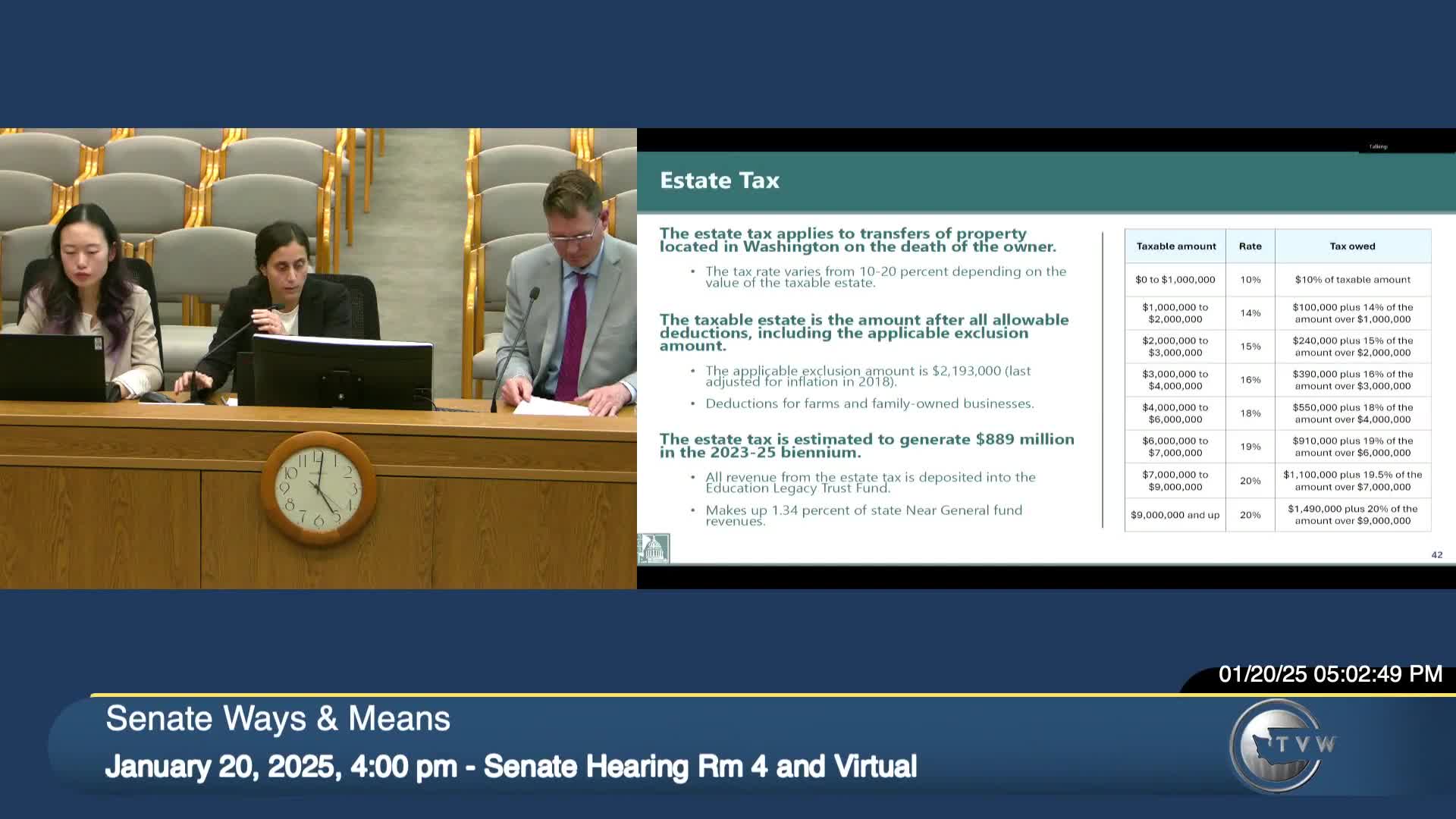
Estate tax: Kennedy explained that Washington’s estate tax applies to transfers at death and that taxable value includes in‑state property and intangible assets. She said current exclusion amounts were set at $2,193,000 (as stated in the presentation) and that the estate tax rate schedule ranges from 10% to 20% depending on the taxable estate value. Staff noted that the exclusion amount has not been updated since 2018 because the local CPI index previously used no longer exists. Kennedy said the estate tax is estimated to generate about $1 million in the biennium as presented (the transcript wording suggested a small revenue estimate for the period cited) and that the revenue is deposited in the Education Legacy Trust account. Staff cautioned that estate tax collections can be volatile because large individual estates can substantially change annual receipts.
Hazardous substance tax: Kennedy reviewed the hazardous substance tax, which applies to petroleum products and certain pesticides and chemicals identified by the Department of Ecology. She said that prior to 2019 the tax was 0.7% of wholesale value and that the 2019 change moved many petroleum products to a volumetric per‑barrel tax (initially $1.09 per barrel and adjusted annually for inflation; staff said the current rate is $1.48 per barrel). For nonpetroleum products and petroleum products not easily measured by barrel, the 0.7% wholesale‑value rate generally continues. Kennedy said the tax is estimated to generate about $693 million in the biennium, with the first $50 million of liquid petroleum receipts each biennium directed to the State Motor Vehicle Fund for transportation stormwater activities and the remainder going to toxic‑control accounts and other dedicated accounts according to statutory percentages.
Staff provided annual collection charts for both taxes and noted the gubernatorial and statutory history that affected prior revenue swings, particularly in the estate tax when the state’s prior estate tax structure was invalidated by the state Supreme Court in 2005 and later replaced by a standalone tax.