Get Full Government Meeting Transcripts, Videos, & Alerts Forever!
Get email alerts on the Transportation topic
No spam. Unsubscribe anytime.
Bill would tighten rules for covering loads on public highways, extend cleanup requirements
Summary
Senate Bill 5215 would tighten secured-load rules for dirt, sand and gravel, phase out the 6-inch freeboard exception by 2028, require drivers to remove spilled loads and remain at the scene until removal, and includes exemptions for state and local highway maintenance activities, committee staff said.
Senate Bill 5215 would revise vehicle secure-load requirements, tighten coverage expectations for loads such as dirt, sand and gravel, and require drivers to remain at the scene until spilled materials are removed.
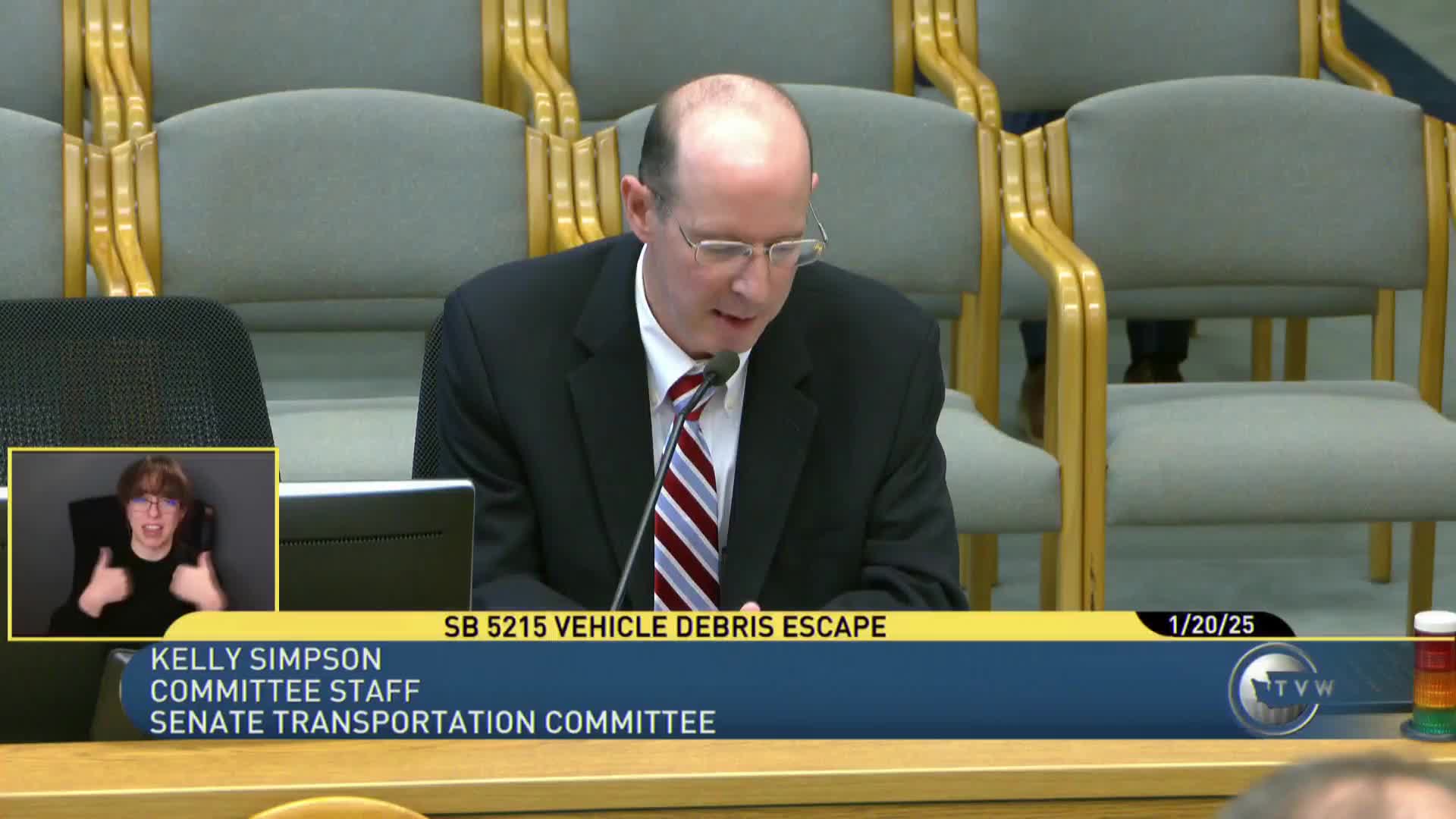
Kelly Simpson, committee staff, told the Senate Transportation Committee that current law allows a truck carrying dirt, sand or gravel to avoid covering the load if it maintains six inches of freeboard in the bed; the bill would phase out that exception by 2028 and require covering whenever a vehicle is equipped with a covering prior to 2028 and in all cases beginning in 2028. The measure also requires drivers to clean up objects that fall onto the highway, remain at the scene until the load is removed and pay removal costs; the bill contains exemptions for certain state and local highway maintenance activities, Simpson said.
Sponsor Senator Shoemake described the bill as addressing a longstanding loophole and said unsecured loads can crack windshields and damage modern vehicle sensors. "As a result of that, we're seeing these crack windshields. It's dangerous, but also as we're seeing cars become more complex with sensors and cameras, etcetera, It's really expensive to repair and so I think of this as a insurance car insurance bill lowering the cost of that as well," Shoemake said.
Local government and industry witnesses asked the committee to refine exemptions for routine maintenance and emergency operations. Axel Swanson of the Association of County Engineers said county road crews use the same vehicles year-round for varied tasks and asked for expanded exemptions so counties would not need tarping equipment on every vehicle. "Our road crews often respond to accidents that damage guard rails and signs, storms that bring down trees and pile up snow, and it's not uncommon for a portion of a roadway to wash away completely or be covered by debris from a slide," Swanson said, adding counties value flexibility in maintenance operations.
Captain Jeff DeVeer of the Washington Trucking Associations, a retired state patrol captain, said trucks are not the only debris source and urged practical discretion in requirements that could make roadside cleanup more hazardous. He urged language that allows a driver limited discretion about how and where to remove spilled material to avoid making roadways less safe.
Several construction and contractors' groups said members generally comply with secure-load rules but raised concerns about removing the six-inch freeboard option without additional exemptions. The committee closed the hearing; staff said a similar 2020 bill produced an estimated $1 million cost to the Department of Transportation for outfitting maintenance trucks.
No committee vote on SB 5215 was recorded in the Jan. 20 transcript; the bill was discussed immediately prior to an executive session during which a different bill (SB 5072) was moved without recommendation to Ways and Means.