Get Full Government Meeting Transcripts, Videos, & Alerts Forever!
Get email alerts on the Selective Consumption Taxes topic
No spam. Unsubscribe anytime.
Overview: REET, cannabis, vapor, tobacco and alcohol taxes and where the revenue goes
Summary
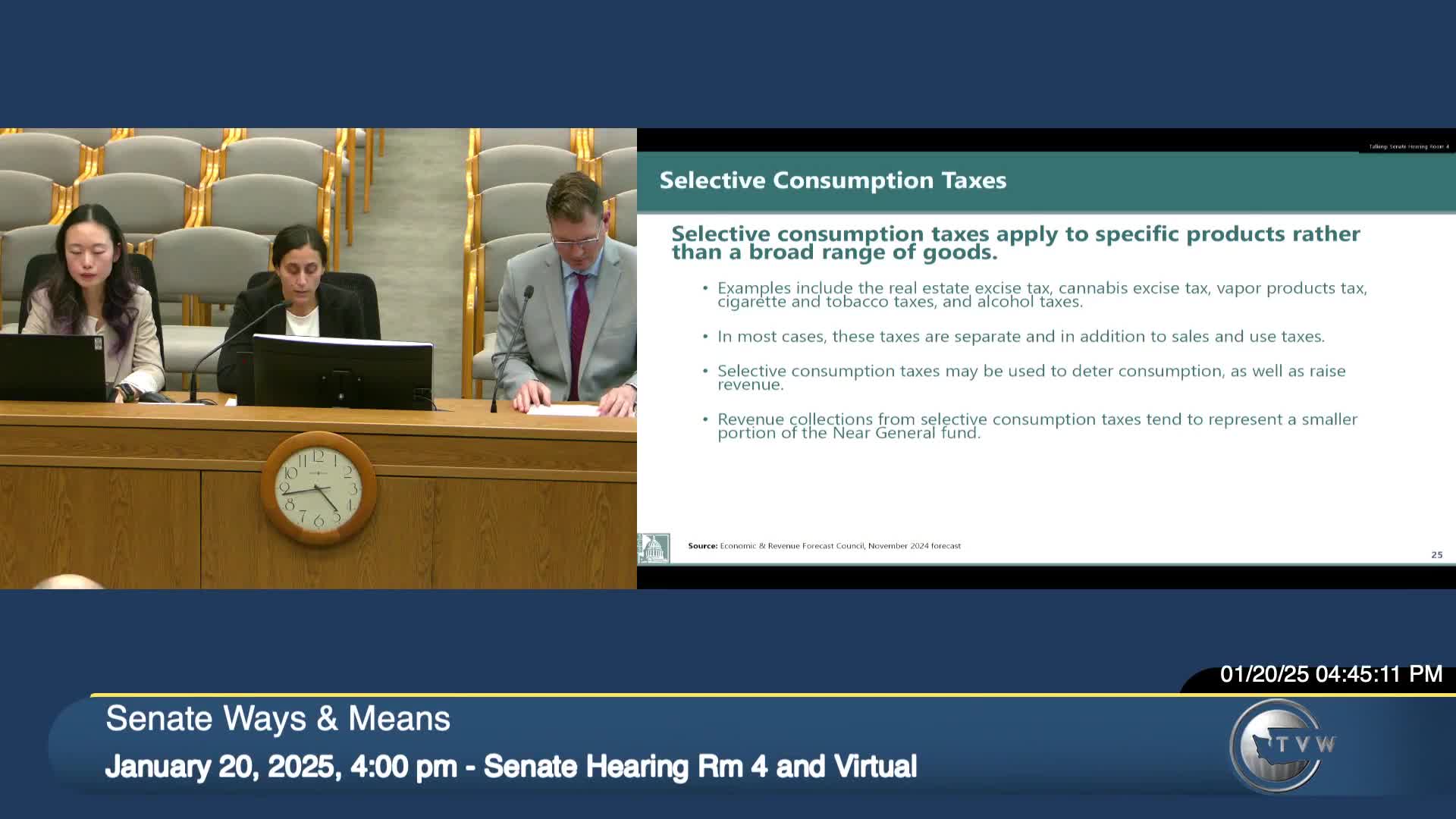
Committee staff summarized the state's selective consumption taxes — including the graduated real estate excise tax, cannabis excise tax distributions, vapor product tax, cigarette and other tobacco taxes, and alcohol taxes — and highlighted volatility and earmarks for those revenues.
Alia Kennedy summarized a group of selective consumption taxes for the committee, emphasizing revenue magnitude, distribution rules and volatility.
Real estate excise tax (REET): Kennedy said Washington moved from a flat REET rate to a graduated structure in 2020. She explained the graduated tiers and gave an example: a $1,000,000 sale would be taxed at 1.1% on the first $525,000 and at higher tier rates above that amount. Staff said REET is the state’s fourth largest tax revenue source and estimated it would generate about $2.5 billion in the current biennium. Kennedy emphasized REET’s volatility, noting the large swings around the 2007 peak and the subsequent decline, and later increases in 2021–22.
Cannabis excise tax: Kennedy reviewed the 37% excise tax on retail cannabis sales (in addition to retail sales taxes). She said the Liquor and Cannabis Board administers the tax and staff presented the distribution formula. Fixed annual amounts are first distributed to specified agencies and programs (for example, Liquor and Cannabis Board administrative costs and Department of Health prevention grants) and the remainder is divided by percentage shares among the Health Care Authority, cities and counties, and the state general fund. Staff clarified that none of the cannabis excise tax goes directly to K‑12 public schools.
Vapor products: Kennedy said the vapor tax, enacted in late 2019, applies to e‑liquids and devices and is structured by milliliters of solution with two rates ($0.09/mL for refillable containers larger than 5 mL and $0.27/mL for most closed systems). She said vapor tax revenue is not deposited to the general fund and instead is split between the Andy Hill Cancer Research Fund and foundational public health services accounts.
Cigarettes and other tobacco products: Staff reviewed the cigarette tax (about $3 per 20‑cigarette pack) and other tobacco product rates, noting the tax is imposed at first possession and that tribes may impose their own cigarette taxes via compacts. Tobacco taxes were estimated to generate about $586 million in the biennium and are deposited in the general fund.
Alcohol taxes: Staff briefly described excise taxes on spirits, beer and wine. They said spirits are taxed differently depending on place of sale and that combined spirits taxes were estimated to raise about $686 million this biennium; beer and wine excise taxes raise smaller amounts and are partitioned to multiple accounts including the liquor revolving fund and Washington State University research programs.
Throughout, staff highlighted which accounts receive revenue and noted where collections have been volatile or have trended down (for example, cigarette tax collections per capita have declined since about 2011).