Get Full Government Meeting Transcripts, Videos, & Alerts Forever!
Get email alerts on the B And O Tax topic
No spam. Unsubscribe anytime.
Committee briefed on B&O and public utility taxes, financial‑institution surcharges and revenue concentration
Summary
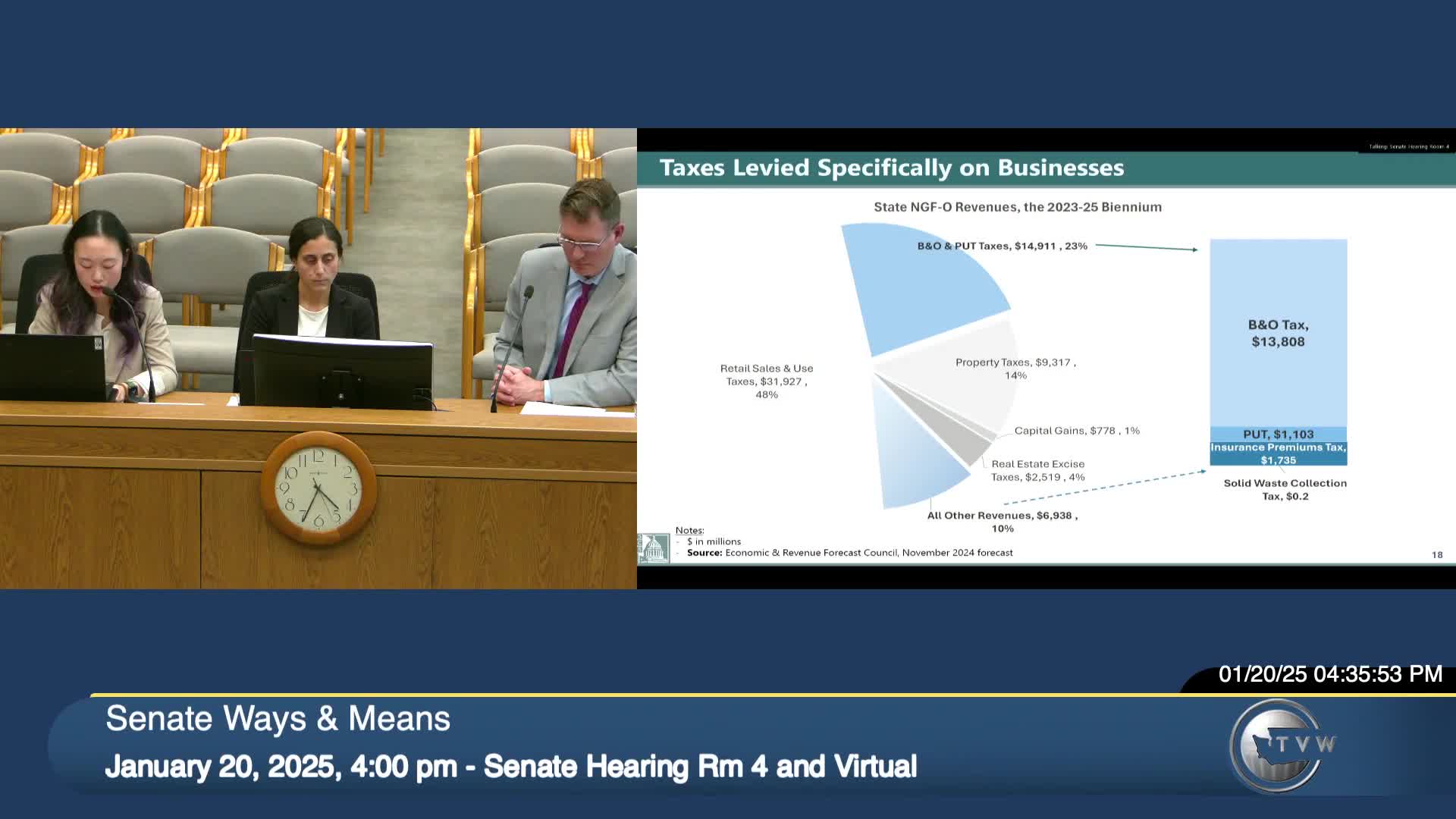
Staff explained that the B&O and public utility taxes together account for about 23% of near‑general‑fund revenues in the 2023–25 biennium, described the B&O rate structure and recent surcharges, and noted a small share of taxpayers contribute a large share of collections.
Alia Kennedy and Tianyi Lan presented the committee with details on Washington’s Business and Occupation (B&O) tax, the public utility tax, and more recent surcharges that affect specific industries.
Kennedy described the B&O tax as a gross‑receipts tax with default classification rates; most businesses fall into retailing, wholesaling, manufacturing, or service categories. Staff said the service classification contributes the most revenue — about 52% of B&O receipts — and noted the service category has two rates (1.75% for firms with gross income over $1,000,000 and 1.5% for others). Staff also reviewed a 2019–20 legislative change that increased the rate for certain service activities and established an advanced‑computing surcharge whose revenues are deposited into a newly created workforce education investment account for higher education.
Tianyi Lan told senators the B&O tax and public utility tax combined represent about 23% of near‑general‑fund revenues in 2023–25 and that, in fiscal 2024, the Department of Revenue collected approximately $6.9 billion in B&O tax from about 374,000 taxpayers. Staff presented a concentration analysis showing the highest 20% of taxpayers (ranked by tax amount) paid more than 95% of B&O receipts; the lowest 20% paid less than 1%, and the largest 100 companies paid over a quarter of collections.
Kennedy also summarized a 1.2% surcharge on specified financial institutions with annual net income at least $1 billion; staff said that surcharge generated about $227 million in 2024 and is forecast to generate roughly $1 billion from 2026–29. Senators asked routine clarifying questions about collection mechanics and classifications.