Get Full Government Meeting Transcripts, Videos, & Alerts Forever!
Get email alerts on the Sales And Use Tax topic
No spam. Unsubscribe anytime.
Sales and use tax remains Washington’s largest revenue source; new working‑family credit expanded
Summary
Staff said sales and use taxes are the state’s largest source of near‑general‑fund revenue, estimated to supply about 48% of the 2023–25 biennium; staff also summarized the Working Families Tax Credit, reporting reach and payouts for the program’s early years.
Tianyi Lan and other committee staff summarized the retail sales and use tax and the Working Families Tax Credit during the hearing.
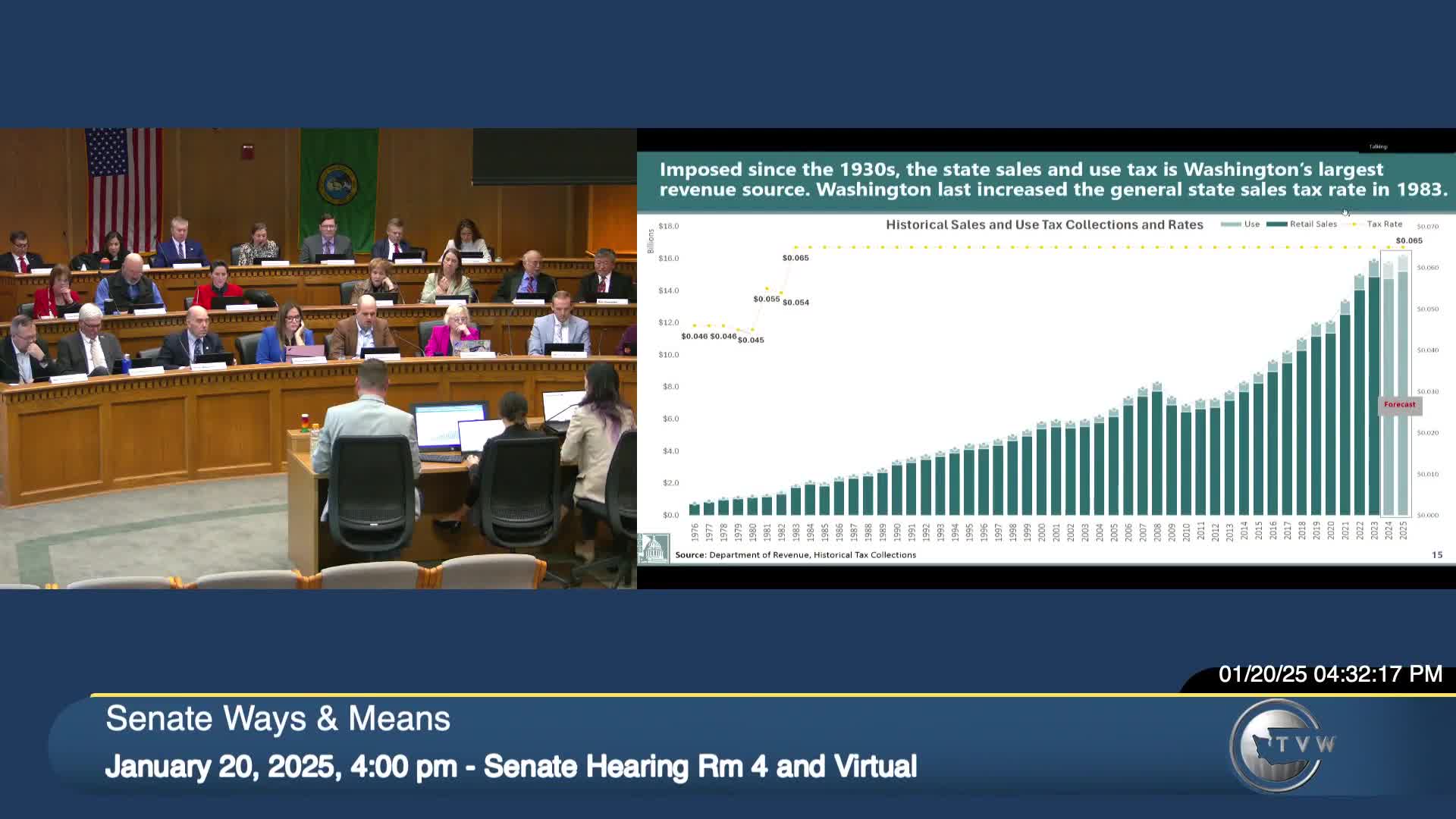
Tianyi Lan told senators that the sales and use tax is Washington’s single largest revenue source. "In the 2025–27 biennium, the tax is estimated to generate about $34,500,000,000 representing 48% of NGFO revenues," Lan said. Staff noted the statewide base retail sales tax rate has not changed since 1983 and that additional specialized sales taxes apply to items such as vehicles, liquor and cannabis.
Staff presented an industry breakdown for sales tax receipts and said while tangible goods remain important, services and construction make substantial contributions: retail trade and construction were cited as major sectors in 2024 collections.
Alia Kennedy summarized the Working Families Tax Credit (WFTC), established by the legislature in 2021. She said the program provides a refundable credit for state retail sales or use tax paid by low‑ and moderate‑income Washington residents. "In WFTC's first year of implementation, about 131,000 applications were approved and about $95,000,000 went out to applicants," Kennedy said. She added that the second year saw 195,000 approved applications and roughly $145,500,000 in payouts. Staff reported that over 80% of recipients are households with children and that the program reached over 287,000 children in calendar year 2024.
Senators asked clarifying questions about which items are measured on earlier charts and about whether retailers collect and remit sales tax by default; staff confirmed that retail sellers generally collect and remit sales tax unless an exemption applies.