Get Full Government Meeting Transcripts, Videos, & Alerts Forever!
Get email alerts on the Rent Control Hb1217 topic
No spam. Unsubscribe anytime.
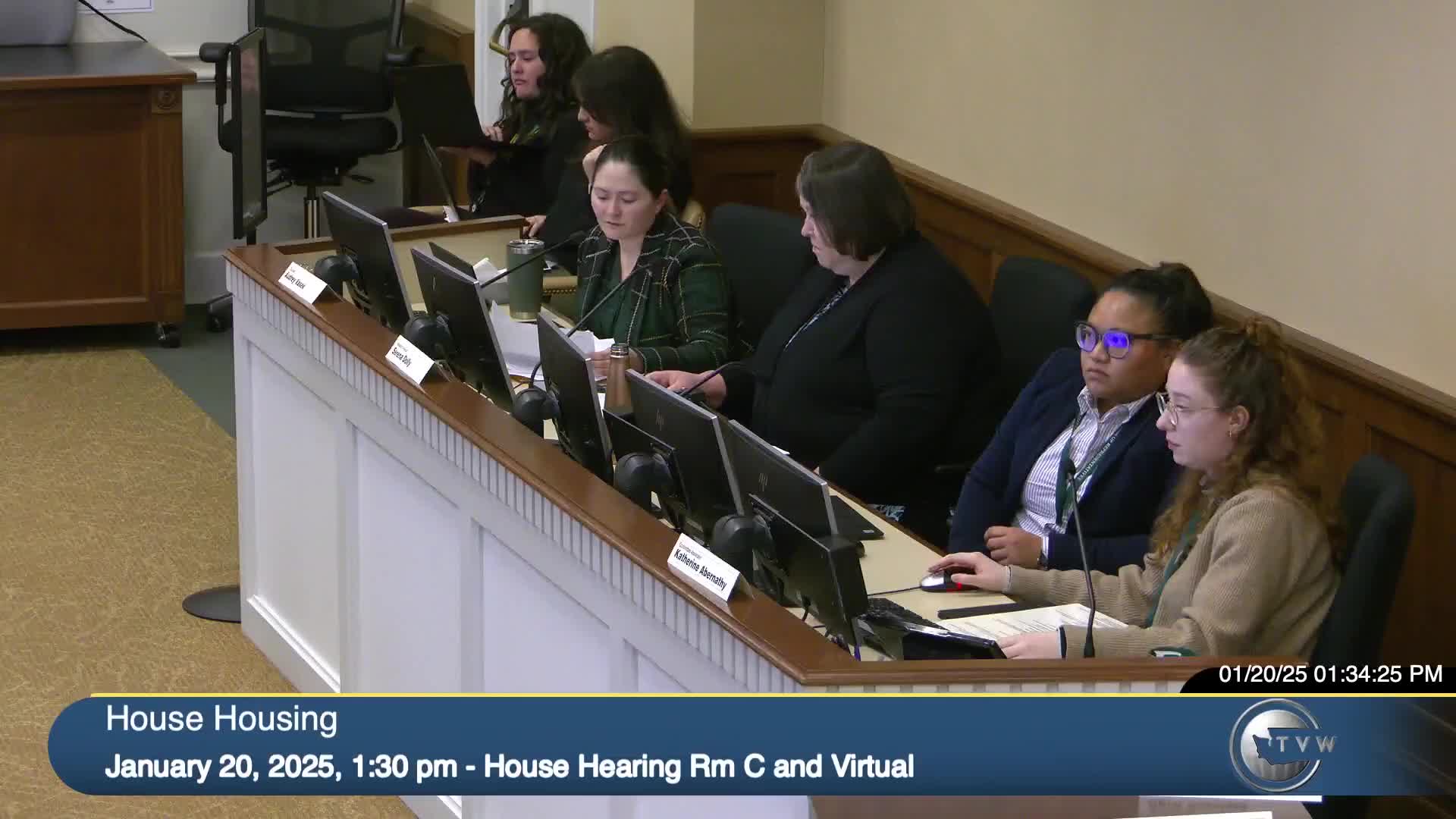
Committee advances substitute HB 1217 limiting rent and fee increases to 7% after partisan debate
Summary
The House Housing Committee on Jan. 20 reported substitute House Bill 1217 out of committee with a due‑pass recommendation, 9–8. The bill sets a 7% cap on rent and fee increases for tenancies governed by the Residential Landlord Tenant Act and the Manufactured Mobile Home Landlord Tenant Act.
The House Housing Committee on Jan. 20 reported substitute House Bill 1217 out of committee with a due-pass recommendation, by a 9–8 vote. The bill as advanced would limit rent and fee increases to 7% in any 12‑month period for tenancies governed by the Residential Landlord Tenant Act and the Manufactured Mobile Home Landlord Tenant Act, with a series of contested proposed amendments considered and mostly rejected during the committee session.
The bill matters because it would set a statewide numeric cap on annual rent and fee increases for covered tenancies and because committee debate highlighted friction between tenant stability advocates and members warning of impacts on housing supply and small landlords.
Staff member Audrey Vasek briefed the committee that HB 1217 “limited rent and fee increases to 7% during any 12‑month period for a tenancy subject to the Residential Landlord Tenant Act and the Manufactured Mobile Home Landlord Tenant Act,” and that the bill packet included 15 amendments. Many amendments were moved by Representative Dufeau; Vice Chair Hill moved that the bill be reported out with a due-pass recommendation.
Lawmakers debated multiple amendments that would have changed the bill’s scope or enforcement. Representative Dufeau introduced Amendment 44 to make the 7% cap grow by the 12‑month change in the Consumer Price Index; Dufeau argued the change was needed so rents could keep pace with property taxes, insurance and maintenance costs. Representative Alvarado opposed the amendment, saying the plain 7% cap “provides predictability so people know the top amount at which the rent can go up so they can plan and budget.” A roll call on Amendment 44 resulted in the amendment failing (vote recorded as nay by Representative Peterson, Representative Hill, Representative Richards, Representative Alvarado, Representative Cortez, Representative Entenmann, Representative Gregerson, Representative Lakanoff, Representative Reid, Representative Timmons and others; ayes included Representative Lowe, Representative Jacobson, Representative Manjarez, Representative Barkis, Representative Connors, Representative Dufo, Representative Engel; the amendment was not adopted). Representative Dufeau said, “This amendment…adds a consumer price index…to the legislation, and that would make sure that it keeps pace with inflation.” Representative Alvarado urged colleagues to “Please vote no.”
Other amendment highlights and outcomes included: - Amendment 45 (remove short‑term and vacation rentals from the bill’s coverage): moved by Representative Dufeau and rejected in a voice vote. Dufeau said short‑term rentals fall under separate statutes; opponents said more stakeholder work was needed. - Amendment 46 (allow month‑to‑month agreements to have different terms than fixed‑term leases): moved by Representative Dufeau; the committee rejected the amendment after opponents said tenants deserve equal protections regardless of lease type. - Amendment 51 (remove the bill’s authorization for the Attorney General to enforce certain provisions under the Consumer Protection Act): moved by Representative Dufeau and rejected. Dufeau described concerns about expanding the Consumer Protection Act’s punitive remedies to small landlords; Representative Alvarado said the Consumer Protection Act is an important enforcement tool for tenants. - Amendment 48 (preempt state enforcement by removing language authorizing local enforcement): moved by Representative Dufeau and rejected; proponents argued for a single statewide enforcement standard, opponents emphasized the role of local governments in protecting vulnerable residents. - Amendment 50 (exempt units where current rent is 85% or less of HUD small‑area fair market rent (SAFMR) from the cap): moved by Representative Dufeau and rejected in roll call. Dufeau said the HUD SAFMR data is published by zip code and would preserve incentives for landlords who charge below‑market rents. - Amendment 62 (exemption where owners spent $10,000+ on repairs/improvements in past 12 months): introduced in packet; eventually withdrawn or not adopted as amended votes proceeded (see record for status labeled withdrawn for some items). - Amendment 60 (expand owner‑occupied exemption from duplexes to include triplexes and 4‑plexes): moved by Representative Dufeau and rejected; proponents said FHA owner‑occupancy treatment justifies the extension, opponents said larger owner‑occupied properties operate more like larger buildings and do not require the same exemption. - Amendment 59 (move the deadline for the Attorney General to publish model lease provisions from Jan. 1, 2025 to Jan. 1, 2026): moved by Representative Alvarado and adopted. The committee adopted this date fix; proponents said the deadline needed updating. - Amendment 65 (remove the emergency clause and set effective date to March 1, 2026 so the AG’s model lease is available before the law takes effect): moved by Representative Dufeau and defeated in roll call. Dufeau argued a delayed effective date was needed to give small providers time to comply; opponents argued manufactured homeowners and tenants need immediate protection. - Amendment 53 (raise the cap on late fees from 1.5% to 10% of monthly rent): moved by Representative Dufeau and defeated after debate. Dufeau said a higher cap creates a meaningful disincentive to late payment; opponents said high late fees make it harder for tenants to catch up and do not address eviction risk. - Amendment 63 (reset rents following a tenant sale of a manufactured home or transfer of manufactured‑home lot tenancy): moved by Representative Dufeau and defeated in roll call; proponents asked that rents be able to reset on a new tenancy, opponents noted statutory complexity and pointed to RCW provisions that may be the appropriate vehicle.
Committee discussion repeatedly divided along the lines that have characterized rent‑limit debates: sponsors and tenant‑protection proponents framed the bill as “basic fairness” that prevents “excessive rent increases” and gives tenants “predictability and stability” in household budgets; opponents and several Republican members warned the bill would reduce housing supply, drive out small landlords and investors, and cited studies they say show permitting and development decline under rent stabilization regimes.
After the amendment process, Vice Chair Hill moved that the adopted amendments be incorporated into a substitute HB 1217 and that the substitute bill be reported out with a due‑pass recommendation. The clerk recorded 9 ayes and 8 nays; the chair announced, “By your vote, substitute House Bill 1217 has been passed as amended.”
The committee record shows a robust set of amendments considered and multiple roll‑call tallies for specific amendments; that record will be part of the committee minutes forwarded with the substitute bill.
Votes at a glance: substitute HB 1217 — reported out of committee (due pass) 9 ayes, 8 nays. Major adopted amendment: Amendment 59 (AG model lease date updated to Jan. 1, 2026). Several sponsor amendments seeking CPI indexing, broader exemptions, or delayed effective dates were not adopted.
The committee paused for caucus during the hearing and resumed to complete the vote; staff provided an amendment packet and the Attorney General’s model lease publication deadline was a focal point of discussion because members argued it affects small landlords’ ability to comply.