Get Full Government Meeting Transcripts, Videos, & Alerts Forever!
Get email alerts on the Environment & Energy topic
No spam. Unsubscribe anytime.
Committee hears HB 1237 to streamline FSEC hearings and set approval standards for clean-energy projects
Summary
House Bill 1237, a measure to change how the Energy Facility Site Evaluation Council (FSEC) conducts public hearings and to list standards for recommendations to the governor, was presented and discussed at a hearing of the Washington State House Environment & Energy Committee.
House Bill 1237, a measure to change how the Energy Facility Site Evaluation Council (FSEC) conducts public hearings and to list standards for recommendations to the governor, was presented and discussed at a hearing of the Washington State House Environment & Energy Committee.
For the record, Matt Sterling, staff to the committee, summarized the bill: “House Bill 1237 changes the public hearings that are required to be conducted prior to the Energy Facility Site Evaluation Council issuing a recommendation to the governor and establishes a set of specific standards for when the FSEC must recommend approval of an application.” He also noted the existing FSEC timeline: recommendations must be submitted to the governor within 12 months of application receipt, with an existing expedited option of 180 days for qualifying projects.
The bill would reduce the current three-step hearing sequence (informational hearing, land-use/zoning hearing, and adjudicative proceeding) to two hearings in many cases, and would require an adjudicative hearing only when a proposed site is inconsistent with applicable land use plans or zoning. Section 2 would also direct FSEC to recommend approval for certain clean-energy facilities when a specified preponderance-of-evidence standard is met, including findings that the project provides public benefits (such as greenhouse gas reductions, jobs, tax and community benefits), avoids or mitigates significant adverse environmental impacts, mitigates impacts to overburdened communities, does not unreasonably threaten health and safety, and includes decommissioning commitments. The bill would repeal the statute sections governing expedited processing and the governor's required operational assessment of FSEC.
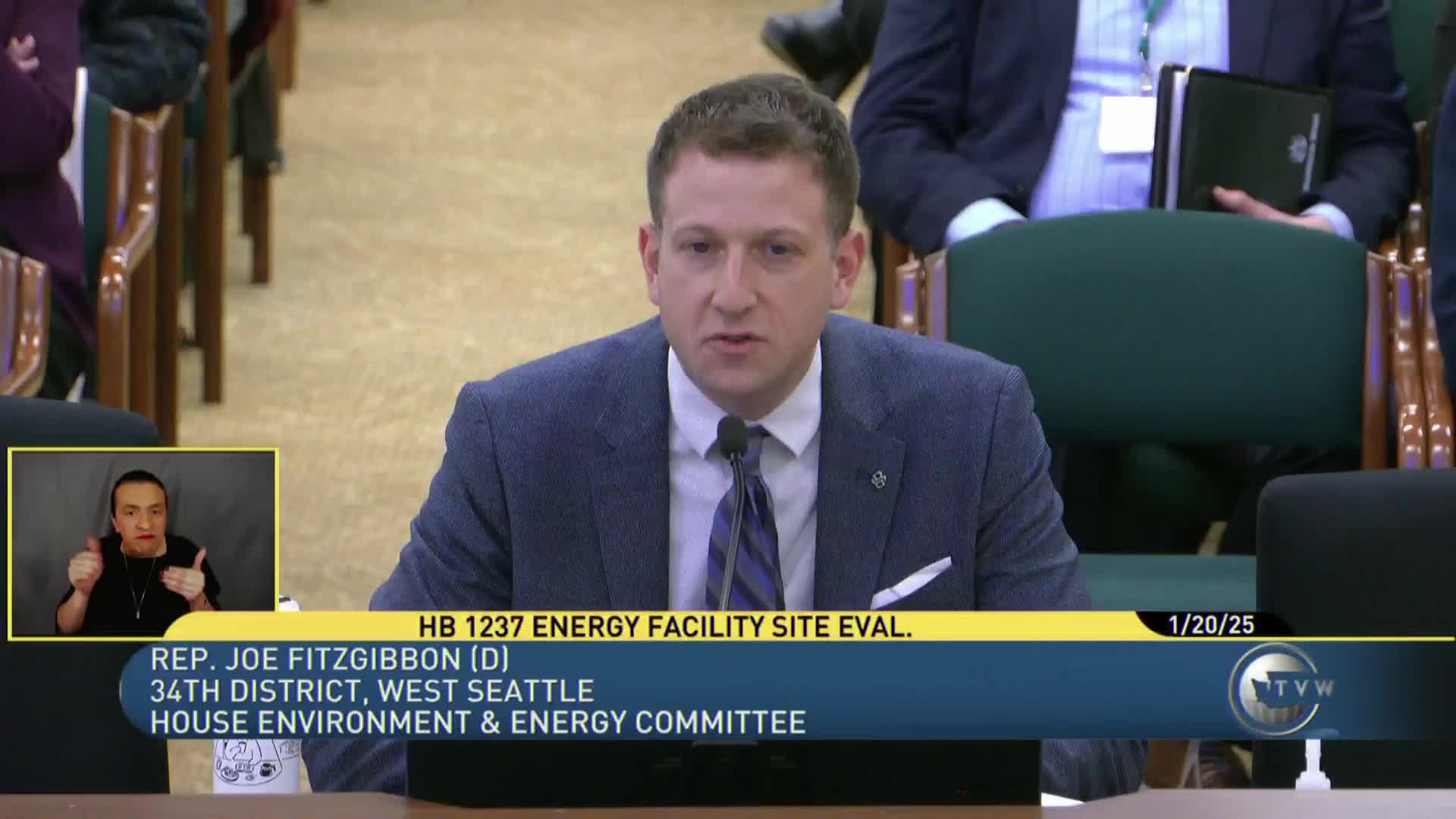
Majority Leader Joe Fitzgibbon (34th Legislative District), the bill sponsor, said the measure aims to “remove some of the subjectivity from the process” by listing criteria FSEC should consider and to “make a more efficient process by consolidating those 3 hearings into 2 hearings.” He acknowledged concerns from stakeholders that adding a longer list of criteria could remain subjective and said he wants to work on making criteria as objective as possible.
Testimony came from industry, labor, environmental groups, tribes and local governments. Puget Sound Energy’s Maggie Douglas said PSE supports the bill’s general principle and “encourage[s] the legislature to continue to pursue more expedited permitting for clean energy projects,” while urging changes to language she called vague and “non measurable and discretionary” in Section 2. Matthew Hepner of the International Brotherhood of Electrical Workers testified in support, saying the bill would “provide a clear approval standard for projects, reducing duplicative processes and accelerating project timelines.” Climate Jobs Washington’s Cassie Bordelon and Renewable Northwest’s Casey McClain supported the bill’s intent but, like other witnesses, asked for clearer, more objective criteria in Section 2.
FSEC Director Sonya Bumpas testified that FSEC supports limiting adjudicative proceedings to cases where the site is inconsistent with land-use controls because adjudication often overlapped with and lengthened the EIS process. She also told the committee that FSEC has concerns that several standards in Section 2 “could potentially lengthen the amount of time it takes to review clean energy facilities,” but said the council will work with sponsors on clearer standards. Earthjustice and the Environmental Priorities Coalition urged caution, warning the bill as drafted would remove adjudicative hearings for projects consistent with local land use and could apply to controversial non‑clean projects as well.
Other testimony flagged questions about which projects should be eligible for streamlined treatment, how to define and measure “public benefits,” whether a state energy strategy should be given weight in approval decisions, and how to protect tribal interests and overburdened communities. Yakama Nation representative Phil Rigdon urged additional protections for tribal rights and suggested requirements such as early demonstration of adequate water supplies and confidential submittal options for sensitive information.
No formal committee vote or final action on HB 1237 was recorded at the hearing. Committee members and the sponsor indicated a willingness to pursue amendments to make the approval criteria more measurable and to limit any adjudication changes to appropriate categories of clean-energy projects.
The committee suspended the HB 1237 hearing before taking action and moved to other bills on the agenda; members said they expected continued negotiation between the sponsor, FSEC and stakeholders.
Ending: The record closes with a schedule of follow-up work and requests for written comments; no adoption or vote on the bill occurred at this hearing.