Get Full Government Meeting Transcripts, Videos, & Alerts Forever!
Get email alerts on the State Property Tax topic
No spam. Unsubscribe anytime.
Committee hears how state property levy, constitutional limits shape school funding
Summary
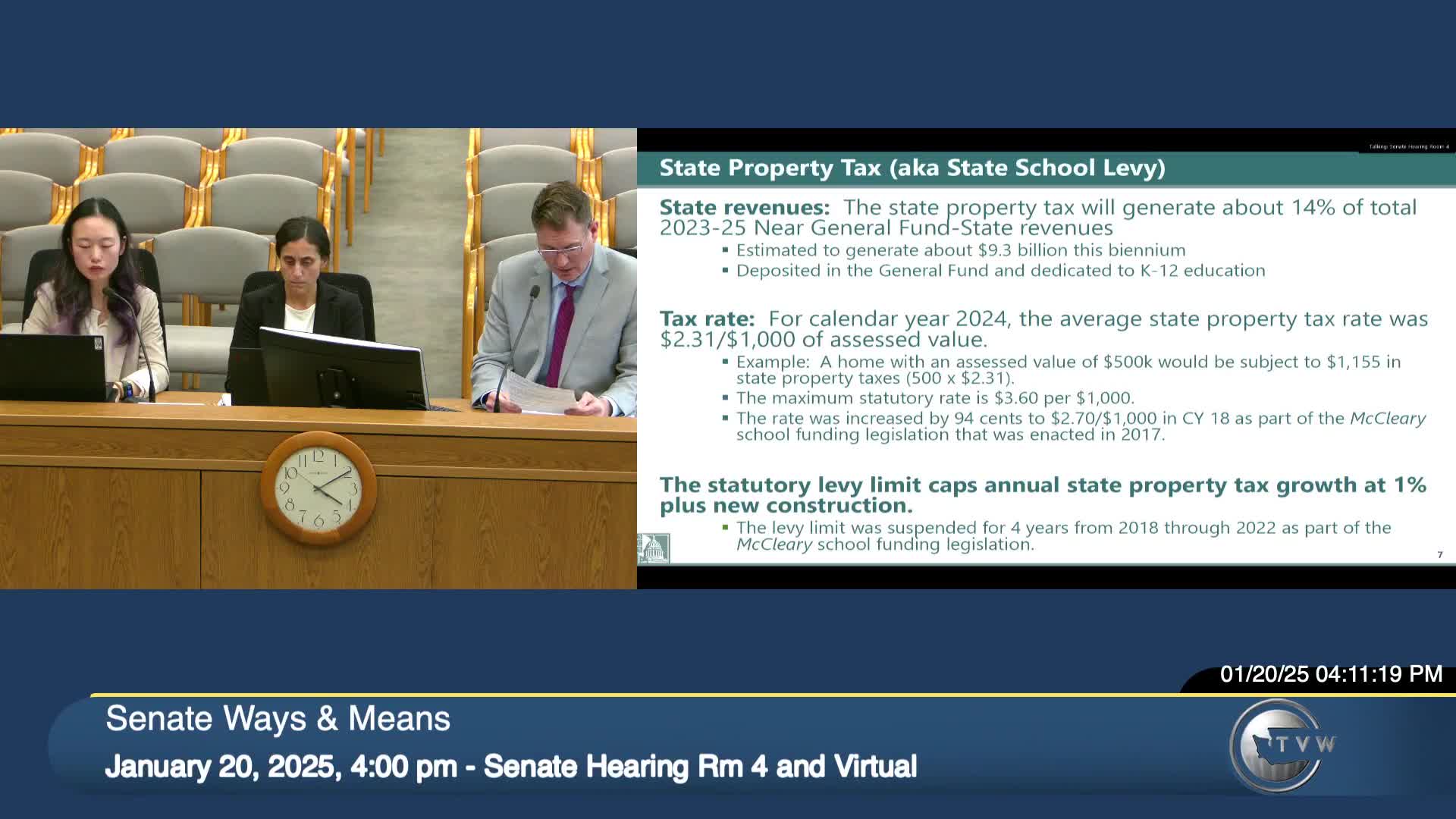
Staff told the committee the state property tax is forecast to raise about $9.3 billion this biennium, is dedicated to K‑12 education, and is bounded by Washington’s constitutional uniformity and a 1% cap on taxes per parcel; staff explained proration rules and the statutory hierarchy used to keep total property tax below the 1% limit.
Jeff Mitchell, committee staff, outlined the mechanics and constraints of Washington’s state property tax during the committee’s January 20 work session.
Mitchell said the state property tax is forecast to generate about $9.3 billion in the 2023–25 biennium and that the revenue is dedicated exclusively to K‑12 education, which is why it is sometimes called the state school levy. "For this year, the state property tax rate is approximately $2.31 per $1,000 of value," he said; he used a $500,000 assessed home as an example to show how the state portion translates into dollars.
Staff reviewed two constitutional constraints. First, the Washington Constitution requires tax uniformity for real estate, which staff said prevents differential tax rates or different assessment percentages for types of real property. Second, a constitutional cap limits property tax on any parcel to 1% of market value (commonly expressed as $10 per $1,000). Mitchell explained that state statute contains a proration mechanism and a hierarchy that reduces or eliminates certain local levies if aggregate rates would otherwise exceed statutory or constitutional limits.
Mitchell also reviewed the statutory rate structure: a $5.90 aggregate rate cap for most local levies, a statutory maximum state property levy of $3.60 per $1,000 (the actual state rate in 2024 was about $2.31), and a residual gap within the $10 constitutional cap that some local levies are placed into. He described the prioritization used when proration is required and gave examples of the order in which levies are reduced or eliminated.
The presentation summarized the 1% annual growth cap (the levy limit) that applies to the state and most local levies, noting that the limit does not apply to school levies. Mitchell reviewed the statute’s history — from a 6% limit in the 1970s to the current 1% limit set by initiative in the early 2000s — and explained how the levy limit can cause tax rates to fall when property values rise faster than the 1% cap.
Senator Freme asked for clarification on the proration prioritization; Mitchell described the hierarchy (for example, county corrections of levy error and flood control districts are high in the ordering, while some cultural access levies fall first under the 5.90 limit). Senator Wellman asked whether enrichment levies are intended to fund programs beyond the state’s basic education obligation; Mitchell confirmed they are.
Staff identified that the state property tax rate rose notably in 2018 under K‑12 funding legislation and that the 1% levy limit was suspended for a period as part of that recalibration.