Get Full Government Meeting Transcripts, Videos, & Alerts Forever!
Get email alerts on the State Tax Structure topic
No spam. Unsubscribe anytime.
Washington relies heavily on sales and business taxes, state overview shows
Summary
Committee staff told the Ways & Means Committee that Washington collected about $38 billion in taxes in fiscal 2023 and that sales and gross receipts taxes (including the B&O tax) account for roughly 60% of that total; staff contrasted Washington’s mix with income-tax states such as Oregon.
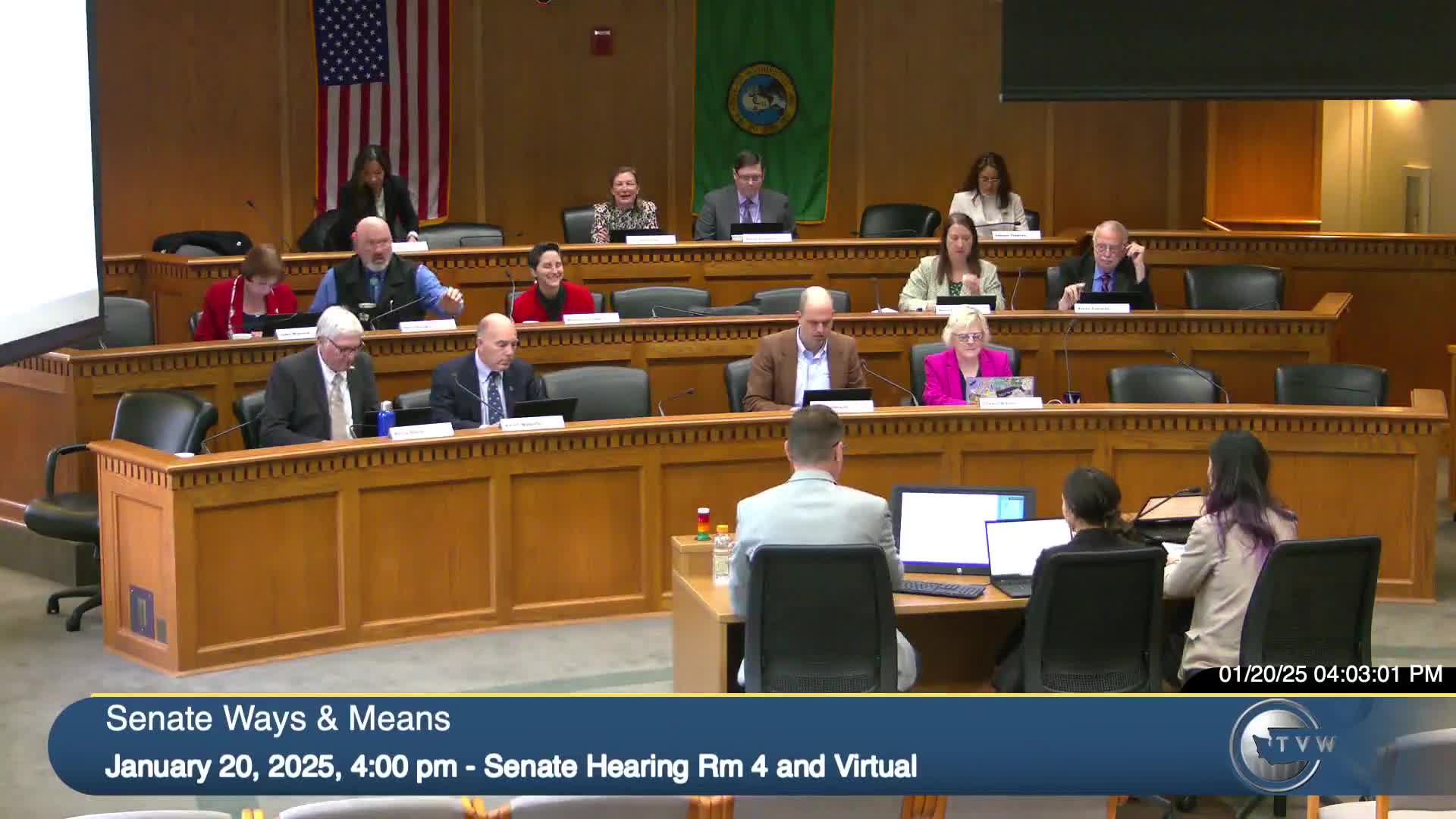
Jeff Mitchell, staff to the Ways & Means Committee, opened a January 20 work session with an overview of Washington’s tax structure and how the state compares with others.
"In fiscal year '23, Washington collected about $38,000,000,000 in taxes across all budgets," Mitchell said, and he noted that about 85% of those revenues support the operating budget. He said the state’s combined general sales and gross receipts taxes — primarily the retail sales tax and the business and occupation (B&O) tax — generated about $23 billion in fiscal 2023, or roughly 60% of total state receipts.
The presentation used Census Bureau state tax survey classifications to compare Washington with other states. Mitchell said Washington derives almost 75% of its tax revenues from various general and selective sales and gross receipts taxes, with property taxes contributing roughly 12%. By contrast, Oregon relies heavily on individual and corporate income taxes and has no state sales tax.
Committee staff emphasized that near‑general‑fund revenues supporting the operating budget concentrate in three sources: retail sales and use tax, major business taxes (including B&O and public utility tax), and the state property tax. Staff reported the near general‑fund revenue estimate for the 2023–25 biennium was about $66.4 billion and said retail sales and use taxes alone were estimated to contribute about 48% of that total.
Senators asked clarifying questions about population growth and the meaning of several charts. Senator Rebecca Wellman asked whether state law intends the state to fund the entirety of the basic education program; Mitchell affirmed that enrichment levies fund programs in addition to the state's basic education obligations. Other senators requested staff provide population growth figures layered onto long‑run revenue charts.
The committee's staff noted long‑run trends: although nominal revenues have grown for decades, revenues as a percentage of personal income have been declining since about 1995. Staff cited factors such as changing consumption patterns (more spending on services and health care that are not subject to sales tax), repeal of prior revenue sources such as the motor vehicle excise tax, and increases in personal income.
The presentation concluded with staff offering the packet as a resource for the upcoming legislative session and invited follow‑up questions.