Get Full Government Meeting Transcripts, Videos, & Alerts Forever!
Get email alerts on the State And Local Government topic
No spam. Unsubscribe anytime.
Committee hears bill to tie state lodging reimbursement to federal GSA rate
Summary
A State and Local Government Committee hearing on Senate Bill 2084 heard testimony supporting a change to North Dakota law to set state lodging reimbursement equal to the federal General Services Administration (GSA) rate, and asked OMB to adopt a fallback fiscal policy when GSA rates are unavailable.
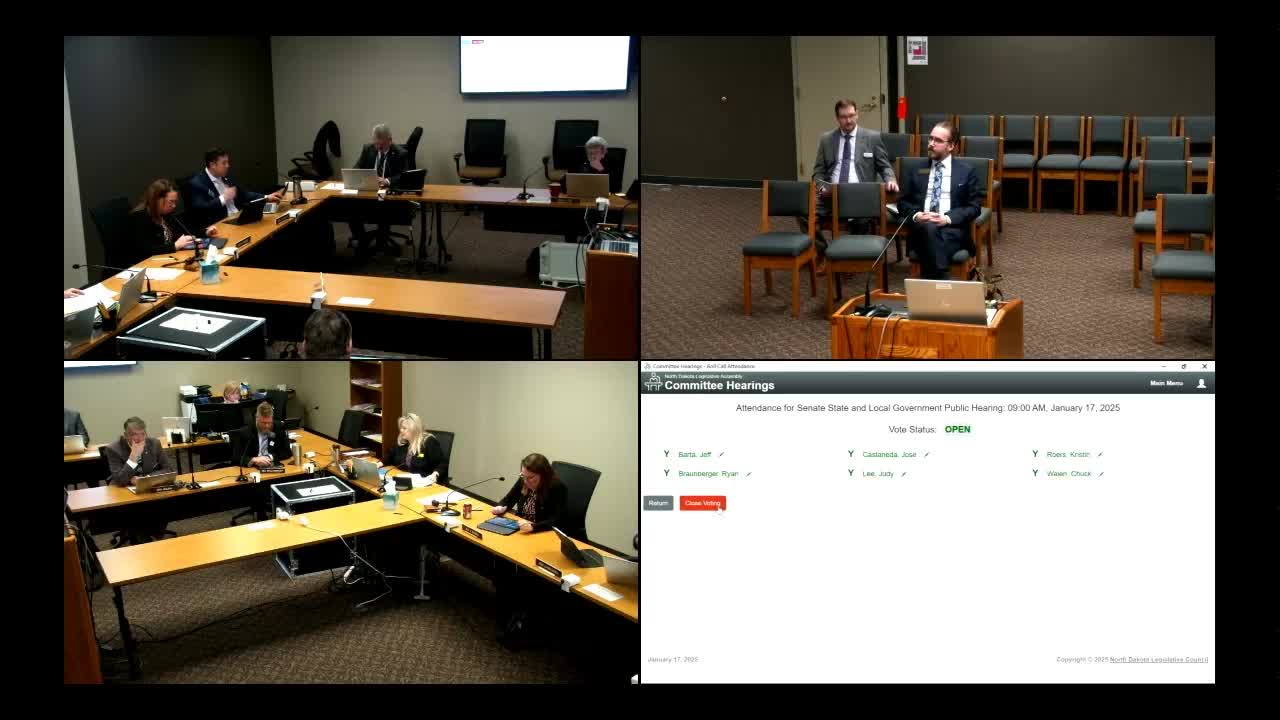
The State and Local Government Committee opened and closed a hearing on Senate Bill 2084, which would amend Century Code 44-08-04(2)(d) to set the state lodging reimbursement rate equal to the federal General Services Administration (GSA) rate for North Dakota and give the Office of Management and Budget (OMB) authority to apply an internal policy when a federal rate is not available.
The change matters to state and local employees, and legislators who travel on state business, because committee witnesses said many hotels no longer honor the current state rate and some employees have had to find other rooms or pay out of pocket. Supporters said adopting the federal GSA rate would expand usable options and reduce time spent securing lodging.
Joe Goplin, director of the fiscal management division at the Office of Management and Budget, told the committee that Section 1 of the bill would “amend and reenact Century Code 44-08-04 subsection 2(d) related to what’s referred to as the state lodging rate.” He told members the law currently directs the state rate to be 90% of the federal GSA rate and said the GSA rate for North Dakota is $110, which makes the allowable in‑state lodging reimbursement rate $99 under current law. Goplin described situations in which hotels offer a limited number of state‑rate rooms and stop honoring that rate when those rooms fill, creating “a daunting, frustrating, and time consuming task” for employees who must reserve lodging near work sites or event locations.
Goplin asked the committee to allow the state to follow the federal GSA rate and direct OMB to update fiscal policy 505 so that, “when the federal rate is not available, state officials, local government, and state team members must document they checked with a minimum of 3 hotels, when available, within the vicinity of where work is being conducted, and choose the most cost‑effective option.” He added the guidance would require staff to consider commuting distance, central location for multi‑stop trips, and amenities such as a continental breakfast when choosing lodging, and said the change would let OMB handle exceptions while maintaining fiscal responsibility.
Rudy Martinson, director of the North Dakota Hospitality Association, said the association represents lodging, restaurant and retail beverage businesses and offered the group’s support for the bill. Martinson recalled earlier work on state lodging law in 2009 and said tying the state rate to the GSA rate makes the reimbursement adjust with market conditions. He told the committee he expects more hotels to honor a single government rate if the state follows the GSA amount.
Committee members asked several operational questions. Senator Varda asked how often employees encountered difficulties finding a room at the state rate; Goplin said it was not daily but that he receives multiple agency calls each week asking for an OMB policy waiver and described current guidance to document attempts to find comparable rooms to avoid personal financial burden. The group also discussed the bill’s scope: the change would apply to the daily state travel rate for all state employees (including legislators) but would not change the separate monthly/legislative session rate provision, which several members noted is handled in a different section and not included in this bill.
Members raised budget timing and fiscal‑note concerns. Committee members asked about an effective date; OMB staff said fiscal notes were calculated assuming an August 1 effective date for the upcoming biennium and suggested that July 1 could be used to align with the fiscal year if the committee preferred. No final decision on an effective date was made during the hearing.
Chairwoman Rohrs praised the flexibility in the OMB approach, saying, “I actually like your approach a little better than what I did because I think it gives a little more flexibility for some regional” scenarios. After testimony and questions, the committee closed the hearing on Senate Bill 2084 and deferred further action to its next meeting to decide which vehicle and timing to use.
The hearing record contains no committee vote on the bill; the committee recorded testimony in favor and closed the hearing pending a future decision on formal action.