Get Full Government Meeting Transcripts, Videos, & Alerts Forever!
Get email alerts on the Hazardous Materials Fees topic
No spam. Unsubscribe anytime.
Committee leaves hazardous-chemical fee bill open; bill would let homeland security set Tier II fees and raise facility cap
Summary
Senate Bill 2082 would allow the Division of Homeland Security to set the Tier II hazardous chemical reporting fee, raise the statutory cap on a facility's payment and permit the state to charge certain formerly exempt government facilities that fail to report.
Senate Bill 2082, which would give the director of the Division of Homeland Security authority to set the Tier II hazardous chemical reporting fee, increase the statutory cap on what a facility can be charged, and allow the state to charge certain previously exempt government facilities that do not report, drew agency testimony about program finances and local use of funds.
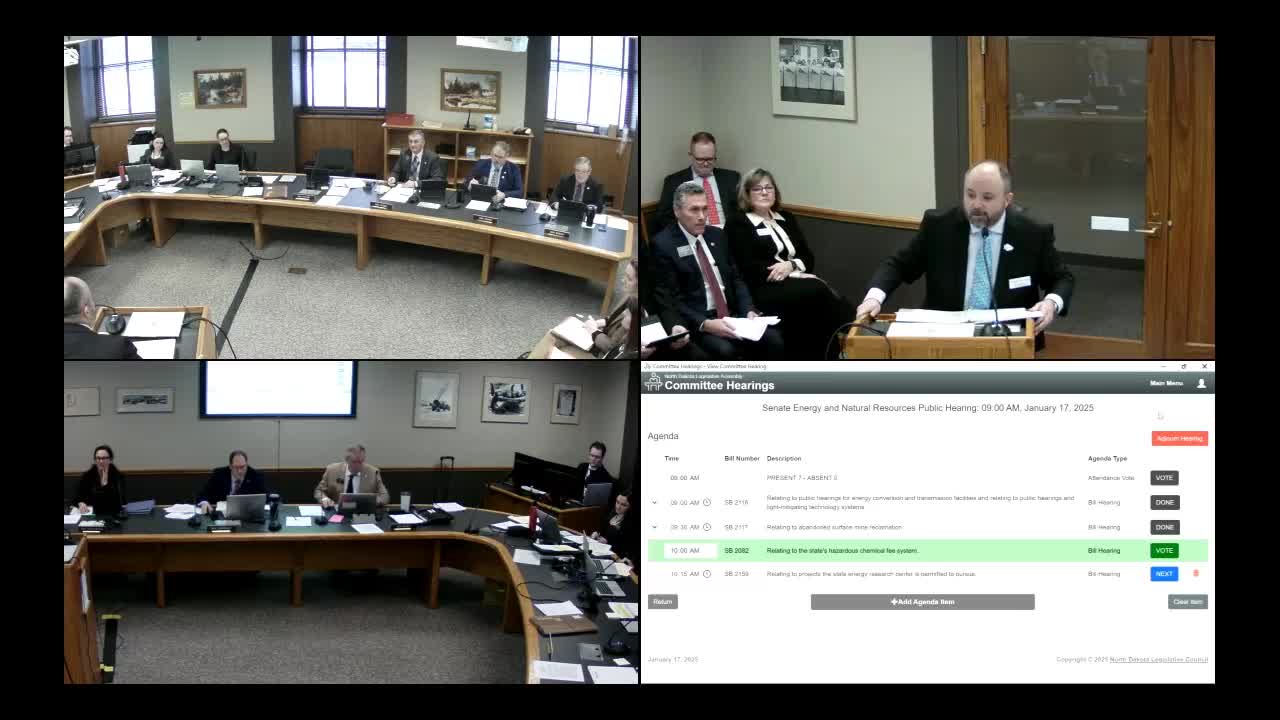
"This bill would do three things," Darren Hanson, homeland security division director at the Department of Emergency Services, told the committee. Hanson said the bill (1) would allow the director to set the Tier II hazardous chemical fee, (2) would increase the cap a facility could pay from $475 to $1,250, and (3) would allow the state to charge fees to facilities previously exempt from paying if they do not comply with reporting requirements.
Hanson explained how fee revenue is used: half of the receipts are distributed to counties to support hazardous-materials programs (often local fire departments) for response equipment and training; the other half funds state maintenance and staffing for the multiagency software system used for reporting chemicals and notifying agencies during incidents. He told senators the original $25 fee was set in 1991 and has not kept pace with inflation; a July 1991–July 2024 inflation adjustment would have put the fee at roughly $57.73.
Committee members asked about safeguards if the director sets fees. Hanson said the bill includes a one‑year notice requirement and that the legislature would keep the statutory cap in place; the agency said it is open to further legislative safeguards. Hanson estimated a $50 fee assumption in the fiscal note and said the division might add about $100,000 to its fund in a first year estimate.
The committee left the hearing open after testimony but later took a recommendation for due pass with referral to the Appropriations Committee. The final committee roll call on the motion recorded 7 yeas, 0 nays. The bill was left open for further public input before final committee action.