Get Full Government Meeting Transcripts, Videos, & Alerts Forever!
Get email alerts on the Traind Funding Formula topic
No spam. Unsubscribe anytime.
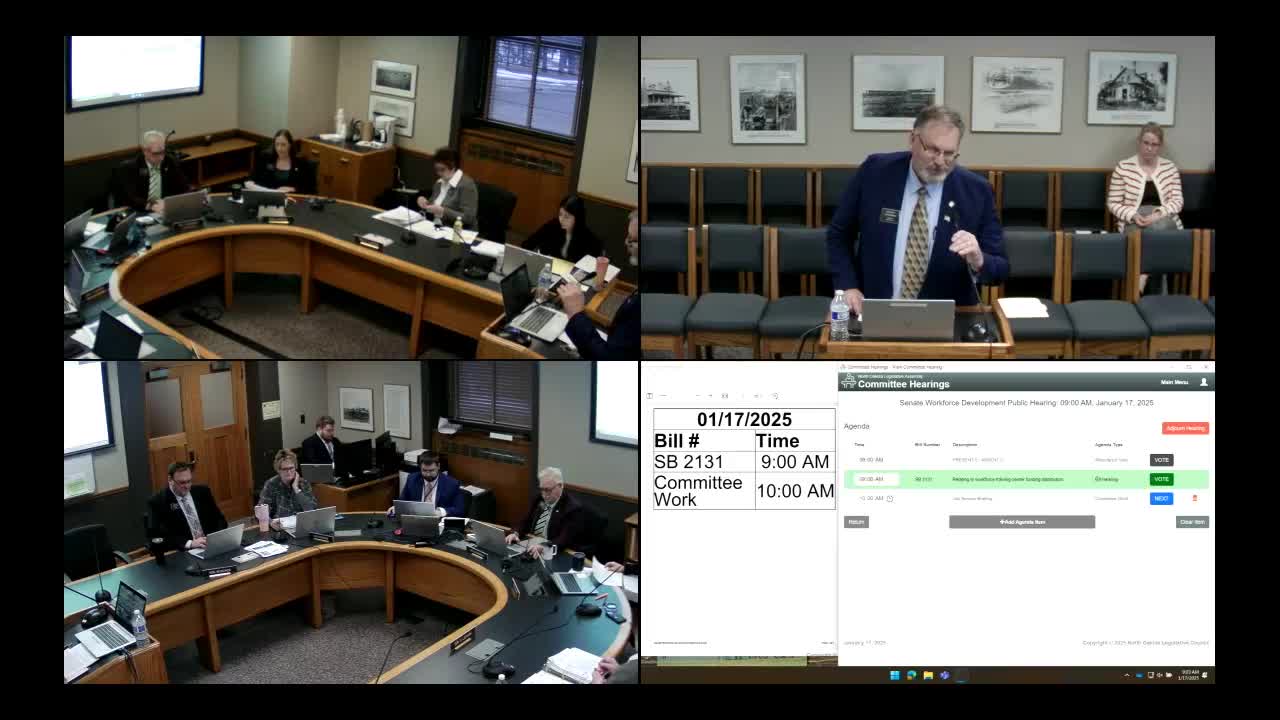
Committee hears competing views on Senate Bill 2131 to change TrainND funding formula
Summary
The Senate Workforce Development Committee on Thursday heard testimony on Senate Bill 2131, which would change how state funds are distributed among the four TrainND workforce training quadrants and would, if codified, fix a new funding formula in law.
The Senate Workforce Development Committee on Thursday heard testimony on Senate Bill 2131, which would change how state funds are distributed among the four TrainND workforce training quadrants and would, if codified, fix a new funding formula in law.
The bill would set a distribution model of 60% allocated evenly across the four TrainND regions, 20% distributed by contact hours and 20% by unduplicated participants, a configuration supporters said would correct a long-standing disadvantage for the northwest quadrant. Senator Todd Beard, a District 23 lawmaker and TrainND employee, told the committee the change was the result of an interim study and asked the committee for a “do pass” recommendation on SB 2131.
The bill matters because TrainND is the state’s network for college-level workforce and technical training and the new formula would change how limited state training dollars are divided among Williston State College (northwest), Lake Region and Devils Lake (northeast), Bismarck State College (southwest) and North Dakota State College of Science in Wahpeton (southeast). Supporters said the proposed model preserves baseline stability while tying part of funding to measurable outcomes.
Senator Todd Beard, District 23, said the northwest region generated high training volumes with relatively little funding for more than 20 years and that the 60/20/20 model reflects the interim committee’s compromise. “I ask for a do pass recommendation on Senate Bill 2,131,” Beard said during his remarks.
Opponents urged caution about putting the formula into statute. Lisa Johnson, Vice Chancellor for Academic and Student Affairs at the North Dakota University System, testified on behalf of NDUS and the four campus presidents who oversee TrainND operations that they support the recommended distribution but oppose codifying it into Century Code. Johnson said the presidents and the TrainND directors “recommended the funding formula that [is] before you,” but asked the committee to refrain from enshrining the policy in statute and instead allow TrainND and the CTE governance structure to retain flexibility.
State Career and Technical Education staff described the administrative timeline: after the interim committee recommendation, the CTE directors finalized counting rules and the state CTE board approved the policy on a two-reading schedule; the policy is scheduled to take effect July 1, 2025, contingent on the appropriation that the department receives. The Department of Career and Technical Education noted that the distribution process has been governed by agreements among presidents and directors since about 1999 and that the new policy replaces a covered-employment–based distribution with a stability-plus-performance model.
Committee members pressed for financial detail and scope clarifications. Witnesses and staff clarified that the proposal affects college-level TrainND funding only and does not change high-school CTE funding. Staff also described current appropriations: TrainND’s base appropriation has been $2.0 million in prior biennia and is now $2.5 million after a prior increase; the department has requested an additional $1.4 million in the current budget cycle to expand outreach and local staffing in under-served communities.
Senators asked whether codifying the formula would hamper flexible responses to rapid growth in career and technical education. Proponents said the interim process and legislative oversight are appropriate; opponents said the presidents and directors agreed to the distribution and should retain the ability to adapt without a statutory change. One staff witness suggested that the state CTE board could serve as an impartial forum if redistribution needed review.
No committee vote was recorded at the hearing. The chair gave committee members time to review the February 22 interim committee presentation and closed the hearing portion on SB 2131 without a recorded action.
The committee also heard several informational clarifications during the hearing, including timeline details for implementation and that the new distribution would apply beginning with the next biennium appropriation cycle.