Get Full Government Meeting Transcripts, Videos, & Alerts Forever!
Get email alerts on the Abandoned Mine Reclamation topic
No spam. Unsubscribe anytime.
Committee approves amendments to align abandoned mine reclamation law with federal rules
Summary
The committee advanced Senate Bill 2117 as amended to update North Dakota's abandoned mine land (AML) law to mirror federal Office of Surface Mining Reclamation and Enforcement (OSMRE) requirements and clarify use of Infrastructure Investment and Jobs Act set‑aside funds.
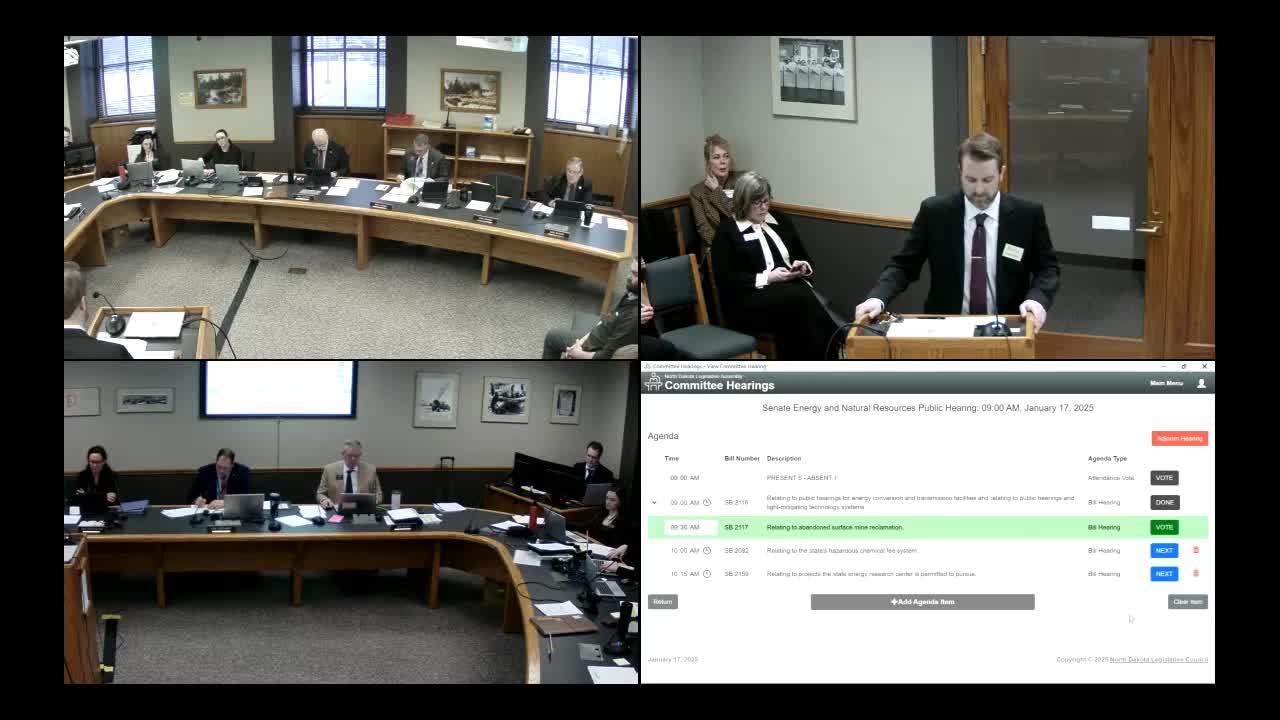
The Senate Energy and Natural Resources Committee voted to recommend Senate Bill 2117 as amended after agency testimony that the changes are housekeeping edits to align state law with federal AML rules and to clarify allowable uses of a federal set‑aside account created by the Infrastructure Investment and Jobs Act.
"The Public Service Commission administers the state's program for abandoned mine land reclamation, with federal oversight from the Office of Surface Mine Reclamation and Enforcement, OSMRE," Jonathan Emeron, reclamation and abandoned mine lands division director at the Public Service Commission, told the committee. Emeron said the bill updates North Dakota Century Code chapter 38-14.2 to match federal regulations in 30 CFR and to incorporate subsequent changes, including authorizations from the Infrastructure Investment and Jobs Act (Public Law 117-58).
Emeron said the Bipartisan Infrastructure Law authorized a multibillion-dollar AML fund at OSMRE and allows states to set aside 30% of an annual grant into a long-term account for future projects; North Dakota's annual AML grant is currently about $3,100,000. The agency requested an amendment to clarify that the set-aside account may be used for projects such as acid mine drainage, subsidence remediation and coal-fire work; Emeron said the amendment mirrors the cited federal language.
Committee members asked how the federal grant amounts are calculated and whether the change affects industry; Emeron and senators responded that funding levels depend on the size of a state's legacy mine inventory and that the amendment reiterates federal law rather than changing substantive state obligations.
Senators approved the proposed amendment on roll call (7 yes, 0 no), then voted 7-0 to recommend the amended bill for passage. The committee designated a carrier for the amendment and the amended bill.