Get Full Government Meeting Transcripts, Videos, & Alerts Forever!
Get email alerts on the Utility Siting Hearings topic
No spam. Unsubscribe anytime.
Committee recommends bill letting PSC hold separate public and technical hearings for siting cases
Summary
The Senate Energy and Natural Resources Committee voted to recommend Senate Bill 2116, which would let the Public Service Commission hold separate public-input hearings and consolidated technical (evidentiary) hearings for electric and pipeline siting cases to improve public accessibility and streamline the evidentiary record.
The Senate Energy and Natural Resources Committee voted to recommend Senate Bill 2116 after testimony that the change would make it easier for affected landowners to provide public input and reduce duplicative technical testimony in multi-county siting cases.
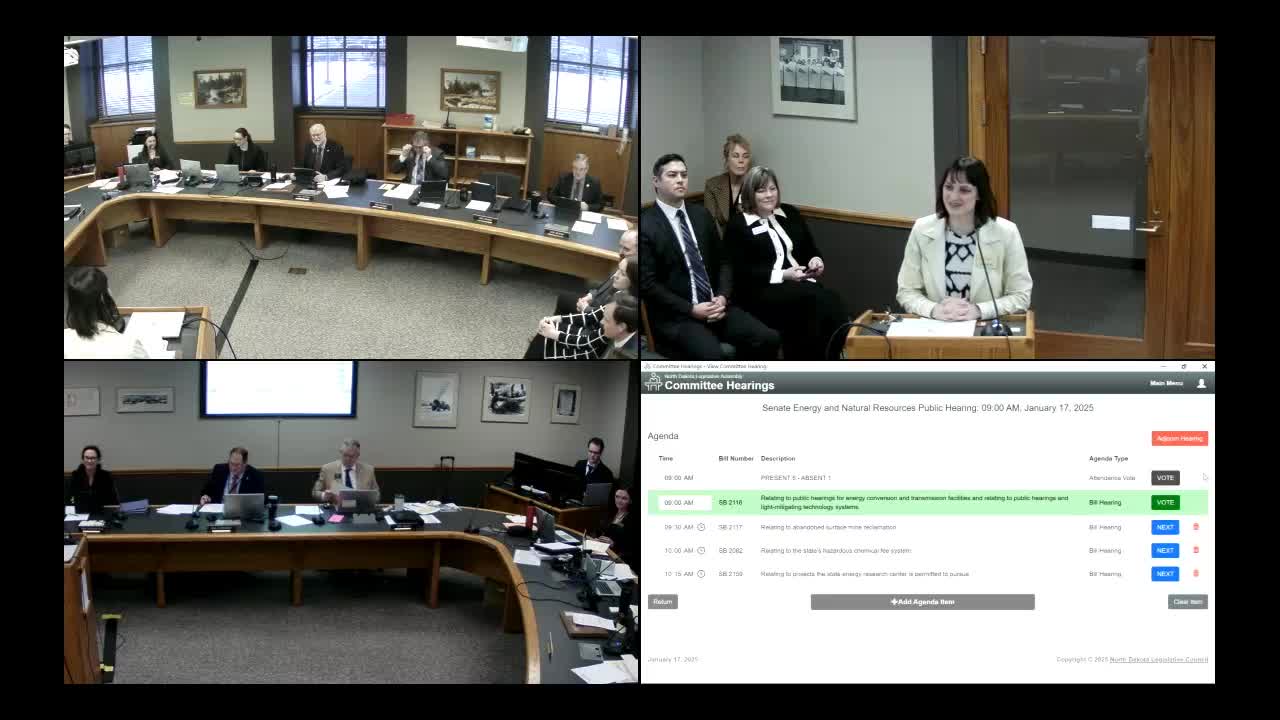
The bill would permit the Public Service Commission to hold separate public hearings focused on community input while conducting a single consolidated technical (evidentiary) hearing on the record. "During the siting process, the commission holds public hearings that include two primary components," Commissioner Jill Kringstead testified. "First, the evidentiary portion ... And second, the public input portion." Kringstead said separating the two could improve accessibility, streamline scheduling and create a clearer evidentiary record to aid quicker decisions and appeals.
Kringstead also told the committee the technical hearing would remain open to the public and be livestreamed on the commission's website. Jack Shue, an attorney with the Public Service Commission, answered a committee question about how the bill defines technical hearings, pointing the committee to the bill's cross-reference language describing the evidentiary procedures permitted at a technical hearing.
Dennis Pathroff, a lobbyist for the GA Group representing the Power Companies of North Dakota (a coalition including MDU Resources, Xcel Energy and Otter Tail Power), testified in support and said the coalition "strongly urge[d] a due pass on this bill," arguing it balances efficiency and public engagement and could reduce costs.
Senator Kessel moved a due-pass recommendation; Senator Gearhart seconded. The committee recorded 6 ayes, 0 nays and 1 absent. The committee designated a carrier for the bill. The action advances SB 2116 out of committee for further consideration.
Chair Patton and members asked clarifying questions during testimony but recorded no amendments in committee.