Get Full Government Meeting Transcripts, Videos, & Alerts Forever!
Get email alerts on the Workforce Scholarships topic
No spam. Unsubscribe anytime.
Bill would create law‑enforcement family scholarship; backers urge it as a recruitment and retention tool
Summary
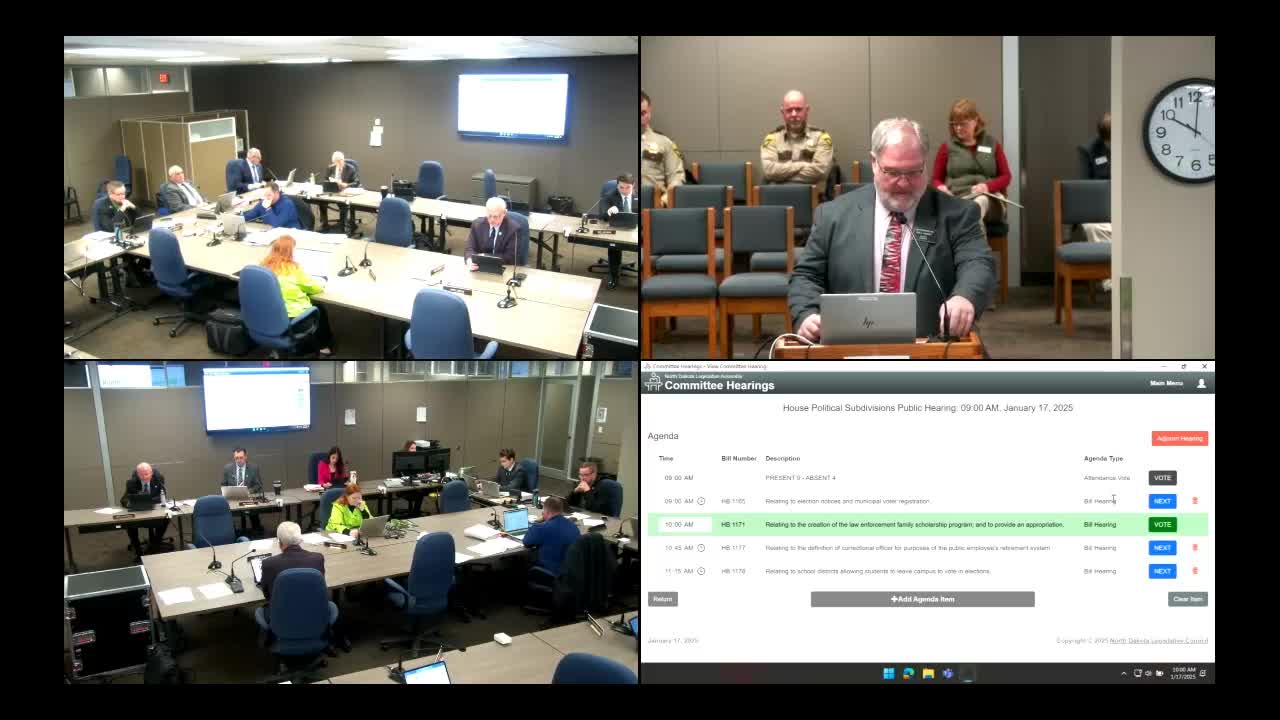
House Bill 1171 would create a scholarship program to cover 50% of tuition (after other aid) for dependents of eligible public safety employees; witnesses said it is intended to help recruit and retain emergency workers. The bill includes a $5 million appropriation and drew questions about eligibility, administration and fiscal scope.
Representative Pat Heinert, sponsor, described House Bill 1171 as a recruitment and retention measure that would create a law enforcement family scholarship covering "50% of the fees for tuition" for dependents of eligible public‑safety employees and would be administered by the State Board of Higher Education.
Dustin Olson, lieutenant with the Burleigh County Sheriff's Department and president of the North Dakota Peace Officers Association, testified in support and said the scholarship "will help assist in the retention of good employees who seek a career in law enforcement." He asked the committee for a due‑pass recommendation.
Stephanie Ingebretsen, appearing for the Chiefs of Police Association and speaking as deputy director/attorney for the North Dakota League of Cities, said the bill requires the dependent to be claimed on federal income tax returns and that the employee be employed at least three years and be active when the scholarship is awarded. She told the committee the scholarship would be awarded for institutions governed by the State Board of Higher Education and that if employment ended after the first semester the scholarship likely would not continue for a subsequent semester. "It does require that for an individual's child to be eligible for this, they need to be a dependent, so claimed as a dependent on federal income tax, and that the person has been employed ... for at least 3 years," she said.
Kelvin Benson, representing the North Dakota Peace Officers Association, supported the bill and said the association would provide further feedback on implementation details and the 50% structure.
Brenda Zastopol, director of financial aid for the North Dakota University System, offered drafting and eligibility amendments. She recommended replacing the single tax‑return dependency test with multiple forms of proof (prior year tax return showing the dependent, a court order or divorce decree, or a birth certificate) and suggested changing award language to allow scholarships and grants up to "cost of attendance" so the program could cover tuition, fees, books, housing and transportation. She also noted that the university system was not involved in developing the bill's $5 million appropriation but could model a high‑level estimate based on occupational SOC codes.
Committee members questioned the size and scope of the appropriation (the bill appropriates $5,000,000 for two years), whether the scholarship would be automatically granted to any eligible dependent without academic or financial‑need review, whether it would apply to graduate and professional programs, and whether the scholarship would cover public institutions only. Witnesses told the committee: the bill as drafted would direct the State Board of Higher Education to grant scholarships to eligible applicants; the bill requires three years of employment and active employment at award time; and the sponsor and witnesses said further drafting could narrow residency, dependency, and award limits.
Ending: Supporters asked for a due‑pass recommendation; witnesses urged additional drafting work on dependency proof, eligible institutions, and the fiscal estimate before the bill proceeds to the appropriations process.