Get Full Government Meeting Transcripts, Videos, & Alerts Forever!
Get email alerts on the Developmental Disabilities topic
No spam. Unsubscribe anytime.
State DD Council asks appropriations panel to fund new staff, will reallocate some federal grants
Summary
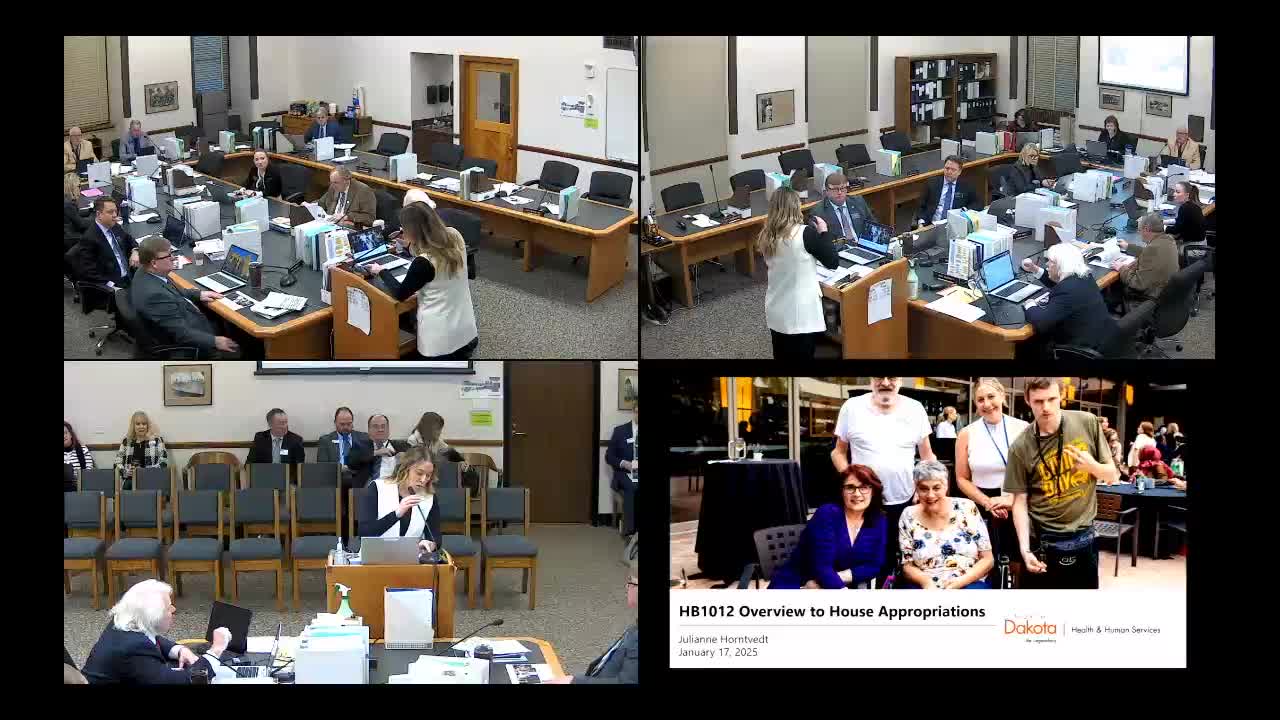
State Developmental Disabilities Council Executive Director Julianne Horntevant told the House Appropriations Committee’s Human Resources Division that the council is seeking to hire additional staff and will shift some federal grant dollars to cover new positions.
State Developmental Disabilities Council Executive Director Julianne Horntevant told the House Appropriations Committee’s Human Resources Division that the council is seeking to hire additional staff and will shift some federal grant dollars to cover new positions.
Horntevant said the council, which receives federal funds under the Developmental Disabilities Assistance and Bill of Rights Act and is administered through the Administration for Community Living, currently operates with about 1.5 full-time equivalents (one full-time staff and a part-time self-advocacy position) and is asking to increase that staffing to the equivalent of three FTEs by adding a full-time position and two part-time positions.
The move, Horntevant said, is intended to bring more project work in-house so the council can directly lead inclusion initiatives, public policy projects and technical-assistance efforts instead of funding outside contractors. "We have a 70 30 ratio as a rule of the funds, which means a max of 30% can be spent on our admin costs," Horntevant told the committee. She added that when staff time is devoted directly to the council’s five-year state plan goals, it is recorded as program work rather than an administrative overhead charge.
Why it matters: the DD Council distributes federal grant and contract funds across the state to pilot inclusion projects, support self-advocacy, and seed housing and community programs. Shifting money from competitive grants into salaries reduces the pool of discretionary awards available to outside providers and local projects while increasing the council’s internal capacity to run and sustain programs.
What the council funds now: Horntevant described recent investments including the state’s Olmstead plan development, peer-to-peer inclusion work in schools, a Grand Forks housing pilot that used council funds to help people move from large congregate settings into smaller apartment-style homes, and new self-advocacy groups and inclusive-childcare pilots. She said the council funds travel and training so people with disabilities and family members can attend meetings and conferences and described plans for statewide outreach as the council prepares its next five-year plan.
Committee concerns and clarifications: Representative Murphy pressed Horntevant on whether moving work in-house will reduce grants to families and providers. Horntevant said projects are not being eliminated today and that until the council actually hires the requested staff the grant line remains funded. "We have not eliminated projects. We are continuing to fund projects within this 5 year plan," she said. Representative Murphy noted examples of previous grant recipients and asked for a breakdown of who received funds and in what amounts; the committee asked Horntevant to provide detailed grant lists and historical expenditures.
Officials also clarified administrative and hiring mechanics: Sarah Stolt, deputy commissioner overseeing the council within the Department of Human Services, told the committee the council’s new positions will be counted against the department’s overall FTE pool even though the salaries would be paid with federal grant dollars. Horntevant emphasized the positions would be federally funded and said hiring had not occurred at the time of the presentation.
Budget specifics and travel: Horntevant said that adding staff explains an increase in the council’s salaries and benefits line and a corresponding smaller grants line in the proposed biennial budget. She outlined higher travel costs tied to continuing quarterly self-advocacy trainings, council meetings, a national conference for council members and staff, regional trainings in seven communities, sibling-support groups and statewide town halls to collect input for the next five-year plan.
Next steps: Committee members asked Horntevant and HHS staff to provide the council’s detailed slides, an annual report, and a line-item list of recent grant awards. Donna Ochland (HHS staff) told the committee the materials would be provided after the hearing. Horntevant said the council will continue work under existing grants until hires are finalized.
Ending: The committee left the council presentation pending follow-up documents that members requested to evaluate grant impacts and the proposed staff reallocation.