Get Full Government Meeting Transcripts, Videos, & Alerts Forever!
Get email alerts on the Und Research Edrf topic
No spam. Unsubscribe anytime.
UND reports 65 percent research spending growth and highlights Economic Diversification Research Fund and challenge grants
Summary
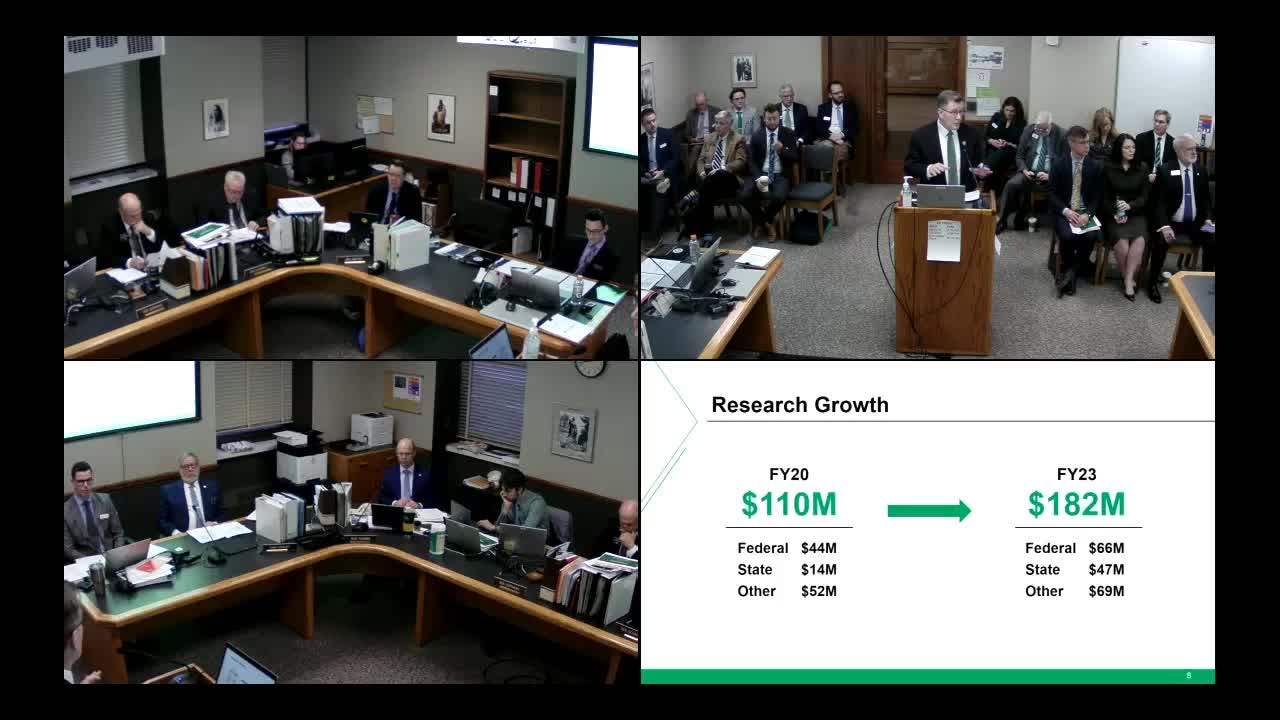
University leaders told the committee UND research expenditures grew about 65 percent over three years and described how the Economic Diversification Research Fund (EDRF) and challenge grants have been used to attract federal and private research dollars.
University of North Dakota President Andy Armacost and research leadership reported rapid growth in sponsored research and described how state investments seed further external funding.
Armacost said UND’s total research expenditures rose about 65 percent over a three‑year period, driven by federal contracts, industry partnerships and state seed investments. He and administration staff described the Economic Diversification Research Fund (EDRF), a $2.5 million allocation from the prior biennium, and an additional $5,500,000 earlier allocation that the university has used for small collaborative grants, faculty research and partnerships with other institutions, tribal colleges and industry. “We have high aspirations that, even larger amounts of money can have a decidedly larger impact on the state of North Dakota,” Armacost said.
The presentation included an account of challenge grant funding: a historical $25,000,000 state investment that attracted approximately $52,000,000 in external philanthropic matching; UND representatives said the university’s endowment now sits in the range of $80 to $100 million and yields annual scholarship support. Armacost suggested adjusting challenge grant match ratios or distribution rules to help smaller institutions with less donor capacity benefit from challenge grants.
Armacost and UND staff also outlined the proposed “National Security Crossroads” initiative, which would coordinate statewide research in satellites, nanomaterials and counter‑unmanned aircraft systems (counter‑UAS) across Minot, Grand Forks, Fargo and Bismarck. He said the nanomaterials initiative, including a new nano foundry, had already attracted more than $1,000,000 in pre‑facility federal grant awards.
Ending: Armacost asked the committee to consider the multiplier effects of modest state seed funding on federally sponsored grants and philanthropic matching and said UND would provide more detailed briefings in follow‑up sessions.