Get Full Government Meeting Transcripts, Videos, & Alerts Forever!
Get email alerts on the Wildlife Law Enforcement topic
No spam. Unsubscribe anytime.
Lawmakers question enforcement capacity and debate coyote control options
Summary
Committee members pressed the Game and Fish Department on law-enforcement staffing, motor-pool costs and coyote management; department officials said bounties are not effective for long-term population control and described existing tools including USDA wildlife services and landowner authorities.
Lawmakers used the Game and Fish Department hearing to press on enforcement staffing levels, vehicle and equipment costs, and coyote management options on private lands.
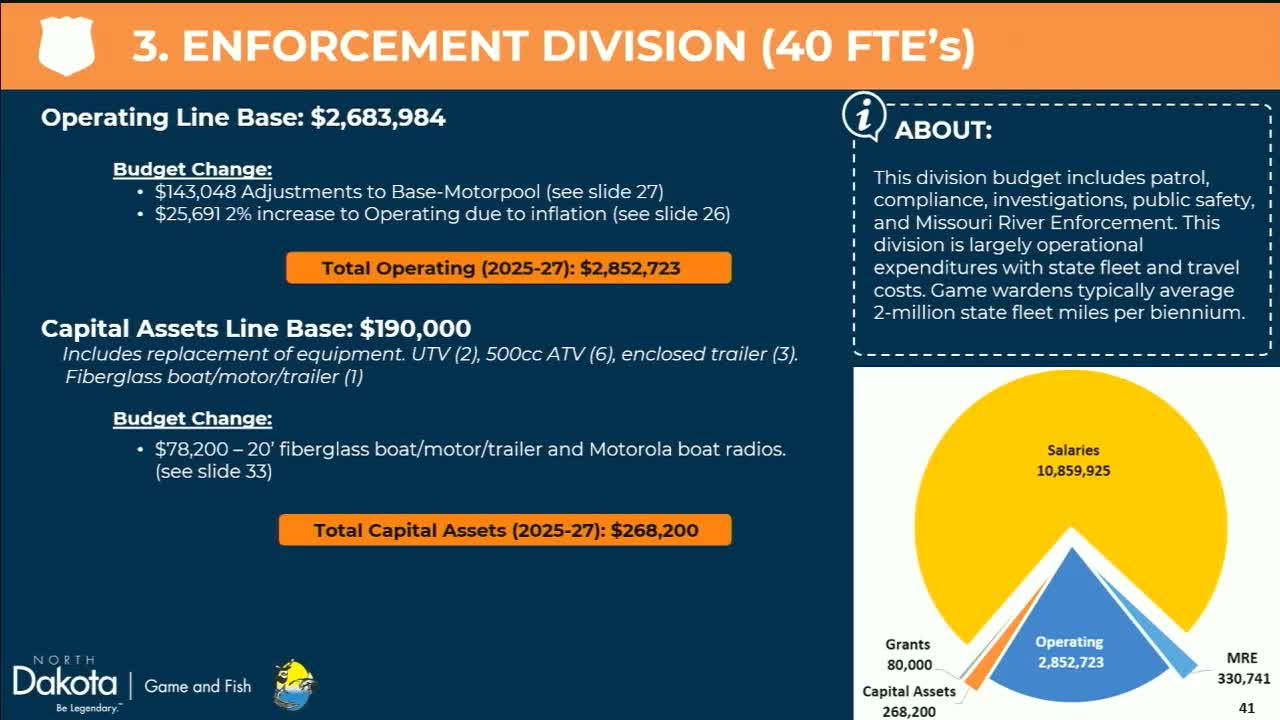
Administrative Services Division Chief Brian Hossick said enforcement covers public-safety patrols, compliance and investigations and that the division’s vehicles log nearly 2 million miles per biennium. He noted motor-pool cost increases and optional requests for enforcement radios, a replacement fiberglass boat and other equipment; some enforcement items qualify for 50% Coast Guard reimbursement.
Committee members asked about warden retirement and turnover. Hossick said the department normally averages about 10 vacancies per biennium but had recently seen elevated vacancies (about 15 in the current period), including internal promotions that create a cascade of openings.
Representative Kempenek and others pressed the department on growing coyote populations and whether a bounty would be an effective tool. Jeb Williams, director, and Hossick responded that bounties have been shown not to work for population control because coyotes increase reproduction when suppressed and that market demand for pelts is low. Williams added that state law already allows broad removal methods for landowners, the department contributes to USDA Wildlife Services in targeted damage cases and the department operates a coyote-catalog program that matches landowners with hunters seeking coyote opportunities.
The department said population control for coyotes is biologically difficult and that many management tools — including aerial operations, targeted removal in depredation cases and landowner-initiated removal — are used in specific circumstances. Lawmakers requested additional information from the department on turnover and program efficacy.