Get email alerts on the Statewide Data Strategy topic
No spam. Unsubscribe anytime.
NDIT outlines statewide data strategy, Lighthouse program and State Data Hub; SLDS modernization flagged as multi-year effort
Summary
NDIT's chief data officer described a multi-year Lighthouse data strategy, created a statewide data governance council, rolled out an analytics proof-of-concept State Data Hub, and requested carryover of prior funds; the state longitudinal data system (SLDS) team said a student information system change will have significant, multi-year impacts.
Kim Weiss, NDIT chief data officer, briefed the committee on the Lighthouse statewide data strategy and implementation roadmap designed to improve data quality, reduce duplication across agencies and enable data-driven policy decisions.
Why it matters: NDIT argued that coordinated data governance, a modern data platform and increased data literacy will allow agencies and legislators to evaluate programs and measure outcomes faster and more reliably. The effort aims to move state government from "reactive to proactive" through better data collection, cataloging and standardization.
Weiss said Phase 1 (completed April 2024) produced a statewide data strategy and implementation roadmap of 26+ projects. The initial vendor-supported program budget (approximately $4.89 million) originated in prior legislative action and transfers; Weiss said some funds remain unspent and NDIT requests carryover authority to complete Phase 2 activities across years 2 and 3 of the roadmap.
Key deliverables described by Weiss included a statewide data governance council (with 21 agencies represented), data- and AI-learning paths for state employees, and a minimum viable product (MVP) of a State Data Hub public dashboard (anticipated for public release at the end of February) with county- and district-level demographic, housing and workforce data to support policy and program analysis.
Weiss emphasized that quality, AI-ready data is a prerequisite for responsible AI adoption. She said NDIT collaborated with the cabinet and elected agencies in early 2024 to establish statewide AI "guardrails" and that NDIT is piloting internal productivity tools ("M3 copilot") and a chatbot to allow natural-language access to nd.gov data.
Tracy Korsmo (State Longitudinal Data System program) joined and described SLDS history: statute creation in 2007, federal grants over time, and the development of K-12 and postsecondary dashboards and workforce linkages. She said North Dakota has broad participation in SLDS and teacher-level dashboards; the system has been used for research (for example, teacher-retention analysis) and is now planning a modernization grant to move infrastructure to current cloud/VM approaches.
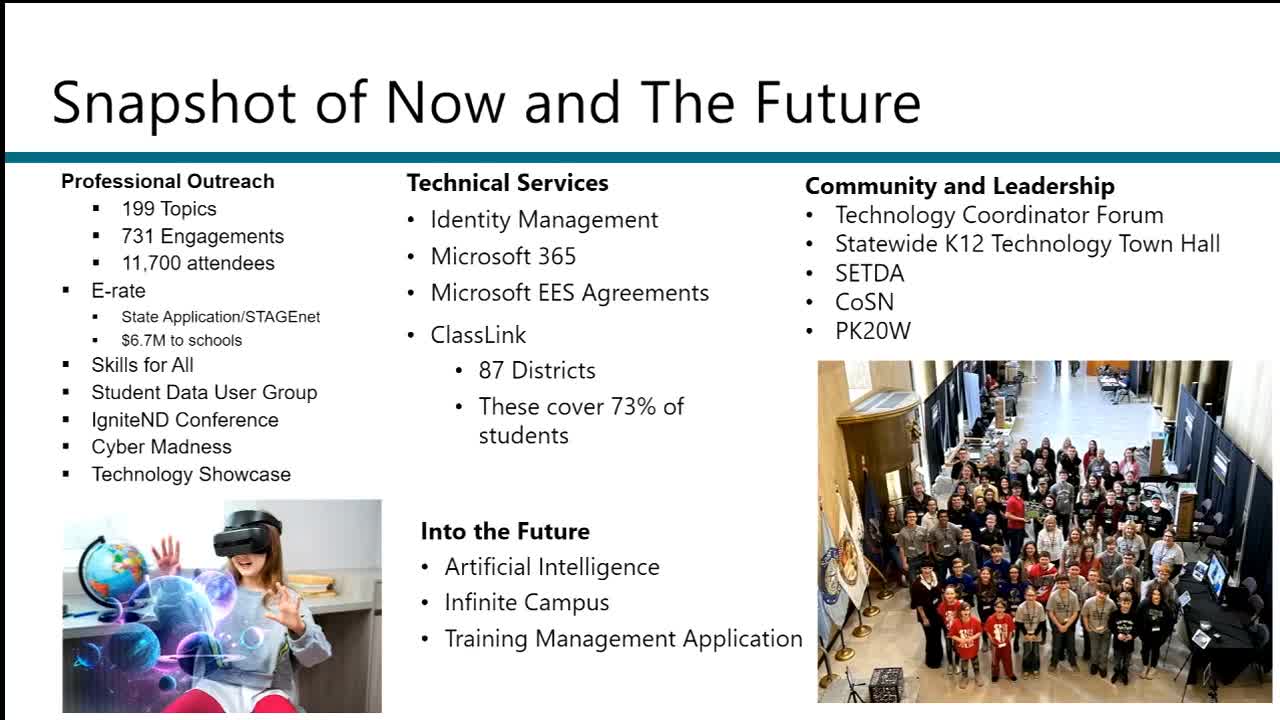
Korsmo warned the committee that an upcoming statewide change from PowerSchool to Infinite Campus (K'12 student information system migration) may constitute a large project with multi-year impacts on SLDS data structures and will likely require three to five years of work to accommodate the change.
Ending: Committee members asked about requiring agencies to perform program evaluation once data is made available; Weiss said NDIT does not mandate program evaluation but is building data literacy and governance tools to enable agencies to perform evaluations. Weiss and Korsmo said additional multi-year investments will be needed to continue SLDS modernization and to translate the Lighthouse roadmap into operational analytics for agencies and policymakers.
AI generated
The text on this page is AI generated. Summaries, highlights, analysis, and video transcripts are all produced from the original source material.
AI can make mistakes, so if you spot one, and we will fix it for everyone.
Note: the source content is unaltered by us. Any content source we link to, be it a video, an audio recording, or a document, is presented exactly as its publisher released it. That publisher is usually a government body, sometimes an individual official or another organisation.