Get Full Government Meeting Transcripts, Videos, & Alerts Forever!
Get email alerts on the Ndit Budget topic
No spam. Unsubscribe anytime.
NDIT briefed senators on IT budget, chargeback model and requests tied to cybersecurity and data programs
Summary
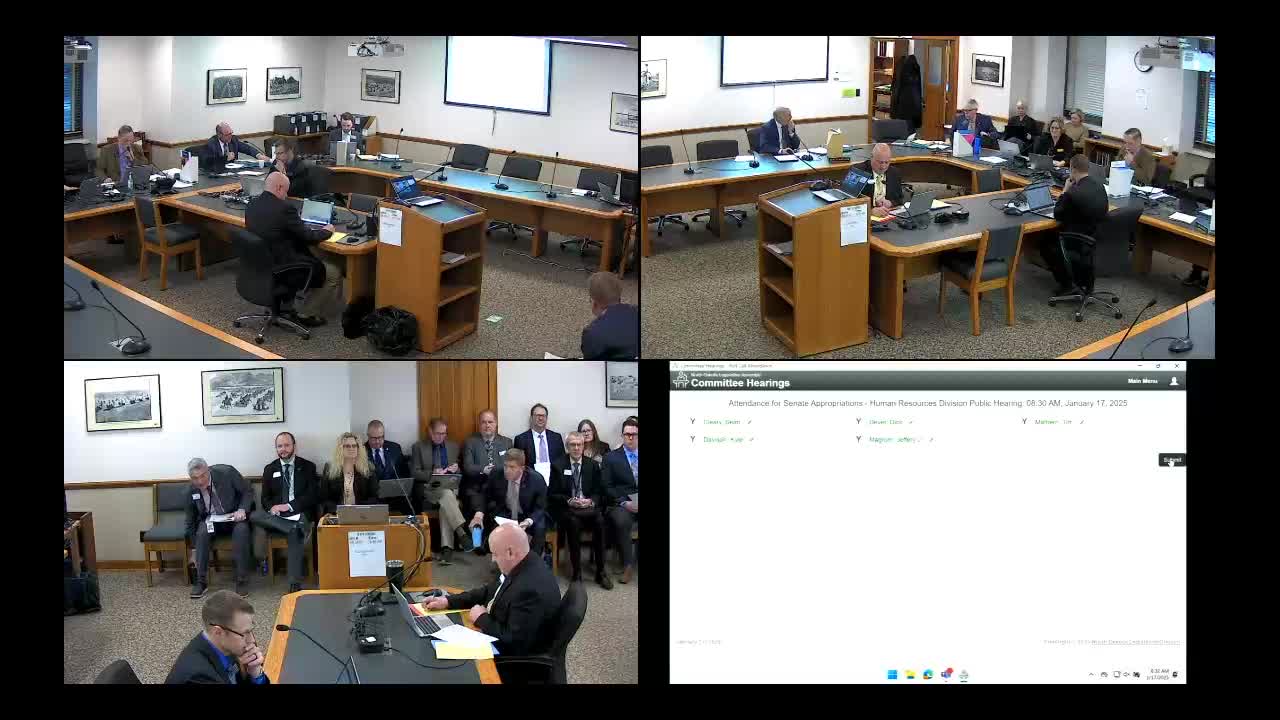
The Senate Appropriations Human Resources Division opened a public hearing on Senate Bill 2021 and heard a multi-part budget briefing from North Dakota Information Technology (NDIT) on staffing, major program needs and how the agency's internal-service chargeback model converts operating expenses into invoices for state agencies.
The Senate Appropriations Human Resources Division opened a public hearing on Senate Bill 2021 and heard a multi-part budget briefing from North Dakota Information Technology (NDIT) on staffing, major program needs and how the agency's internal-service chargeback model converts operating expenses into invoices for state agencies.
Levi (staff member) presented a Legislative Council vacancy report compiled from agency responses as of Dec. 1, 2024 that lists vacant full-time equivalent (FTE) positions across state government. Committee members were given the report for informational use as the panel begins appropriations work.
Why it matters: NDIT provides back-of-house technology services to most state agencies. How the Legislature funds those services and whether NDIT continues to collect part of its funding through agency chargebacks will affect operating budgets across state government and the timing of procurement and project starts.
Greg Hoffman, deputy CIO for NDIT, told the committee that NDIT operates largely as an internal service fund: the agency receives authority to spend and then converts vendor costs, staffing and infrastructure into service fees that are billed to client agencies. "We set rates well before the biennium those services will be consumed," Hoffman said in the presentation, explaining the timeline: rate development begins in even-numbered years and is applied to services delivered in the subsequent biennium. He noted the practical challenge: rates set in 2024 reflect estimates for services delivered in 2025'27.
Hoffman outlined the agency's hybrid funding approach. Some core functions (for example the statewide cybersecurity program) have been funded directly by general fund appropriations; other services are charged back to individual agencies. He described how NDIT translates appropriations for a service into a per-unit billing metric (for instance a per-FTE hosting or support fee) that appears on agency invoices.
The presentation listed the administration's proposed items affecting NDIT's budget. Among them were continued funding requests for cybersecurity tools and vulnerability remediation, data- and health-information initiatives (including work tied to the North Dakota Health Information Network), and replacement of legacy training-management software used by K'12 support teams. NDIT staff indicated some items in the current biennium were one-time funds and therefore removed from the base when calculating the next biennium's request.
Committee members asked how NDIT's chargeback model produces adjustments to individual agency line items. Hoffman and committee members discussed that an agency's executive budget may include separate appropriation authority to pay NDIT's service fees; the two appropriations (NDIT's spending authority and agencies' appropriation to pay NDIT) both appear in budget documents even though they relate to the same underlying services. Hoffman said the agency and OMB meet with client agencies during rate-setting to estimate utilization and mitigate surprises.
NDIT officials also previewed decision packages that appear in the governor's budget: requests tied to cybersecurity, data platform and analytics work, continued support for the health information program and infrastructure modernization. Hoffman noted the Armstrong administration's budget included a mix of continuing appropriation authority and one-time special-fund transfers; staff promised a detailed breakout on software, licensing and inflationary drivers in follow-up materials.
The committee recessed the hearing after the briefing and scheduled continued consideration of NDIT budget and program details at a later date.
Ending: Senators asked NDIT staff to return with more granular cost breakdowns, and NDIT said it would provide a clearer breakout of vendor/tool inflation and which costs are one-time vs. ongoing ahead of upcoming appropriation decisions.