Get Full Government Meeting Transcripts, Videos, & Alerts Forever!
Get email alerts on the Reservoir Permits topic
No spam. Unsubscribe anytime.
Committee hears mixed reaction on bill to let reservoir permits shift to passive uses to protect storage rights
Summary
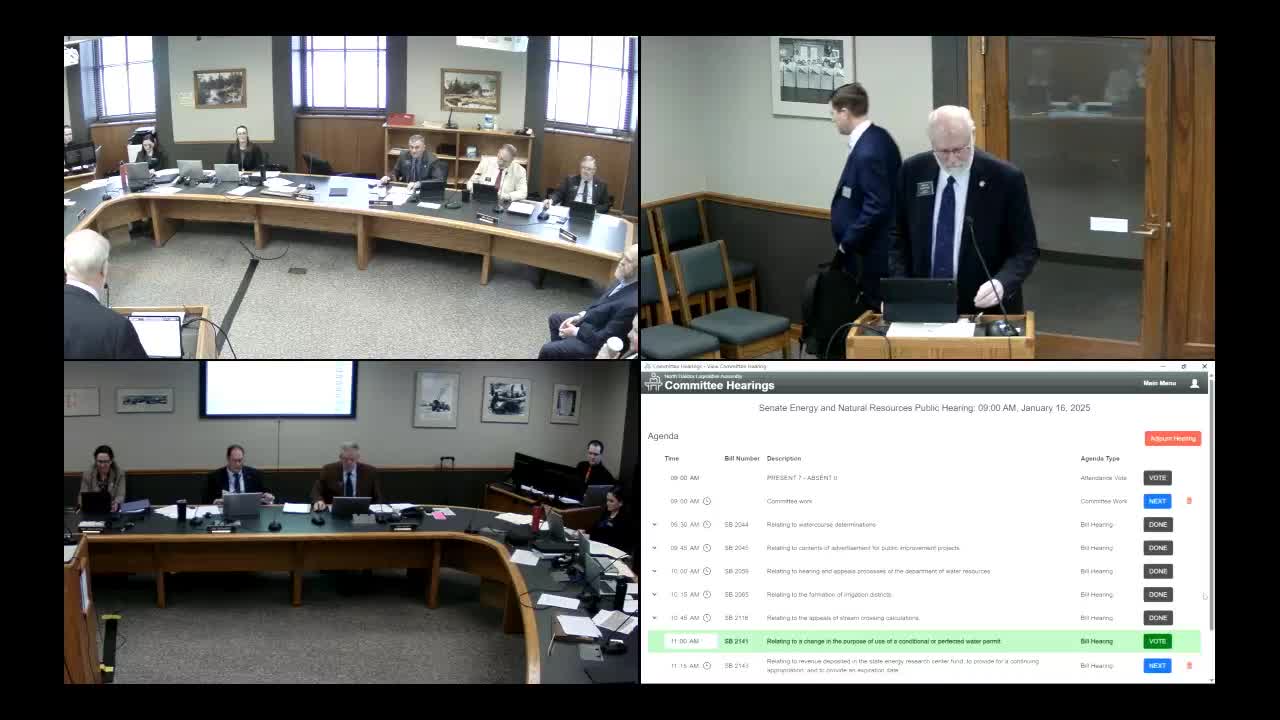
The Senate Energy and Natural Resources Committee heard testimony on Senate Bill 2141, which would allow certain reservoir permits to change to passive uses (such as fish and wildlife or livestock) to preserve reservoir permits when superior uses are abandoned or never developed.
Senate Bill 2141 would allow water permits tied to reservoirs to change purpose of use in order to preserve the reservoir’s permit and priority when the originally authorized, superior use (for example, irrigation or industrial withdrawals) is abandoned or not developed.
Andrew Nygren, water appropriation division director at the Department of Water Resources, told the committee the bill addresses a narrow set of permits: reservoirs that have authorized storage and withdrawals but where the higher‑priority use is no longer occurring or the works were never constructed. He said the proposal would allow the permit to change to a passive purpose—such as fish, wildlife and recreation—so the structure remains permitted rather than risk cancellation. "This bill addresses the problem by allowing the permit to change from irrigation to industrial, for example, to fish and wildlife use. This allows the structure to remain while accommodating the cancellation of those thralls associated with the abandoned or never developed use," Nygren said.
Committee members asked clarifying questions about what constitutes passive use and whether passive uses include livestock watering that draws directly from a reservoir versus stock drinking from the reservoir rim. Nygren clarified that "passive uses" refer to storage and evaporative losses with no active withdrawals, and that withdrawals for livestock watering would be treated as active diversions and could require a separate appropriation if they exceed the permited volume.
Public testimony included opposition from local residents and stakeholders concerned about large concentrated animal feeding operations seeking to access water under the proposed change. Eric Olson, an Abercrombie resident, said proposed mega‑dairies could request large livestock permits and "use water that is already allocated to domestic and municipal use," warning of potential environmental and community impacts. Sam Wagner of the Dakota Resource Council expressed conditional support if the bill’s livestock language were clarified and urged clearer safeguards to protect cities and businesses' growth.
The committee held the record open for written testimony and did not record a committee recommendation during the hearing. Department staff and public commenters asked for clarifications to the livestock language; no committee vote was taken at the hearing close.