Get Full Government Meeting Transcripts, Videos, & Alerts Forever!
Get email alerts on the Irrigation Districts topic
No spam. Unsubscribe anytime.
Panel backs bill shifting probable‑cost estimate responsibility to petitioners for irrigation districts
Summary
Senate Bill 2065 would require petitioning entities forming irrigation districts to prepare the probable‑cost estimate currently prepared by the Department of Water Resources; committee recommended a due‑pass, arguing the petitioner’s consultants are better placed to prepare initial cost estimates.
Senate Bill 2065, introduced by the Department of Water Resources, would change the process for forming irrigation districts by assigning the responsibility for preparing a probable‑cost estimate to the petitioning entity rather than the Department of Water Resources.
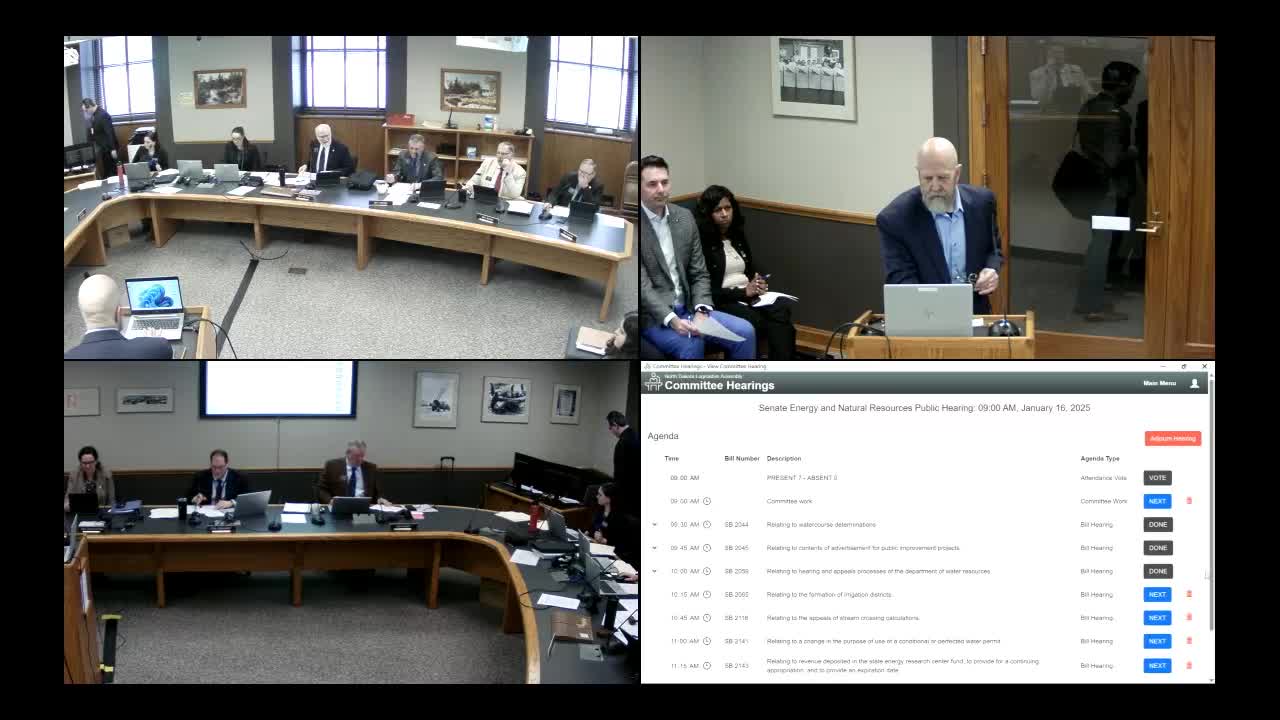
Patrick Frygen, planning and education division director at the department, told the committee petitioning entities already prepare extensive feasibility reports—maps, soils analysis, conveyance details—and that requiring the department to prepare a separate probable‑cost summary is redundant. "Since the petitioning entity had gone through the process of creating this report and their consultant is looking at all the methods of construction and all the detailed conveyance works, they are much better suited and prepared to develop a probable cost than the agency is," Frygen said.
Committee members questioned whether shifting the requirement would increase costs for petitioners or slow the process if petitioners failed to include the estimate; Frygen said petitioners typically have consultants and that the change should shorten the timeline by reducing duplication. He described the department’s role under the proposed language as making a determination using the petitioner’s feasibility report rather than preparing an independent summary.
After hearing no opposition, the committee voted to recommend a due‑pass on SB 2065 by unanimous vote. Senator Kessel moved the motion and Senator Engalls seconded; the committee reported a 7‑0 recommendation. Senator Egan volunteered to carry the bill to the floor.