Get Full Government Meeting Transcripts, Videos, & Alerts Forever!
Get email alerts on the Public Safety Alerts topic
No spam. Unsubscribe anytime.
Committee considers changes to North Dakota Silver Alert rules to allow family reports, tighten criteria
Summary
The Senate State and Local Government Committee heard testimony on Senate Bill 2098 to revise North Dakota's Amber/Blue/Silver alert statutes, allowing family-initiated silver alerts with sufficient evidence, tightening danger language to match AMBER criteria and consolidating alert law. No committee vote was taken.
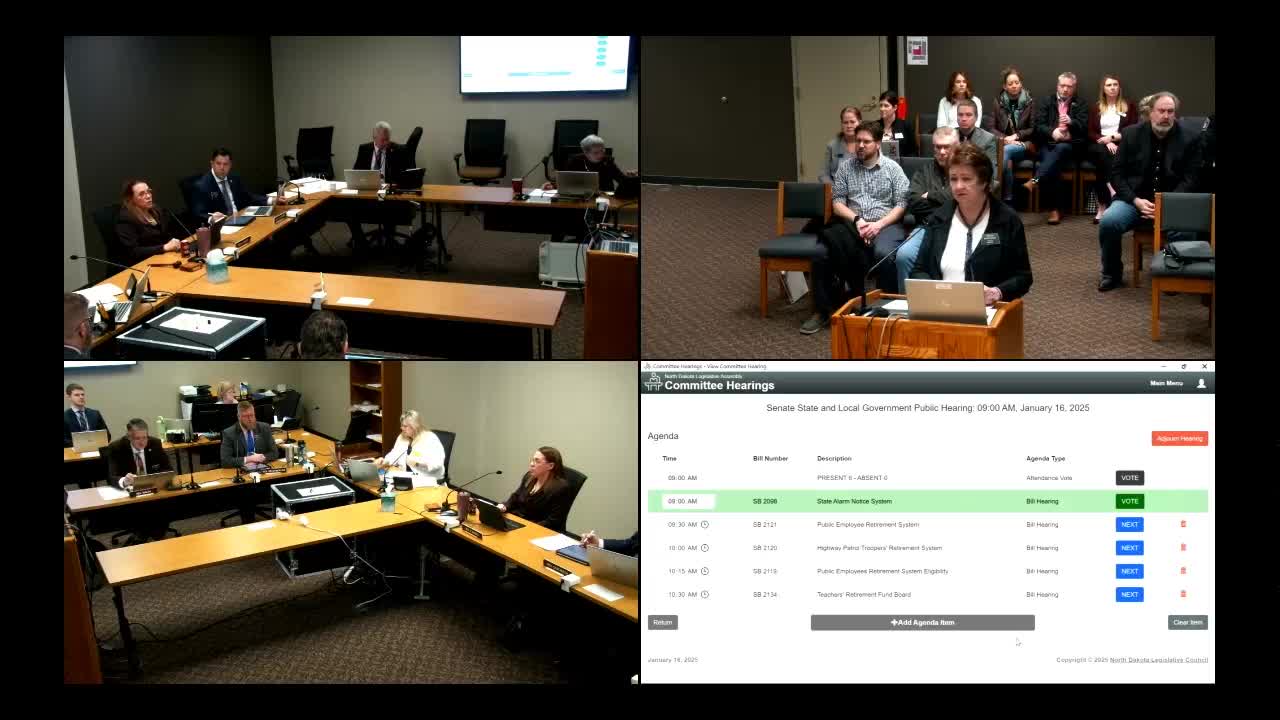
The Senate State and Local Government Committee opened a hearing on Senate Bill 2098 to revise North Dakota's alert statutes, including changes to Silver Alert procedures that would allow issuance based on a report from a missing adult's family member when the family provides sufficient evidence of a threat to health or safety. Senator Diane Larson, sponsor, told the committee the bill largely reorganizes existing language and adds the new provision allowing family-initiated Silver Alert requests when the report contains sufficient evidence.
The bill would add the term "endangered" across Silver Alert definitions and align the danger standard with AMBER Alert language, substituting wording that the missing person "may be in grave danger of serious bodily harm or death." Sergeant Jenna Claussen Huberts, North Dakota Highway Patrol alerts coordinator, said the change "expands that discretion for law enforcement when finding missing endangered individuals, but it also maintains that high standard of that strict criteria." She described the alert workflow: local law enforcement submits a request form to state radio, the Watch Center and state radio run verification checks, and the alerts group convenes a Teams call to decide whether to issue. The highway patrol aims to issue alerts within 30 minutes when the request form is complete but said clarifying questions can extend that to about an hour.
Family and advocacy testimony illustrated the stakes. Lisa Lycan Monroe described searching for her father, Lloyd Lycan, after he went missing in November 2023 and said law enforcement told her he did not qualify for a Silver Alert because he lacked a formal dementia diagnosis. "It was a devastating blow to our family that dad did not qualify because he did not have a medical diagnosis of dementia or Alzheimer's," Monroe told the committee, and she urged the panel to broaden eligibility criteria so seniors in similar situations do not "fall through the cracks." Badlands Search and Rescue's Travis Bateman urged removing a physician-diagnosis requirement and suggested tighter time-to-issue targets, recommending a 2-hour maximum from request to approval/denial in some testimony materials.
Agencies that operate the alert system recommended consolidating alert law and preserving strict criteria to avoid alert fatigue. Sergeant Claussen Huberts said North Dakota issues relatively few public alerts (she cited about nine Silver/Blue/Amber alerts in a recent year and roughly 21'22 requests) and emphasized that too many public blasts reduce effectiveness because recipients opt out. Steven Harstead, chief agent with the Bureau of Criminal Investigation, described the process as a "team approach" involving local law enforcement, the Watch Center, state radio, BCI and the highway patrol.
Department of Health and Human Services officials flagged drafting issues. Tina Bay, director of the Developmental Disability Section, told the committee that the bill's cross-references to Century Code could create a gap: the cited section (25-01.2-01) covers both children and adults but the bill language at one point uses "minor" and elsewhere refers to "disabled adult," which could leave adults with developmental disabilities unprotected. Nancy Nicholas Meyer, director of Adult and Aging Services, urged adding language so credible reports could be made by people other than family members: "It could be family members or other individuals who have had substantial contact with the individual," she said.
Committee members asked several clarifying questions about the 65-year age threshold for elderly alerts and how the law would treat younger adults with severe cognitive or physical impairments. Sergeant Claussen Huberts said the statutory 65-year threshold stands because the statute separately covers disabled adults and that Silver Alerts already apply to younger adults with qualifying impairments when the criteria are met. The committee also discussed privacy steps taken when an alerted person is later located; Claussen Huberts said officers contact the located person and discuss whether they want further media statements or to be left alone.
No formal committee action was taken on SB 2098 at the hearing. Committee members asked agencies and interested parties to work on drafting and clarifying language, including who may file a report and how references to Century Code definitions should be written.
The hearing closed with the committee inviting recommended drafting changes and additional information from highway patrol, BCI, DES (the Watch Center) and DHHS.