Get Full Government Meeting Transcripts, Videos, & Alerts Forever!
Get email alerts on the Election Timing topic
No spam. Unsubscribe anytime.
Committee advances bill extending bonding-election notice from 20 to 64 days
Summary
The Political Subdivision Committee voted 11-0 (2 absent) to give House Bill 1138 a due-pass recommendation to extend the minimum notice for bonding elections from 20 days to 64 days, aligning bonding-election timelines with other statutes and giving local officials more time to prepare.
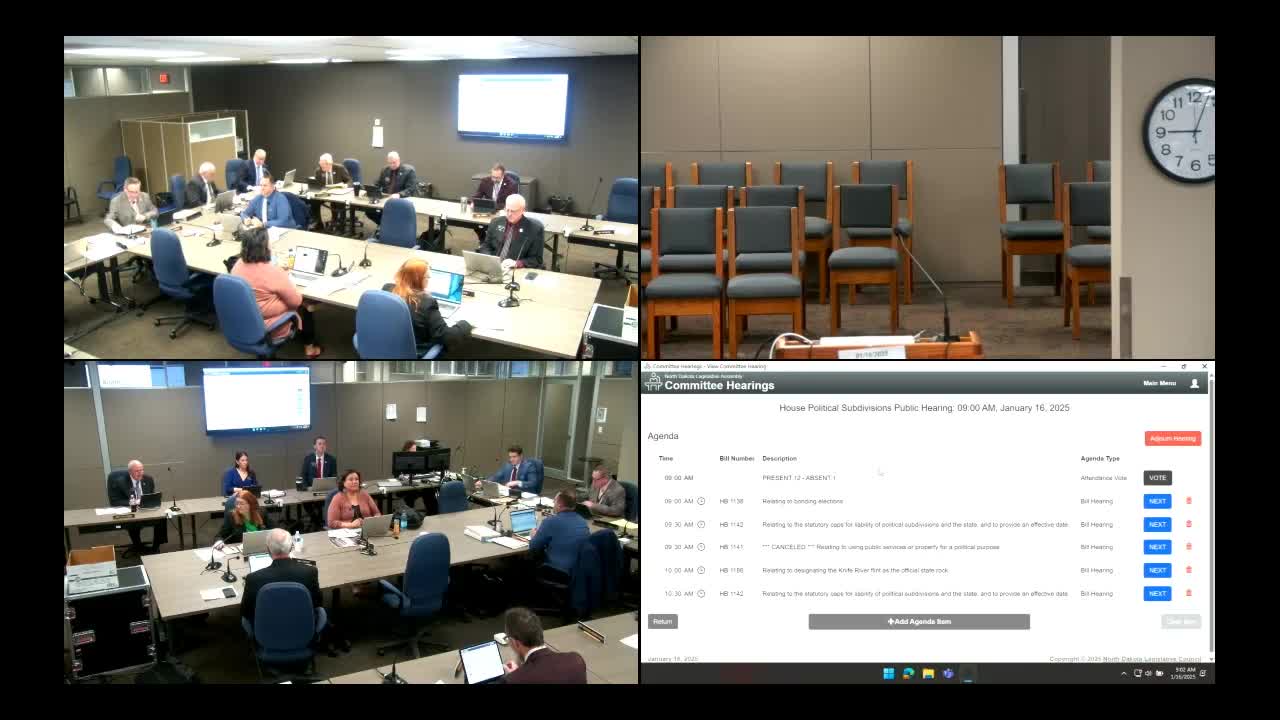
House Bill 1138, which would lengthen the minimum public-notice period for bonding elections from 20 days to 64 days, was given a due-pass recommendation by the Political Subdivision Committee after brief discussion and an 11-0 voice vote with two members absent.
The change “brings the 20 days out to a 64 day,” state Representative Brandy Pyle of District 22 said in introducing the bill, adding that the amendment is intended to make the schedule “standard across the board.”
The bill would amend section 21-03-11 of the North Dakota Century Code to require 64 days’ notice for bonding elections—the same timeline already used elsewhere in state election law. “20 days, I feel, isn't an adequate enough time for an election official to prepare for an election,” North Dakota Secretary of State Michael Howe told the committee, saying the longer period would help school business managers, city administrators and other local officials prepare ballots, secure polling places and recruit poll workers.
Committee members asked clarifying questions about why bonding elections had a 20-day rule. Howe said he did not know why the 20-day window remained an outlier in code but said the 64-day period would improve public awareness and administrative preparation. Committee members also confirmed the bill does not force bonding elections to coincide with primary or general elections; it simply sets a longer minimum timeline once a governing body votes to place a bond question on the ballot.
Representative Moshenbacher moved a due-pass recommendation; Representative Hager seconded. The clerk closed the roll: the committee recorded 11 yea, 0 nay, 2 absent; the motion carried and House Bill 1138 advances out of committee. The transcript indicates no testimony in opposition and no amendments were offered during the hearing.
The bill now moves to the next step in the legislative process with the committee’s recommendation. No effective date or implementation details beyond the statutory change were specified in the committee hearing.