Get Full Government Meeting Transcripts, Videos, & Alerts Forever!
Get email alerts on the Watercourse Determinations topic
No spam. Unsubscribe anytime.
Committee advances bill shifting water‑course determinations to local districts
Summary
The Senate Energy and Natural Resources Committee recommended a do‑pass on Senate Bill 2044, which moves initial water‑course determinations from the Department of Water Resources to local water resource districts and establishes the department as an appeal forum. Testimony said the change should speed decisions; committee vote was unanimous.
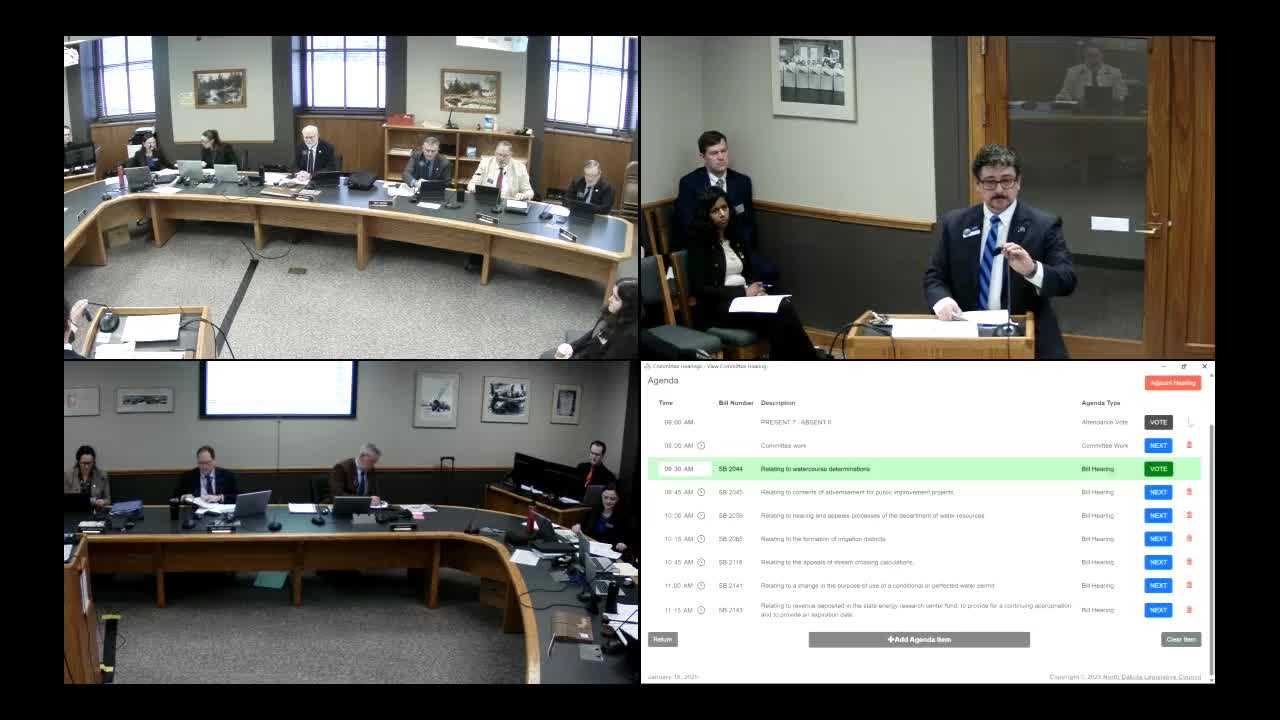
Senate Energy and Natural Resources Committee Chairman Patton on Tuesday opened a hearing and later recommended a do‑pass on Senate Bill 2044, a measure that would make local water resource districts the primary decisionmaker on whether a feature constitutes a watercourse and give the Department of Water Resources an administrative appeal role.
Supporters told the committee the change is intended to speed resolution of water‑course questions and preserve an appeal path to the department. Aaron Carranza, director of the regulatory division at the Department of Water Resources, said the department currently receives few requests but that permitting workload can delay determinations and that the bill would transition the department to an appellate role. "This bill proposes transition department from the primary request and determination role into an appeal remedy for any aggrieved party by a state or state political subdivision watercourse determination," Carranza said.
Jack Dwyer, executive secretary for the North Dakota Water Resource Districts Association, testified the association supports the bill. He told the committee water resource districts are "competent to make these determinations, and they can make these determinations more quickly, than involving the Department of Water Resources," and described the proposed administrative appeal as a fallback for conflicts arising from local determinations.
Senators asked about caseload size and appeals. Carranza said the department typically handles about "1 to 2" water‑course cases per year over the last decade and expects appeals to be "few and far between," while Dwyer explained the practical legal differences between a water course and a waterway and why the distinction matters for available remedies.
After proponent testimony and no opposition, Senator Kessel moved a do‑pass recommendation. The motion was seconded and the committee voted unanimously in favor. The clerk recorded a unanimous committee recommendation to pass SB 2044.
The bill would also reference recently adopted administrative rules (North Dakota Administrative Code Chapter 891501) that outline the department's determination process, according to Carranza. Proponents said the local‑first approach and a clear appellate route should reduce delays when permitting workloads are high.
The committee designated a carrier to shepherd the measure to the floor.
The committee record shows the motion to recommend a do‑pass was made by Senator Kessel and seconded; the committee reported the motion carried unanimously.