Get Full Government Meeting Transcripts, Videos, & Alerts Forever!
Get email alerts on the Long Term Care topic
No spam. Unsubscribe anytime.
Adult family homes and nursing providers cite rapid demand growth, bed‑hold gaps and workforce pressure
Summary
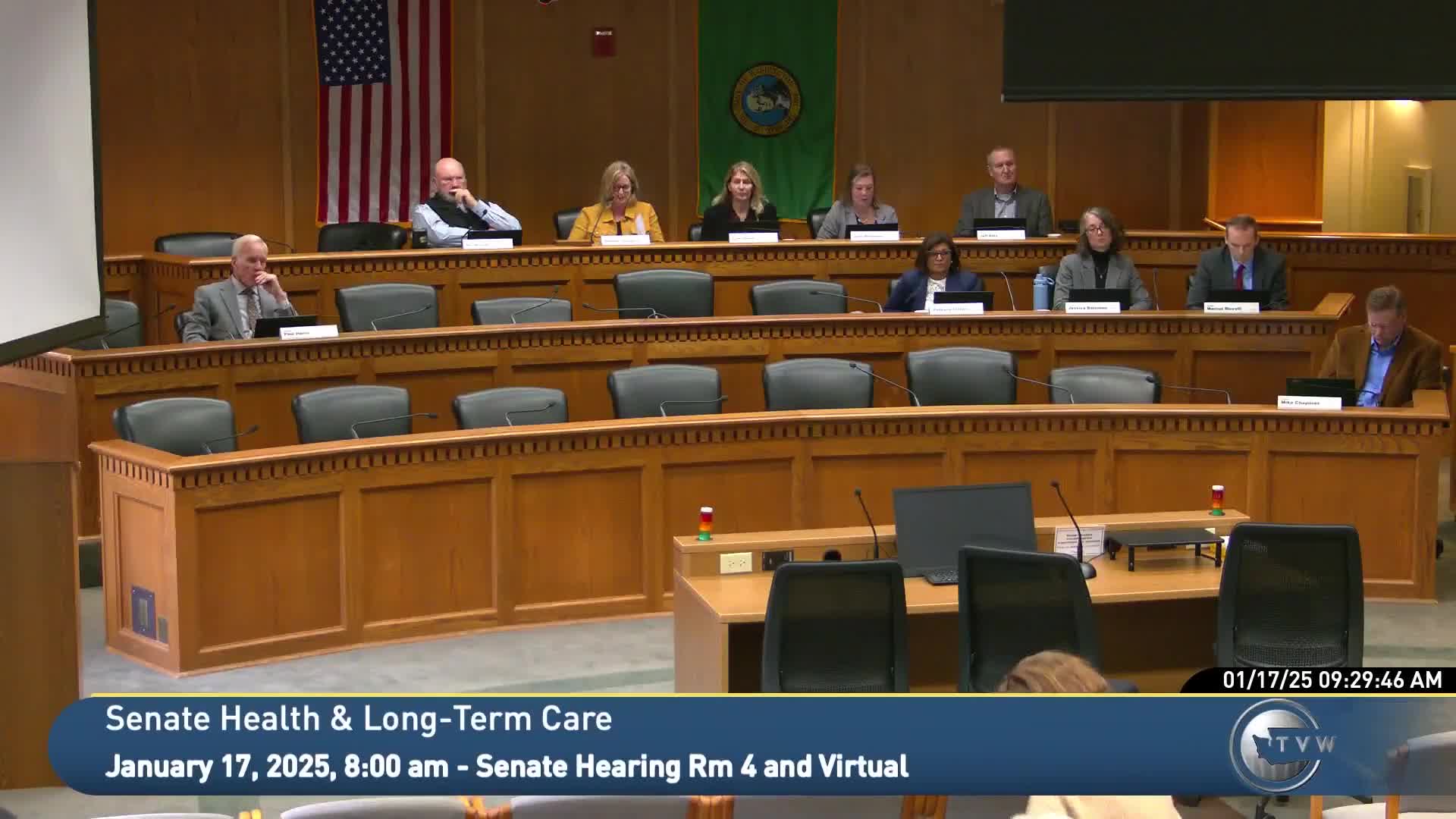
Adult family homes, assisted living and skilled nursing providers told the Senate Health & Long Term Care Committee that demand for home‑and‑community‑based long‑term services is rising and that payment, workforce and liability pressures are creating placement and discharge bottlenecks.
Adult family homes, assisted living and skilled nursing operators told the Senate Health & Long Term Care Committee that demand for home‑and‑community‑based long‑term services is rising, that Medicaid covers the majority of residents in those settings, and that payment, workforce and insurance costs are creating bottlenecks that push patients to remain in hospitals longer.
John Ficker, executive director of the Adult Family Home Council, said adult family homes have grown substantially and now number more than 5,000 facilities across Washington with nearly 30,000 beds. He said roughly 91% of adult family homes are contracted to provide Medicaid services and that about two‑thirds of contracted beds are occupied by Medicaid or state‑funded residents. "If just 5% of our population was moved from the adult family home to a skilled nursing facility, an annual increase in expenditure by the state would be a minimum of $20 million," Ficker said.
Ficker described adult family homes as small, often family‑run residential settings that can care for higher‑acuity residents, including people with dementia, brain injury or developmental disability. He urged changes to several program details: faster Department of Health credentialing timelines, mitigation funds for unpaid client participation (to mirror landlord protections), and an increase in the so‑called bed‑hold payment. Under current practice he described, the first seven days of a bed hold pay roughly 70% of a resident—s base daily rate, but for days eight through 20 the payment is $15 per day. Ficker said a proposed increase to $75 for days 8–20 would be modest relative to the costs of keeping patients in hospitals.
Pete Wilkin, director of operations for Nightingale Healthcare, described operational constraints in skilled nursing and assisted living. He said his company operates multiple skilled nursing and assisted living facilities across several counties and that facilities serve both short‑term post‑acute patients and long‑term residents, the latter of whom rely heavily on Medicaid. "Reimbursement is the other R word," Wilkin said, explaining that narrow margins, mixed payer sources and administrative denials create incentives that can keep people in higher‑cost settings.
Wilkin gave examples of regulatory and liability constraints that can limit placement options and complicate admissions. He said regulatory requirements intended to ensure resident safety sometimes create practical barriers to admitting patients — for example, accommodations and staffing to permit a resident who smokes to do so safely — and that escalating liability insurance costs and litigation risk increase operating expense and narrow options.
Both speakers described workforce pressure across home‑and‑community settings and post‑acute providers: tight labor markets, credentialing delays and limited access to training or testing were cited as recruitment and retention barriers. Ficker also noted a collective bargaining agreement for adult family home workers that raised compensation in 2024 and asked the Legislature to support funding that reflects recent contract settlements.
Lawmakers asked about how adult family homes, assisted living, skilled nursing and hospitals can better coordinate to ease discharge bottlenecks. Witnesses recommended modest targeted investments in bed‑hold payments, operational supports for workforce entry, and stabilization of Medicaid contracts that underpin provider capacity. Ficker indicated a willingness to pilot expanded developmental‑disability placements if funding is available.