Get Full Government Meeting Transcripts, Videos, & Alerts Forever!
Get email alerts on the Payment Fees Tips Sales Tax topic
No spam. Unsubscribe anytime.
Senate committee hears testimony on bill to bar card companies from charging fees on taxes and tips
Summary
Senate Labor & Commerce opened a hearing on Senate Bill 5070 on Jan. 1, 2025, when committee staff described a proposal to bar some payment processors and card issuers from charging merchants fees on sales tax and tips and to prohibit employers from deducting such fees from employee tips.
Senate Labor & Commerce opened a hearing on Senate Bill 5070 on Jan. 1, 2025, when committee staff described a proposal to bar some payment processors and card issuers from charging merchants fees on sales tax and tips and to prohibit employers from deducting such fees from employee tips. Marlon Yanez, staff to the committee, summarized the bill and said, “This bill changes Washington law in 4 ways,” listing prohibitions on fees, a $1,000 per-transaction civil penalty, an anti-avoidance provision, and a ban on employers reducing workers’ tips by interchange amounts.
Supporters, including hospitality workers, independent retailers and many small business owners, told the committee the practice effectively taxes working people or penalizes businesses that collect sales tax. “This practice needs to stop,” said Eunice Howe, lead organizer with Unite Here Local Aid, the Hospitality Workers Labor Union of the Northwest, adding that proposed contract language to shift card fees onto workers would amount to pay cuts for tipped staff. Several tip-dependent workers described household impacts: Otis Williams, a cook at T-Mobile Park, said a few hundred dollars a season matters for his family of six, and William Mateo, a Salty’s employee at SeaTac, said extra fees on tips would add financial burden for his household.
Retail and small-business witnesses gave concrete cost figures. Katie Beeson of the Washington Food Industry Association cited industry estimates that merchants paid roughly $384,000,000 in interchange fees on sales tax in Washington in 2023 and about $6.6 billion in interchange fees overall. Small-business owners gave local examples: Samantha Bergman said her two-store operation paid about $26,668 in card fees in 2024 while remitting roughly $25,000 in sales tax, and that roughly $1,867 of her fees were assessed on sales tax and about $3,000 on tips.
Banking and payments-industry witnesses raised legal and technical objections. Steve Rauschenberger, who described himself as a former Illinois state senator and advocate for payment networks, said the national card networks and federally chartered banks would likely challenge state-level restrictions; he said a federal judge in Illinois issued an injunction that currently blocks parts of that state’s law as it applies to federally chartered banks. Glenn Simicak, president and CEO of the Washington Bankers Association, said the current system funds fraud protection and cardholder benefits and warned that Section 5 of the bill could curtail data-sharing that banks use to detect fraud. Joe Adamak, speaking for Washington’s credit unions, said his members do not oppose the portions of the bill that protect workers’ tips but are concerned about the operational and fraud-detection challenges and the portion that directly would prohibit interchange on taxes and tips.
Committee members asked staff about the Illinois litigation and about differential effects on federally chartered versus state-chartered banks. Marlon Yanez told the committee the Illinois litigation is ongoing and that a preliminary injunction applies differently to federally chartered and state-chartered institutions, and offered to follow up with more detail. Committee members also asked ESD and other staff about who would bear costs and whether federal preemption or banking law would prevent parts of the bill.
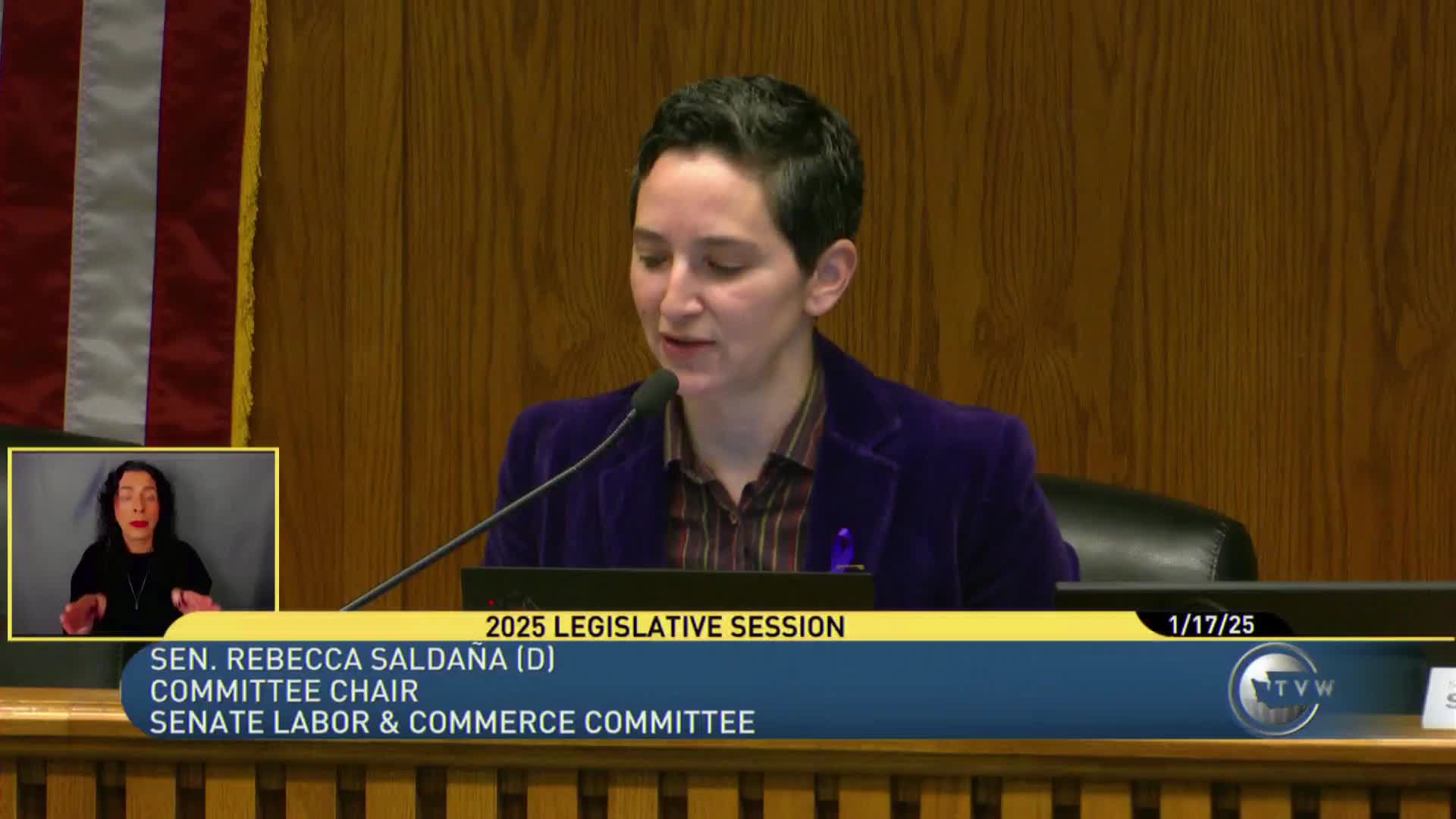
The chair closed the hearing after roughly three hours of testimony; no committee vote or final action on SB 5070 was recorded. Chair Rebecca Saldanha said she would continue discussions with stakeholders and cosponsors to find a path forward. The public record shown in committee remarks included both industry data and numerous individual statements: the chair reported about 320 pro sign-ins and about 60 con sign-ins for the hearing.
— Ending — The committee did not take final action. Sponsors and staff will follow up with members about legal questions raised during testimony, including federal preemption and operational feasibility, as they consider next steps.