Get Full Government Meeting Transcripts, Videos, & Alerts Forever!
Get email alerts on the Primary Care topic
No spam. Unsubscribe anytime.
Washington lawmakers hear plan to boost primary care spending, shift payment toward team-based care
Summary
State health officials, physician groups and community health centers told the Senate Health & Long Term Care Committee that Washington spends roughly 6% of health dollars on primary care, well below the legislature—s 12% goal, and urged multi-payer payment changes, higher Medicaid rates and support for team-based models to expand access.
The Senate Health & Long Term Care Committee on Friday heard that Washington currently spends about 6% of total health expenditures on primary care and that state leaders and health systems must change payment models to expand access.
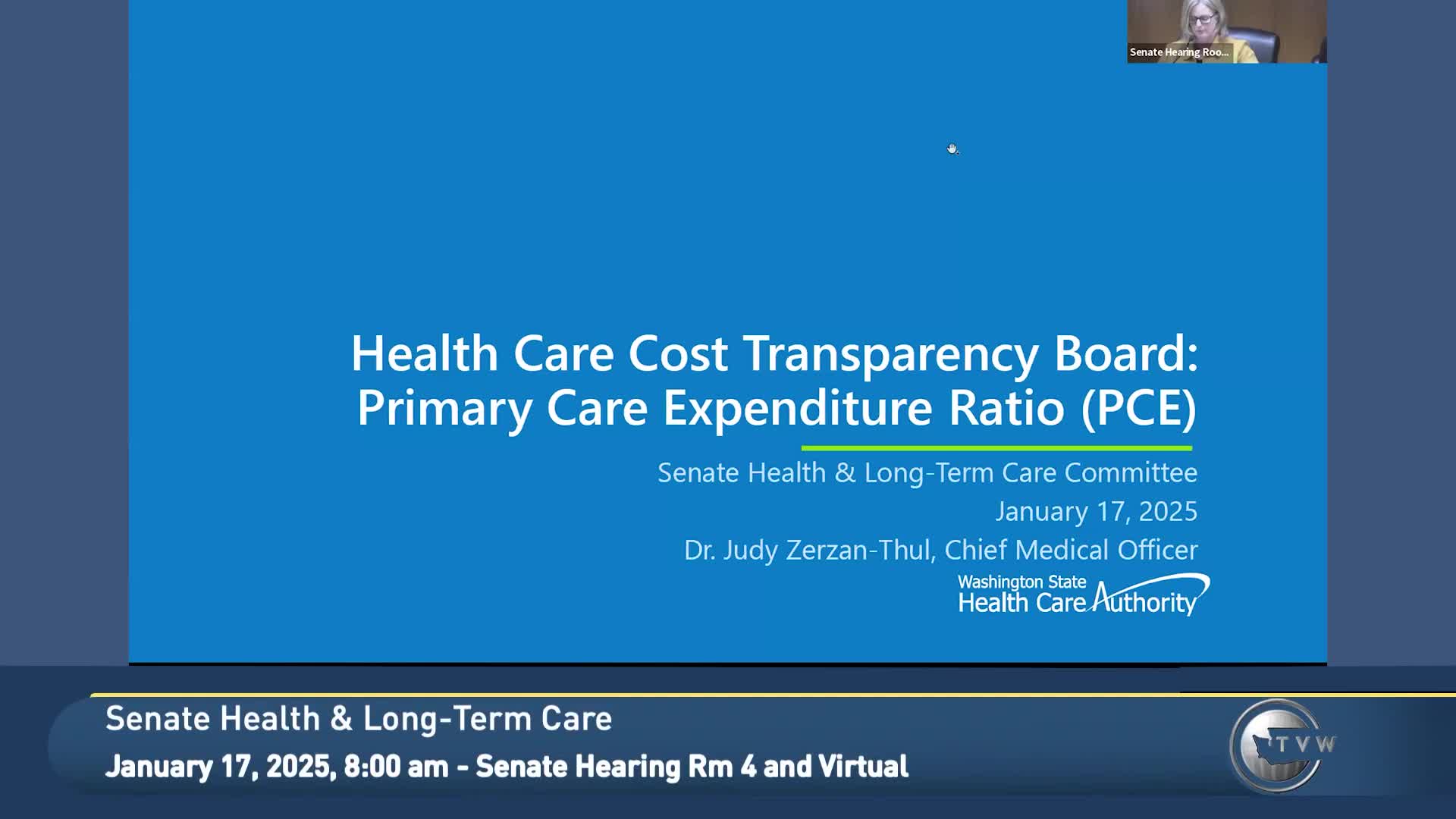
Dr. Judy Zirzen Thule, chief medical officer at the Health Care Authority, told the committee that primary care investment in Washington remains low and that current fee-for-service payment fragments care and discourages team-based models. "Primary care spending is just under 6% of total expenditures in Washington state," Zirzen Thule said, adding that the legislature set a 12% target in 2022 through Senate Bill 5589.
The gap between current spending and the 12% goal matters because primary care teams — clinicians, medical assistants, community health workers and care coordinators — need payment structures that cover non‑billable team activities, speakers said. "The best primary care isn—t just a doctor or a nurse interacting with you. It—s a whole team," Zirzen Thule said.
Sean Graham, director of government affairs at the Washington State Medical Association, told senators that physician practices face staffing shortages, administrative burdens and low Medicaid reimbursement that drive practices to limit Medicaid panels. He said a WSMA membership survey found more than 90% of respondents described prior authorization as "very burdensome," and about 63% of practices are limiting their Medicaid patient panels. "More than 80% say they would be able to maintain and increase Medicaid panels if rates were raised to Medicare levels," Graham said.
Physician and primary care groups urged three broad strategies: (1) increase the share of total health spending that goes to primary care; (2) move payment away from visit-level fee‑for‑service toward per‑member/per‑month or other value‑based models that cover team-based services; and (3) align payers across commercial plans, Medicaid managed care and public employers.
Dr. Katrina Ryu, an osteopathic family physician with the Washington Academy of Family Physicians, said simplification and aligned, value‑based payments would free clinicians from administrative work and support full‑scope family medicine. "We simplify by moving away from procedure widget based payments and toward payments based on value," Ryu said.
The committee also heard details on how primary care spending is measured and what can change. The primary care advisory committee to the state's health care cost transparency board recommended a revised, claims-based definition that excludes obstetrician–gynecologists and excludes urgent care and emergency department episodes from the primary care category. The committee recommended an annual increase target (roughly 1% per year, consistent with other states) and a policy to raise Medicaid primary care reimbursement to no less than 100% of Medicare by 2028.
Community health center leaders described how federally qualified health centers deliver comprehensive primary care and social supports to low‑income patients and Medicaid enrollees. Lisa O—Hallum, CEO of HealthPoint, said Washington—s 28 health centers operate more than 400 delivery sites and served nearly 700,000 Medicaid patients in 2023. Rhonda Hoff, CEO of Yakima Neighborhood Health Services, said health centers employ about 13,000 people statewide and house roughly half the state's residency slots, making them central to workforce training and care access.
Committee members asked about implementation details, including how to scale per‑member payment models, the role of workforce investments such as family medicine residency slots, and whether raising Medicaid rates would reduce reliance on emergency departments. Panelists noted prior action from the 2023 Legislature to modernize prior authorization and the continuing work of federal and state primary care transformation initiatives.
The presenters recommended incremental targets and multi‑payer collaboration while cautioning that the state—s budget constraints will shape what can be adopted this session. "A lot of payment decisions impact access to primary care," Zirzen Thule said. "It doesn—t have to be new money; it could be reinvestment of current dollars."