Get Full Government Meeting Transcripts, Videos, & Alerts Forever!
Get email alerts on the Ceta Fuel Mix topic
No spam. Unsubscribe anytime.
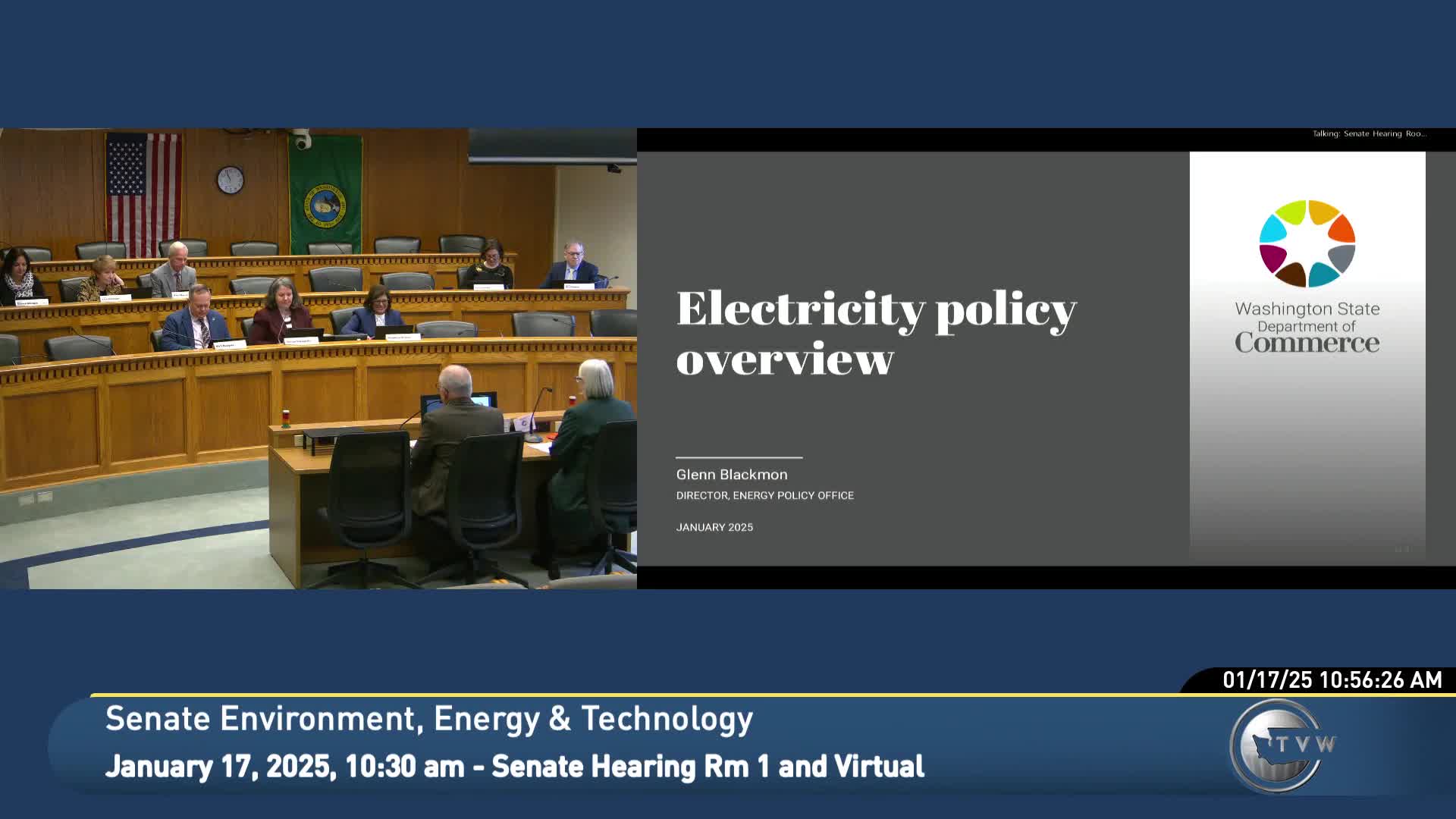
Commerce and UTC brief senators on fuel‑mix disclosures, CETA implementation and resource‑adequacy concerns
Summary
Department of Commerce and the Utilities and Transportation Commission updated the Senate Environment, Energy & Technology Committee on fuel‑mix disclosure rules, how the Clean Energy Transformation Act (CETA) applies across utilities, and ongoing resource adequacy and data‑center load‑growth questions.
At a committee work session, the Department of Commerce and the Washington Utilities and Transportation Commission (UTC) briefed senators on fuel‑mix disclosure practices and the status of implementing the Clean Energy Transformation Act (CETA), highlighting remaining technical and market challenges.
“Before 2019, there was unspecified electricity, but it didn’t show up in the disclosure,” Glenn Blackman, director of the Energy Policy Office at the Department of Commerce, told the committee. “We reached the conclusion that it would be better just to say it. If you don’t know it, then just say you don’t know it.” The “unspecified” category reflects wholesale trading and contract practices where the fuel source for a block of power is not tracked or the environmental attributes (RECs) are separated from the energy purchase.
Commerce described how fuel‑mix disclosure reports provide a consumption‑side view of where electricity serving Washington customers comes from (hydro, wind, natural gas, coal, unspecified, etc.). The agency stressed the difference between power generated in Washington and power used to serve Washington customers, noting hydro generation is often shared regionally through Bonneville and other transfers.
Blackman reviewed CETA’s timelines and compliance framework: a 2025 standard that effectively removes coal‑fired power from utility portfolios serving Washington customers; a 2030 greenhouse‑gas‑neutral standard that requires utilities to use renewable or nonemitting electricity equal to 100% of load but allows up to 20% to be met with alternative compliance methods (effectively an 80% direct clean requirement); and a 2045 deadline for 100% renewable or nonemitting electricity when the 20% alternative compliance option is removed.
Commissioner Anne Rendell of the UTC described the commission’s role overseeing investor‑owned utilities (Avista, Pacific Power/PacificCorp and Puget Sound Energy) and reported all three investor‑owned utilities will meet the 2025 coal‑phase requirement, although approaches differ: Avista and PacifiCorp relinquished ownership interest in a coal facility, while PacifiCorp will not include coal costs in Washington rates and is converting some coal resources to gas. Rendell described commission review of four‑year clean energy implementation plans, the ability to approve plans with conditions, and ongoing litigation over interim targets for a system operator (PacificCorp).
Both presenters emphasized resource adequacy and the law’s “off‑ramp” for reliability: a utility that determines compliance would threaten reliability may seek procedural relief and must present a plan to return to compliance. Commerce and the UTC convene an annual resource‑adequacy meeting and are discussing adding seasonal readiness meetings (spring for summer readiness and fall for winter readiness).
Senators raised questions about geographic variation in fuel mix (for example Douglas and Pend Oreille counties showing higher unspecified shares), how utilities’ business decisions affect transfers, and the potential impacts of large new loads such as data centers. Commerce noted regional forecasts that anticipate large load growth at hyperscale and colocation data centers nationally, but stressed utilities do not currently report data‑center loads separately and that large new loads submitted to the Bonneville Power Administration have been concentrated in specific regional utilities. Commerce said Bonneville’s queue and regional planning provide notice for large new loads and cited examples of large notified loads associated with major technology companies.
Officials also reviewed how CETA interacts with other laws: the Energy Independence Act (EIA) remains relevant for some efficiency and conservation requirements and has different eligibility rules for renewables; the Climate Commitment Act (CCA) establishes a statewide emissions cap and covers electricity emissions but CETA is the primary driver of electricity‑sector emissions reductions under Washington law.
Both agencies flagged technical rulemaking and implementation issues that remain, including definitions for nonemitting resources, the treatment of unspecified contracts and RECs, how large customers demonstrate compliance, and whether Commerce needs rule changes to reflect legislative changes to reporting requirements. Commerce also presented a study on an optional statewide energy‑assistance model intended to improve support to households with high energy burdens; the study did not recommend immediate implementation but offered design options for the Legislature to consider.
What’s next: investor‑owned utilities will file compliance progress and implementation plan updates in coming months; Commerce and the UTC will continue rulemaking and seasonal readiness planning and discuss how to improve public data (for example, mapping large new loads). No legislative decisions were made during the work session.