Get AI Briefings, Transcripts & Alerts on Local & National Government Meetings — Forever.
Senate panel hears bill to delay Washington solar‑panel recycling deadline, create advisory committee
Loading...
Summary
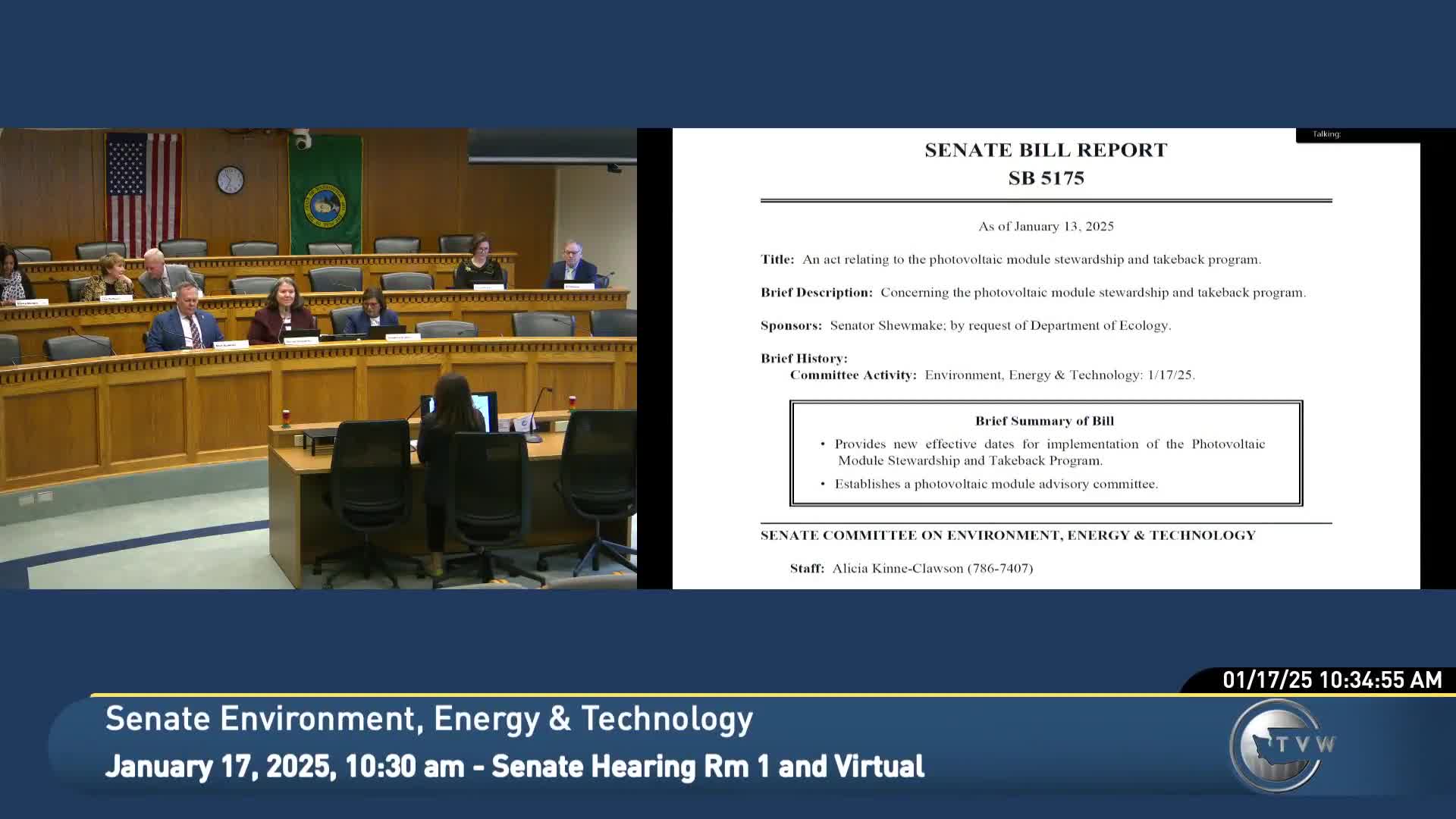
The Senate Environment, Energy & Technology Committee heard testimony in favor of Senate Bill 5175, which would delay and refine Washington’s photovoltaic module stewardship program and create an advisory committee to design a manufacturer‑funded take‑back and recycling system.
The Senate Environment, Energy & Technology Committee heard testimony in favor of Senate Bill 5175, which would delay and refine Washington’s photovoltaic (PV) module stewardship and take‑back program and establish an advisory committee to develop a practical recycling system financed by manufacturers.
Supporters, including the Department of Ecology and industry groups, told the committee the current implementation timeline risks manufacturers exiting the Washington market. “If the stewardship program ... takes effect as scheduled on July 1st this year, there will be solar panel manufacturers that will abandon the Washington market,” Bill Wills, senior policy advisor for the Washington Solar Energy Industries Association, said.
The bill would require each manufacturer to prepare and submit a PV module stewardship plan to the Department of Ecology by Jan. 31, 2028, or within 30 days of the manufacturer’s first sale into the state. After the program’s first year of implementation, manufacturers or a stewardship organization must provide an implementation and performance report. Beginning Jan. 1, 2029, manufacturers, distributors, retailers and installers would be prohibited from selling PV modules into Washington unless the manufacturer has submitted an approved stewardship plan to Ecology. The bill also directs Ecology to contract with an independent third‑party consultant to convene and support a Photovoltaic Module Advisory Committee that will develop recommendations for a convenient, safe and environmentally sound recycling system financed by manufacturers. The bill contains an emergency clause with an effective date to June 30, 2025.
Department of Ecology testimony framed the bill as a targeted pause to allow stakeholders to reach consensus on logistics and financing. “We support take back and end of life product stewardship programs and recognize that discarded solar panels are hazardous to the environment and if not handled properly,” Peter Lyon, manager of the Solid Waste Management Program at the Department of Ecology, said.
Commerce also testified in support, warning that an immediate effective date could impede the state’s clean‑energy programs. “Without the extension of time created in this bill, we anticipate that many solar panel manufacturers will stop selling panels into Washington on July 1st,” Nora Hawkins, senior energy policy specialist at the Department of Commerce, said, noting Commerce has a $156,000,000 federal solar grant it expects would be affected if panels are unavailable.
Several private‑sector and nonprofit testifiers described existing industry efforts and urged either a delay or a shorter delay than proposed. Heather Elvis of Electra, which she described as a stewardship program for solar panels, said her group submitted a stewardship plan to Ecology and had multiple manufacturers prepared to sign on. “All manufacturers have to do is sign on to our plan, and we remove the long term burden at the lowest cost,” Elvis said, and urged the committee to consider shortening the timeline to 2027.
Labor and workforce groups supported the bill’s goals while asking for an explicit labor seat on the advisory committee. “The dismantling, decommissioning and recycling of solar panels requires training our members possess,” Matthew Hepner, executive director of the Certified Electrical Workers of Washington, said, urging a labor representative on the advisory committee; the prime sponsor said she would offer such an amendment.
Testimony also highlighted startup and small‑business concerns that repeatedly changing deadlines can harm early‑stage firms investing in recycling technologies. Atul Deshmane, identified as a public utility district commissioner and speaking as a private citizen, said changing deadlines can create cash‑flow problems for early‑stage recycling companies.
The committee closed the public hearing without taking a vote. The sponsor said she will offer an amendment to include a labor representative on the advisory committee and that the bill is intended to avoid disrupting panel sales or reducing competition while stakeholders develop a practicable stewardship structure.
What’s next: the committee moved to a work session after the hearing; no formal action on SB 5175 was recorded in the hearing. If enacted, the bill would extend the deadlines, create the advisory committee and require Ecology to contract with an independent facilitator to develop the take‑back and recycling system.