Get Full Government Meeting Transcripts, Videos, & Alerts Forever!
Get email alerts on the Public Works Prompt Pay topic
No spam. Unsubscribe anytime.
Committee hears SB 5176 to tighten prompt‑pay rules for public works; CPARB recommendations guide bill
Summary
Senate Bill 5176 would implement Capital Projects Advisory Review Board (CPARB) prompt‑pay recommendations: 30‑day payments by owners, 10‑day subcontractor payment retention, 1% monthly interest on late payments, reduced withholding for disputes from 150% to 100%, and clearer contract payment schedules. Supporters say it helps small and diverse
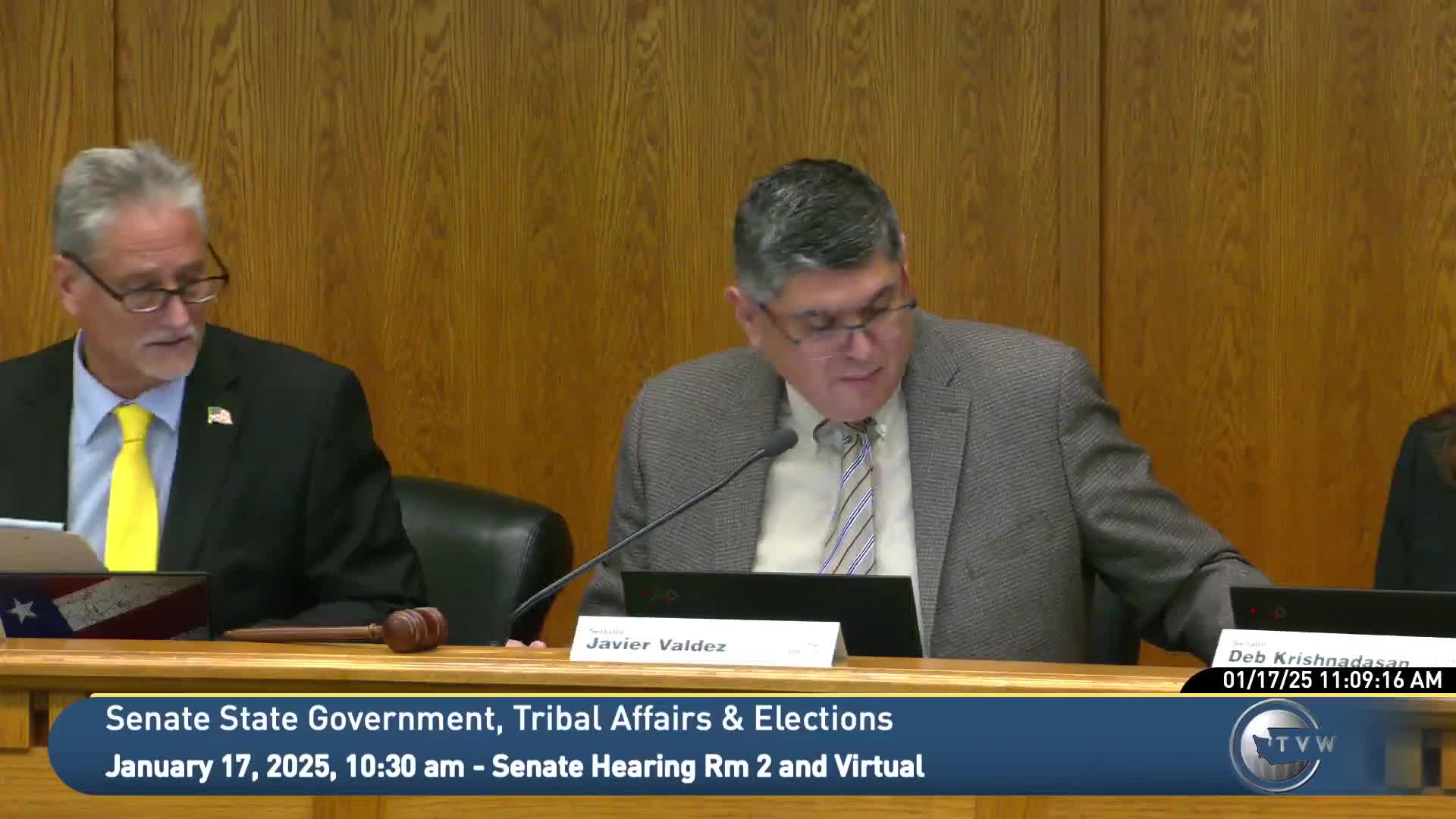
The Senate State Government, Tribal Affairs and Elections Committee held a public hearing Jan. 17 on Senate Bill 5176, a proposal implementing prompt‑pay recommendations from the Capital Projects Advisory Review Board intended to make payment timelines on public works projects more predictable for contractors and subcontractors.
Sponsor Chair Valdez opened by describing the bill as the product of CPARB’s review following 2024 legislation (gross substitute Senate Bill 6040) and said the recommendations were aimed at helping small, women‑ and minority‑owned contractors who have long faced delayed payments. Danielle Creech, staff to the committee, told members the bill “requires the state or municipality to make payments on public works projects within 30 days of receiving a properly completed invoice” while retaining the existing requirement that subcontractors be paid within 10 days of the prime contractor receiving payment. The bill would also impose a 1% interest charge per month on late payments, require payment schedules and timelines be included in contracts, reduce allowable withholding in good‑faith disputes from 150% to 100% of the disputed amount, and change the timing for requesting change orders.
CPARB representatives testified in support. Lyneth Riley Hall, CPARB chair, said the board unanimously backed the BEDBI committee recommendations; Leika Fernandes, chair of CPARB’s Business Equity and Diverse Business Inclusion committee, said the board surveyed owners and contractors—receiving more than 387 responses—and endorsed measures to increase clarity, accountability and fairness, including the 1% monthly interest and reduced withholding.
Trade groups and local governments offered qualified support and implementation concerns. Jerry Vandewood of the Associated General Contractors urged passage to improve transparency and accountability along the payment chain. The American Council of Engineering Companies’ Van Collins asked that language clearly cover consultants, engineering firms and project management contracts. Several water and sewer districts, represented by Scott Hazelgrove and others, asked for clarifications so that required payment timelines do not begin before necessary agency sign‑offs (for example final releases from L&I or federal/state funding authorities). Multiple local government associations (Association of Washington Cities; Washington State Association of Counties) and small cities said implementation support and training (MRSC) would be important and asked for definitions or thresholds so very small works rosters are not unduly burdened.
Small‑business advocates stressed economic consequences of delayed payment. Julius Brooks of Gates Consulting and Paula Sardinas of WBBA/Tabor 100 described late payments that stretched 60 days or longer and said timely payments improve small firms’ creditworthiness and capacity to pay payroll, suppliers and union obligations. The Northwest Minority Builders Alliance’s Jimmy Mata said delayed payment can pose existential risk for some small firms.
Committee members asked staff and witnesses to clarify when the 30‑day clock starts relative to required agency sign‑offs and when change‑order timing should be measured. Several witnesses urged explicit recognition of electronic payments and electronic acceptance as constituting payment for the purpose of the timelines.
No committee vote was taken; the bill remains in public hearing for further work and potential amendment.