Get Full Government Meeting Transcripts, Videos, & Alerts Forever!
Get email alerts on the Committee Executive Session Votes topic
No spam. Unsubscribe anytime.
Senate State Government committee gives due‑pass recommendations to four bills including voting and records measures
Summary
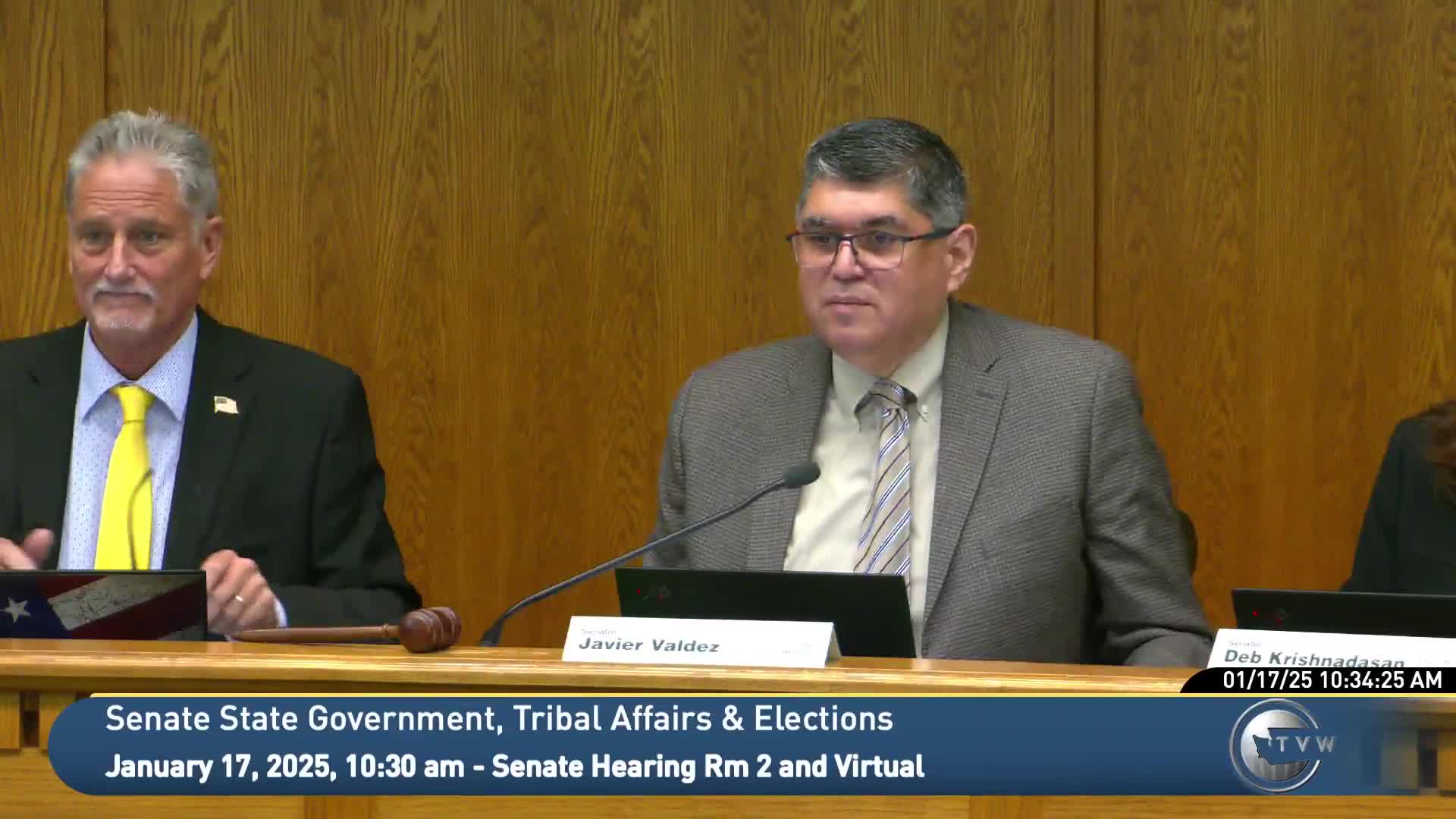
The Senate State Government, Tribal Affairs and Elections Committee met Jan. 17 in Olympia and online and in executive session advanced four bills: SB 5000 (state nickname), SB 5102 (narrow Public Records Act exemption), proposed substitute A for SB 5017 (adopting the Uniform Military and Overseas Voter Act with study and portal restrictions), and SB 5069 (state voter pamphlet changes).
The Senate State Government, Tribal Affairs and Elections Committee met Jan. 17 in Olympia and virtually and, in executive session, advanced four bills with due‑pass recommendations to the next committee: Senate Bill 5000, Senate Bill 5102, proposed substitute A for Senate Bill 5017, and Senate Bill 5069.
The committee’s staff briefed members before votes. Danielle Creech, staff to the committee, summarized SB 5000 as “relating to establishing the state nickname” and told members the bill would designate “the Evergreen State as the official state nickname of the state of Washington.” William (staff) summarized SB 5102 as creating “an exemption in the Public Records Act for internal analyses and methodologies used by local governments, and their risk pools in setting member premium contribution rates.”
The committee also considered SB 5017, which would adopt the Uniform Military and Overseas Voter Act and make related edits to the Revised Code of Washington. William told the committee a proposed substitute A narrows some timing requirements (for example changing a fixed 2‑business‑day mail requirement to “the time that is practicable” for sending ballots after receiving an application) restores a 90‑day candidate list timing provision, and removes authority for the Secretary of State to approve an electronic ballot portal without express legislative authority. William also noted a Secretary of State fiscal estimate of approximately $50,000 for portal implementation across FY2025–FY2027 and that the substitute requires annual progress reports to the Legislature with a final report due Dec. 1, 2028.
On SB 5069, William said the bill would require the Secretary of State to print and distribute a voter pamphlet before the primary in each even‑numbered year and before the general election every year, and that a Senator Wilson amendment would allow separate candidate statements to be inserted for primary and general elections. There was no fiscal note for SB 5069, William said.
Vice Chair Krishna Dawson moved that SB 5000 receive a due‑pass recommendation and be sent to rules; the motion was seconded and the chair announced the bill passed by voice vote, “subject to signatures.” The committee similarly moved and passed SB 5102 on a due‑pass recommendation. The committee adopted proposed substitute A for SB 5017 (the sponsor moved adoption of the substitute and members voted in favor), then moved that proposed substitute A receive a due‑pass recommendation and be sent to rules. For SB 5069 the committee moved that the bill receive a due‑pass recommendation and be sent to Ways and Means; the chair said the bill passed subject to signatures.
All four actions were taken by voice vote during executive session. Where a roll‑call was not recorded in the transcript, the chair announced each bill as passing “subject to signatures.” The committee did not record roll‑call tallies in the hearing record provided.
What’s next: each bill will be transmitted as directed (rules or Ways and Means) for further consideration; SB 5017’s substitute language requires reporting back from the Secretary of State on electronic ballot portal progress through Dec. 1, 2028.