Get Full Government Meeting Transcripts, Videos, & Alerts Forever!
Get email alerts on the Workforce Mental Health topic
No spam. Unsubscribe anytime.
Committee hears bill to extend K–12 secondary-trauma supports to higher education workforce
Summary
A House committee heard testimony on House Bill 1035, which would require community and technical colleges and regional universities to publish resources and adopt model policies addressing secondary traumatic stress among faculty, staff and trustees; supporters described faculty dealing with student suicides and pandemic-era trauma.
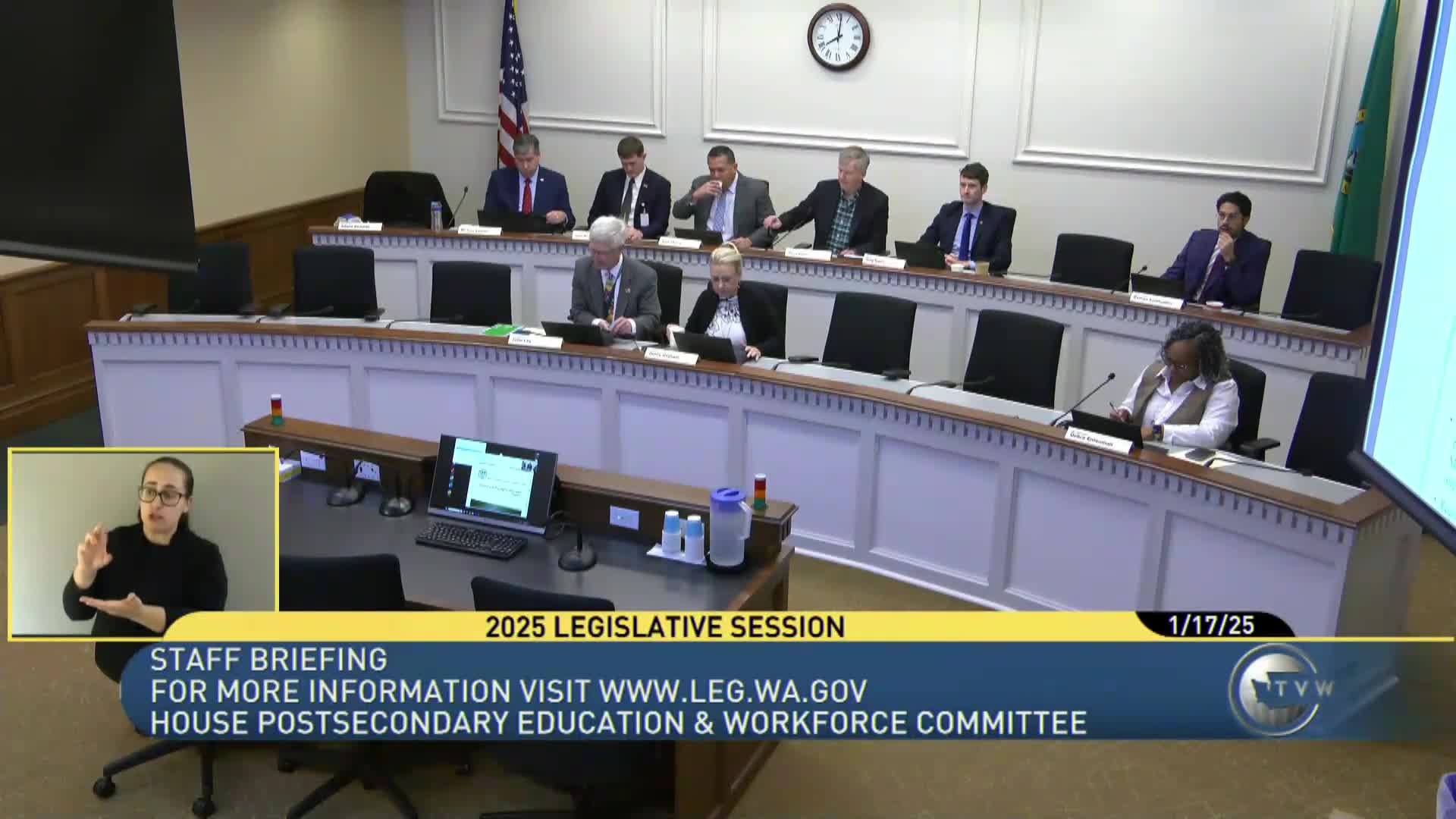
House Bill 1035, which would require public two- and four‑year institutions to adopt model policies and publish links to resources to prevent and address secondary traumatic stress in the higher‑education workforce, was the subject of a public hearing before the House Postsecondary Education & Workforce Committee.
The bill would direct the State Board for Community and Technical Colleges and the regional university boards to develop and periodically update model policies and procedures that include a workforce mental health committee. Each community and technical college district and regional university would be required to adopt or amend policies that incorporate the model policy, and institutions would post links to resources, self‑assessments and best practices for faculty, staff and trustees.
Saranda Ross, counsel to the committee, summarized the bill for members, saying the legislature previously addressed similar needs in K–12 through substitute House Bill 1363 (2021), which required the Washington State School Directors Association and the Office of the Superintendent of Public Instruction to produce model policies and resources. Ross said HB 1035 mirrors that approach for higher education by requiring institutions to publish resources on their websites and to establish workforce mental health committees with duties described in the bill analysis.
Representative Ortiz Self, the bill’s prime sponsor, told the committee the measure “mirrors in many ways what we passed a few years ago” for K–12 and is intended to provide higher‑education instructors and staff the same access to resources. Ortiz Self recounted receiving a call from a college professor who said a student in the professor’s class had died by suicide and that faculty were struggling to process that traumatic event. “Somehow, we expect educators to be strong and not to feel the pain that their students are feeling,” Ortiz Self said, and urged the committee’s support.
Witnesses who testified in support described classroom and campus experiences that supporters said make the bill necessary. Sue Nightingale, representing the Washington Education Association (WEA), told the committee that post‑pandemic students bring “complicated family situations and lives,” and faculty and staff need resources and information similar to what K–12 educators already receive. “The stories that we hear are tragic and sad, and they tend to pile up on us,” Nightingale said.
Bill Line, testifying as a pinch‑hitter for Simone Beau of the WEA, said faculty try to treat students “as whole people” and that repeated exposure to students’ traumatic experiences affects instructors’ ability to do their jobs. Line said HB 1035 would “provide resources for faculty across the state to deal with those kinds of problems as they come up.”
The committee paused the public hearing on HB 1035 to take up a scheduled work session. After the work session the committee returned and closed the HB 1035 hearing without a recorded vote. No formal amendments or roll‑call actions were taken during the hearing.
Supporters urged the committee to act quickly so higher‑education employees have access to developed resources and clear institutional procedures; no opponents offered testimony during the recorded public hearing.
The bill’s text and the committee’s fiscal materials were not discussed in detail during the testimony; the staff briefing referenced duties for workforce mental health committees “listed in the bill analysis.” The committee will consider amendments and next steps in future meetings.
Ending: Committee staff paused the hearing to proceed to a scheduled work session on higher‑education funding and will resume consideration of public testimony and possible next steps for HB 1035 at a later date.