Get Full Government Meeting Transcripts, Videos, & Alerts Forever!
Get email alerts on the Ai Training Transparency topic
No spam. Unsubscribe anytime.
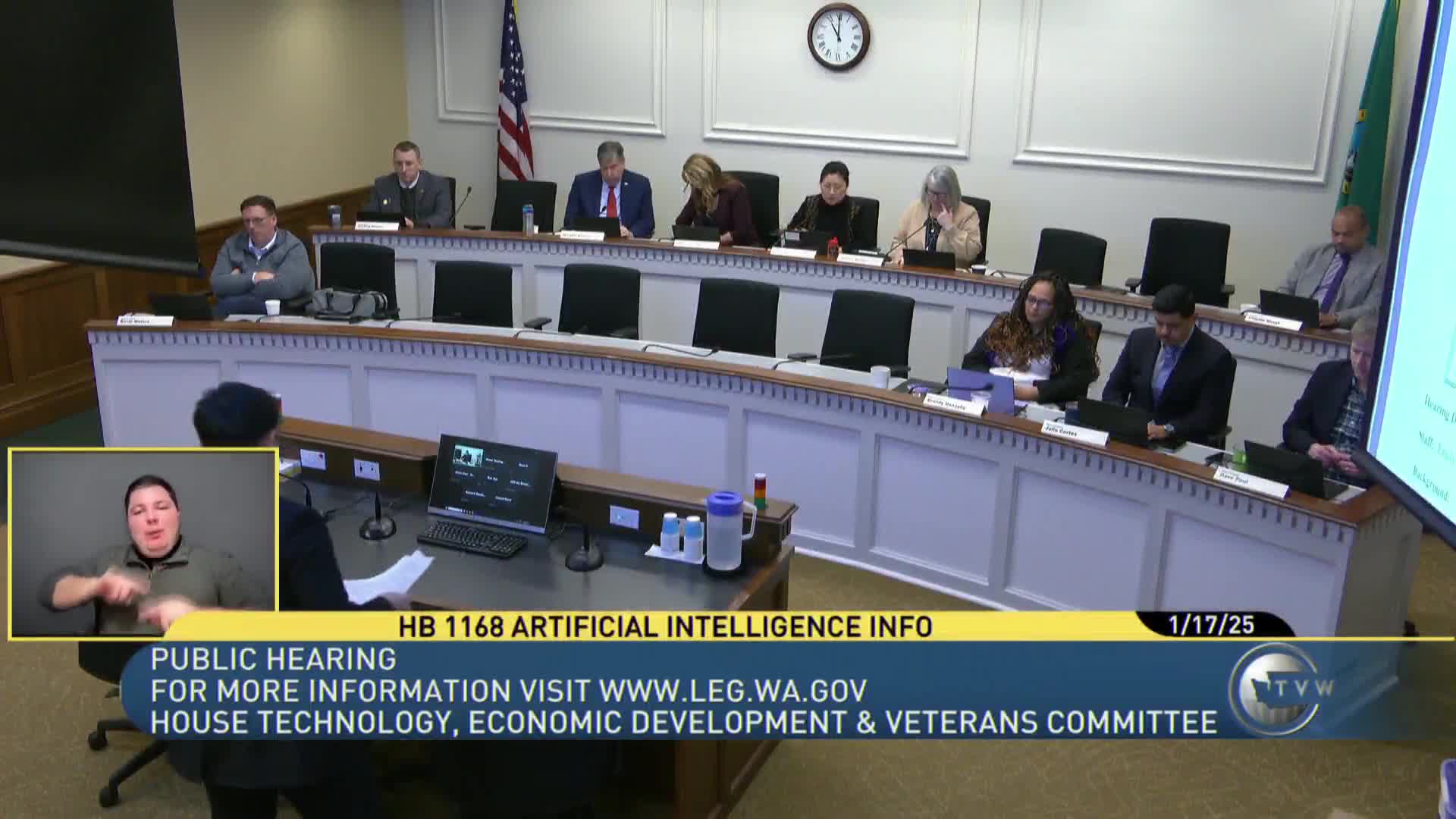
Committee hears bill to require AI developers to post training‑data disclosures; enforcement, trade secrets and scope draw debate
Summary
House Bill 1168 would require developers of generative AI systems made available for public use to publish documentation describing training datasets, including sources, types of data and whether datasets contain personal or copyrighted information.
Committee staff framed House Bill 1168 as a transparency measure that would require developers of generative artificial intelligence systems to post documentation about the datasets used to train models that are made available for public use.
Emily Pool, nonpartisan staff to the committee, told members the bill would require developers — a term defined to include individuals, agencies and corporations that design, code, produce or substantially modify a generative AI system — to post information about dataset sources, the kinds of data points included, whether personal information is present and whether copyrighted works were used. The bill would apply to systems released or substantially modified on or after Jan. 1, 2022, require compliance by Jan. 1, 2026, and assign enforcement to the attorney general with a civil penalty of $5,000 per violation and per day that a violation continues.
Representative Clyde Shavers, the bill’s prime sponsor, framed the legislation as “transparency” that preserves innovation. “The core principle here in House Bill 1168 is transparency. It is not to stifle progress, but to empower consumers and developers alike by fostering trust in these technologies,” Shavers said.
Supporters told the committee transparency is needed to help buyers, deployers and policy makers assess risks in models. Jay Jasima, co‑founder of Transparency Coalition and an affiliated University of Washington professor, said the bill “does not require people to disclose any secrets, any methods, any proprietary methods” and argued developers already announce dataset licensing deals publicly.
Industry and trade groups pushed back on the bill’s scope, enforcement and commercial effects. Rose Feliciano, executive director for Washington and the Northwest for TechNet, testified in opposition to the bill as written, saying the measure includes a private right of action that California’s model lacked and that reporting mandates are “overly prescriptive” and lack trade‑secret protections. Morgan Irwin of the Association of Washington Business and other industry witnesses expressed concern that the state AI task force, established to study AI issues, is the appropriate venue to refine technical and enforcement questions before statutory action.
Committee members asked staff and witnesses practical questions about the penalty structure, the definition of “developer” (including whether a party that substantially modifies an off‑the‑shelf model would be covered) and whether the bill includes a cure period; staff said the current text does not specify a cure period. Members also discussed whether penalties would be assessed per violation or per day and how that would be implemented by the attorney general.
The hearing record shows substantial stakeholder engagement and competing priorities: proponents stressing consumer transparency and auditability, and industry groups urging additional protections for trade secrets and clearer enforcement language. No committee vote was taken at this hearing; the measure will be subject to follow‑up, amendments and possible work‑session discussion.
Ending: The committee closed the hearing on House Bill 1168 after testimony from the prime sponsor, staff and invited panels.