Get Full Government Meeting Transcripts, Videos, & Alerts Forever!
Get email alerts on the Small Claims Court topic
No spam. Unsubscribe anytime.
Committee hears bill to change small-claims notice from ‘will’ to ‘may’ so judges can consider merits
Summary
On Jan. 17 the Civil Rights & Judiciary Committee heard House Bill 1007, which would change small-claims notice language so a default judgment 'may' rather than 'will' be entered if a defendant fails to appear. Sponsors and judges said the change aligns notices with current practice and prevents misleading unrepresented litigants.
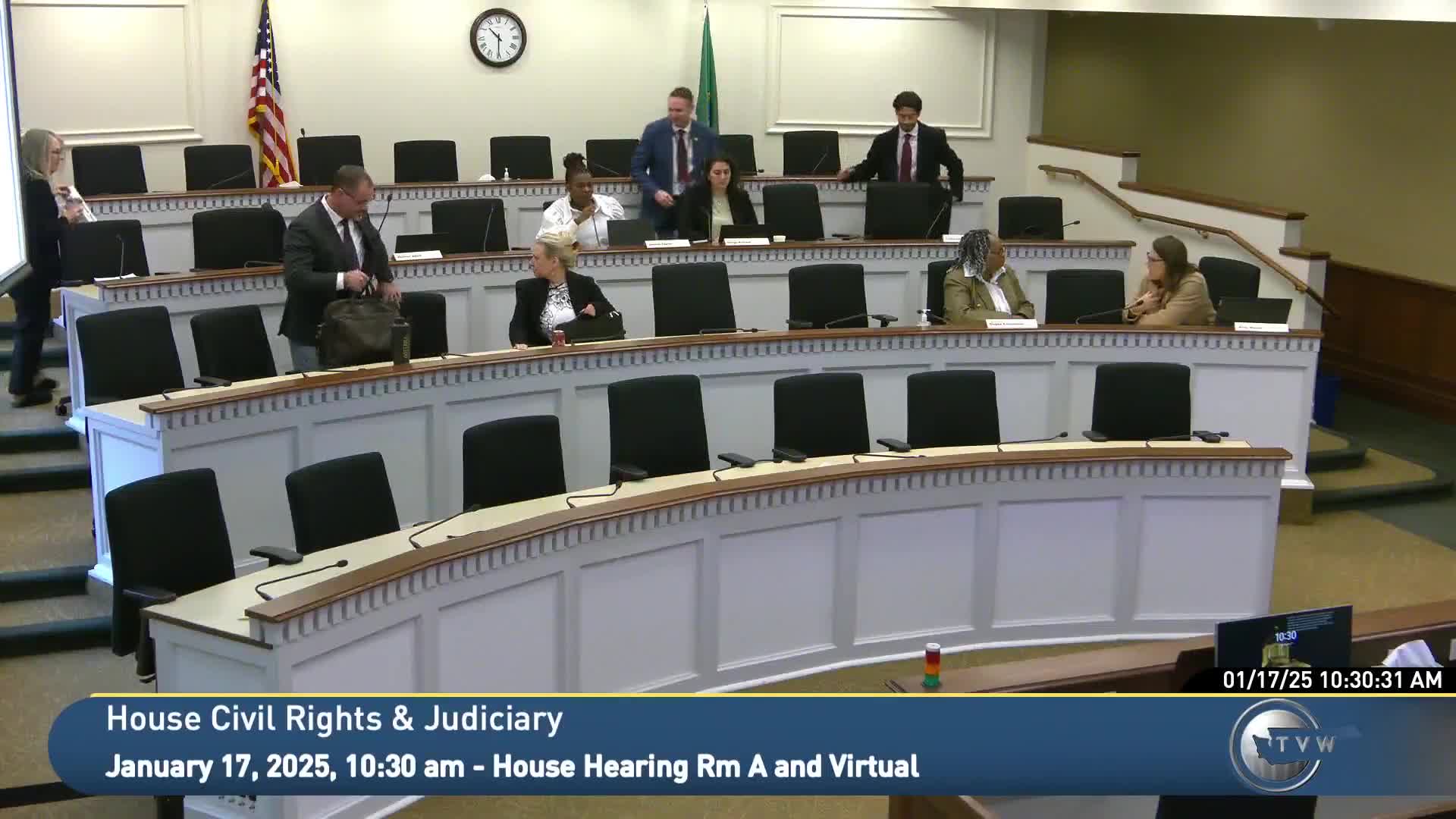
The Civil Rights & Judiciary Committee met Jan. 17 to hear House Bill 1007, a measure that would change the standard small-claims notice to say a judgment "may" rather than "will" be entered if a defendant fails to appear.
Supporters told the committee the change is intended to reflect judicial practice and avoid creating false expectations for largely self-represented litigants in small-claims court.
Staff to the committee, Matt Sterling, told members that current notices direct defendants to appear and advise that "if the defendant fails to appear, judgment will be given against the defendant for the amount of the claim." Sterling said HB 1007 would require that the notice instead "must contain a statement advising the defendant that in case of the defendant's failure to appear, judgment may rather than will be given against the defendant for the amount of the claim."
Representative Loe, the bill sponsor, said the bill arose after meetings with district court judges. "Current law requires notice to litigants in small claims matters to say ... the plaintiff will receive judgment. However, there are cases where it's not appropriate to issue a judgment for the plaintiff," Loe said, and added the change "reflects the current practice of allowing judges to decide on the merits of the case while at the same time giving the litigants a true expectation of how the case should be resolved."
Pierce County District Court Judge Carl Williams, testifying on behalf of the District Court Municipal Court Judges Association, described examples where a default judgment would not be appropriate even if a defendant fails to appear. Williams said a plaintiff who cannot show any monetary loss after an automobile collision, for example, should not receive an automatic judgment merely because the defendant did not attend. "It is unfair to the litigants to require a notice that specifies a specific outcome if that outcome conflicts with the law," Williams said. He told the committee the bill "only modifies the language of the notice. The law around defaults remains the same."
Melissa Johnson, also speaking for district and municipal court judges, told the committee judges across the state raised similar concerns in the interim and supported the change to reduce confusion for lay litigants.
Committee members asked about how small-claims practice compares to superior court. Representative Graham asked whether superior court summons use similar mandatory language; Judge Williams said he was not familiar with superior court language but emphasized that small-claims proceedings typically involve unrepresented parties who can misunderstand the implications of the notice.
The hearing record contains differing numerical descriptions of small-claims jurisdiction: Sterling described small-claims jurisdiction as cases "if the amount claimed does not exceed $5,000," while Judge Williams referred to small claims as cases "where monetary recovery is $10,000 or less." That discrepancy was present in the hearing and is reflected here rather than resolved by this article.
No formal action or vote on the bill was recorded at the hearing; sponsors, staff and judges concluded their testimony and the committee closed the hearing on HB 1007.
The committee will determine whether to move the bill forward in subsequent meetings. If advanced, the change would affect the text of the notice served on defendants in small-claims matters and would not change existing default-judgment law, according to testimony.