Get Full Government Meeting Transcripts, Videos, & Alerts Forever!
Get email alerts on the Economic Services Administration topic
No spam. Unsubscribe anytime.
Economic Services Administration briefs committee on caseloads, refugee supports and technology gaps
Summary
Bryce Montgomery, director in the Economic Services Administration (ESA), told the committee ESA serves more than 1.7 million Washingtonians, highlighted refugee and tribal program expansion, described the new Summer EBT ("Sunbucks") rollout, and warned of technology and safety needs in community services offices.
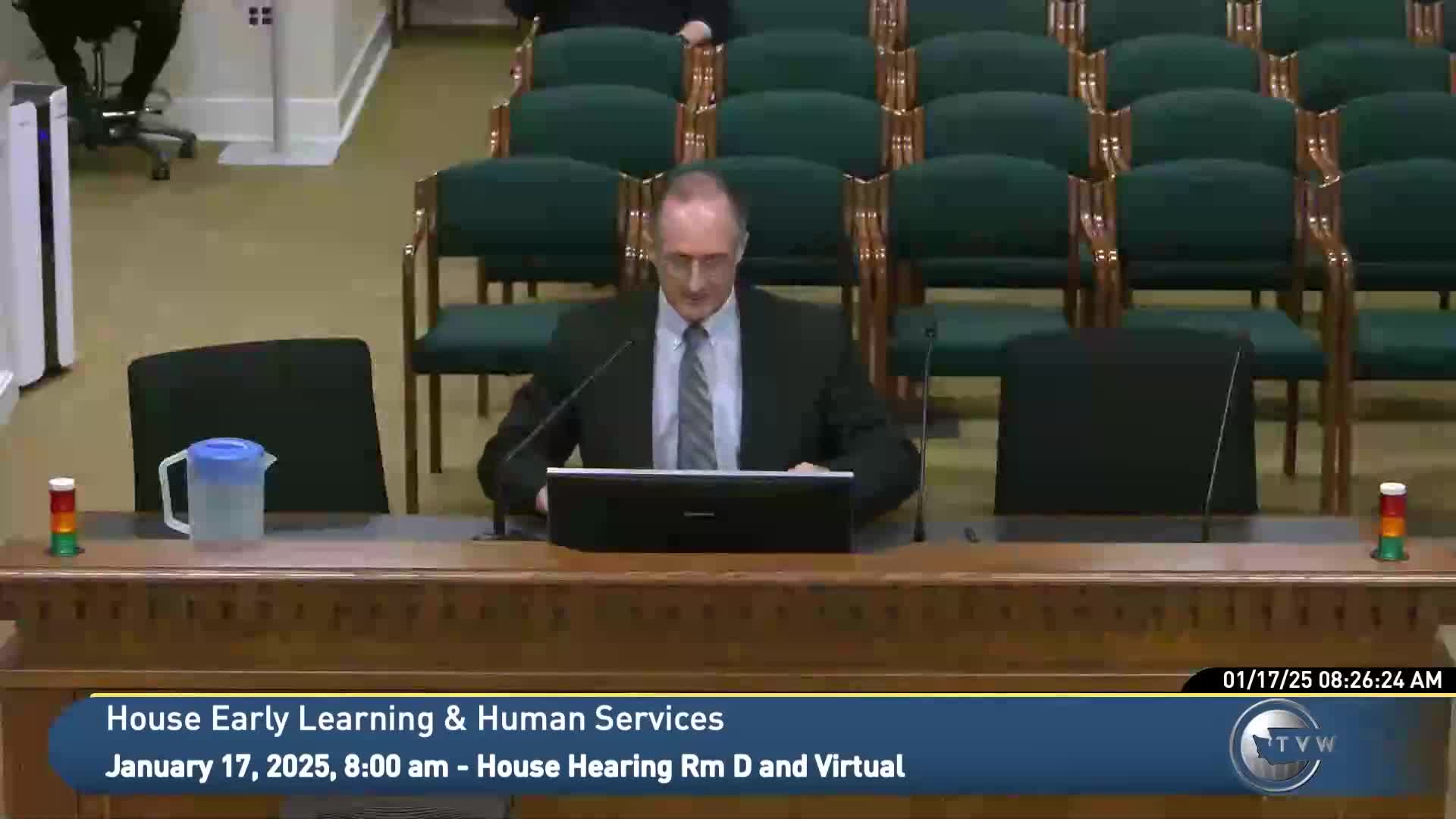
Bryce Montgomery, director for the Community Services Division in the Economic Services Administration (ESA) at the Department of Social and Health Services, delivered an overview of ESA programs and operational challenges to the Human Services, Youth, & Early Learning committee.
Montgomery said ESA serves more than 1,700,000 individuals statewide with a staff of roughly 38,100 and that the Community Services Division connects families to benefits including food assistance, cash assistance, SNAP, employment and training, and services for older adults. He described ESA’s partnership work with tribes, noting an expansion of the Tribal SNAP eligibility determination pilot and intergovernmental agreements to ensure tribal access to maintenance-of-effort funds.
Montgomery highlighted the Office of Refugee and Immigrant Assistance (ORIA) growth: he said ORIA partnered with 53 community-based organizations in fiscal year 2021 and invested more than $100,000,000 in state and federal resources by fiscal year 2025 across 29 programs and 125 community-based partners. He said additional funding in the governor’s 2026 proposal would continue a Washington migrant and asylum seeker support project.
Montgomery described results from the state’s Summer EBT program (referred to during testimony as Sunbucks), noting the Consolidated Appropriations Act of 2023 authorized a permanent summer EBT. He said Sunbucks provided $120 per child in 2024 (federally funded) and that it delivered roughly $71,000,000 in federal funds to feed nearly 600,000 children statewide that summer.
On program integrity and operations, Montgomery said ESA’s Division of Program Integrity conducts statistically valid case reviews and site visits, and that Quality Assurance and Management Evaluation teams sample cases and review issuance accuracy. He also raised operational challenges: outdated technology at customer service centers and long wait times for customers, inconsistent safety and security measures across more than 50 community services offices, and recent incidents including drug use in restrooms and August gun violence at a Capitol Hill office. He told the committee that improving phone systems, document upload capabilities and robotic process automation are priorities.
Montgomery noted ESA must implement bills already passed by the Legislature that carry fiscal impacts; he cited ESHB 1260 (2023) changing recovery policies for ABD cash assistance effective October 2025 and ESHB 1652 (2024) requiring child support pass-through to TANF families beginning January 1, 2026. Montgomery closed by describing an agency bill (HB 1243 and companion S 5079) to ease recovery of unintentional overpayments for older adults and adults with disabilities, which he said would have a comparatively small biennial fiscal cost (estimated $308,000) and would allow DSHS to waive certain recoveries that create hardship for very low-income recipients.
Committee members asked follow-up questions about the timing and scale of newcomer funding and the roll-out of tribal SNAP expansion; Montgomery offered to return details to members via staff.