Get Full Government Meeting Transcripts, Videos, & Alerts Forever!
Get email alerts on the Growth Management topic
No spam. Unsubscribe anytime.
Committee hears bill to close Growth Management Act ‘reversion’ loophole
Summary
At a Local Government Committee public hearing, sponsors and stakeholders debated House Bill 1135, which would require the Growth Management Hearings Board to evaluate whether an older, repealed plan or regulation (reverted to after repeal) complies with the Growth Management Act before lifting any finding of invalidity.
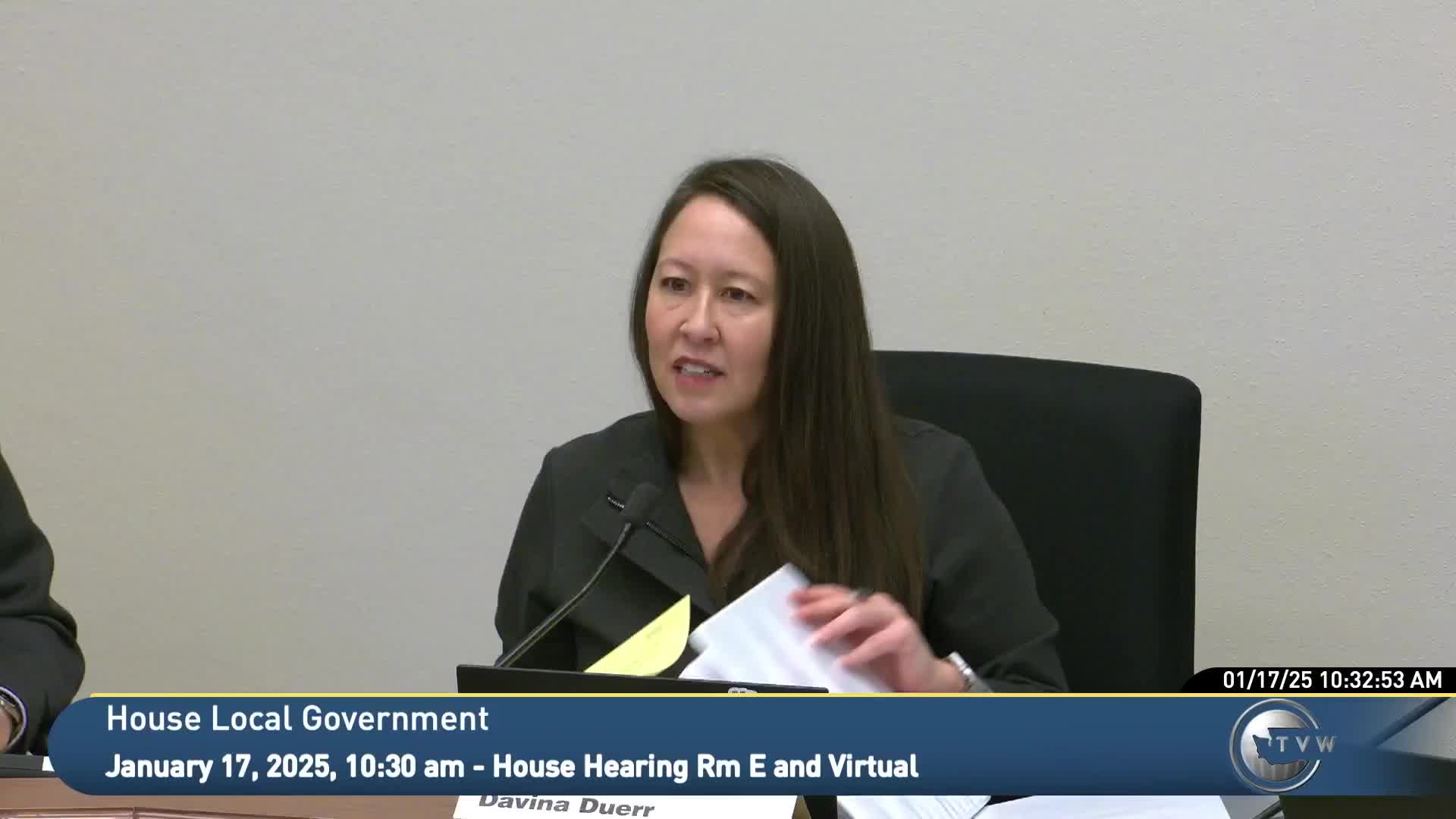
House Bill 1135 received its first public hearing before the Local Government Committee on Oct. 12, 2025. Representative Deuer, chair of the committee and sponsor of the bill, said the measure would stop local governments from reverting to older plans or regulations that may not meet new Growth Management Act requirements when a recently adopted update is found invalid.
The bill matters because it addresses a procedural gap that stakeholders say allows jurisdictions to avoid updating plans to meet new statutory requirements. “This is really just a clarification of the law as I think the intent is,” Representative Deuer said, testifying from the dais as bill sponsor.
Kellan Wright, staff to the committee, outlined the current statutory framework. “The bill before you is House Bill 1135, an act relating to ensuring that local government planning complies with the Growth Management Act,” Wright said, describing the Growth Management Hearings Board’s role, time limits for petitions and board orders, and the limited set of parties that may file petitions. Wright noted key deadlines in current law: petitions generally must be filed within 60 days of a local action and the board must issue a final order within 180 days of receiving a petition.
Supporters said the bill would prevent what they called a costly form of regulatory backsliding. Bryce Yaden, testifying for FutureWise, said the concern is jurisdictions updating comprehensive plans to meet new housing and climate requirements then reverting to older, noncompliant rules if the newer regulations are invalidated. “What we don't want to see is jurisdictions updating their comp plans to try and meet the housing element, being found out of compliance … repealing that and then still not meeting those new needs,” Yaden said.
The Washington State Association of Counties, represented by Kelsey Hulse, said it supports the bill’s intent but asked for clarifying language to address a practical question raised by staff and local governments: what happens in the interim between a board determination of invalidity and adoption of interim controls if the underlying older code is also not compliant? “It would be helpful to understand what should happen in the time in between a determination of invalidity where the underlying code is also invalid prior to the adoption of interim controls,” Hulse said, and she asked to work with the sponsor on implementation language.
Carl Schroeder of the Association of Washington Cities likewise urged refinement to avoid indefinite exposure to appeals over longstanding decisions. John Worthington of Sequim gave broader critical remarks about perceived limits of the Growth Management Act’s reach on shipping emissions and other matters, but those points addressed larger planning concerns rather than the bill’s narrow procedural fix.
Committee members asked whether the bill would prevent local governments from proactively updating plans ahead of state action; Representative Deuer said the bill was not intended to make lawful proactive updates illegal and that staff and stakeholders could draft clarifying language if necessary.
The hearing closed after multiple stakeholders — including counties and cities — asked to continue work on precise statutory language to make the bill implementable for jurisdictions of different sizes.
Votes or formal committee action were not recorded at the hearing; staff briefed and the committee took testimony only.