Get Full Government Meeting Transcripts, Videos, & Alerts Forever!
Get email alerts on the Workers Comp Ptsd Coroners topic
No spam. Unsubscribe anytime.
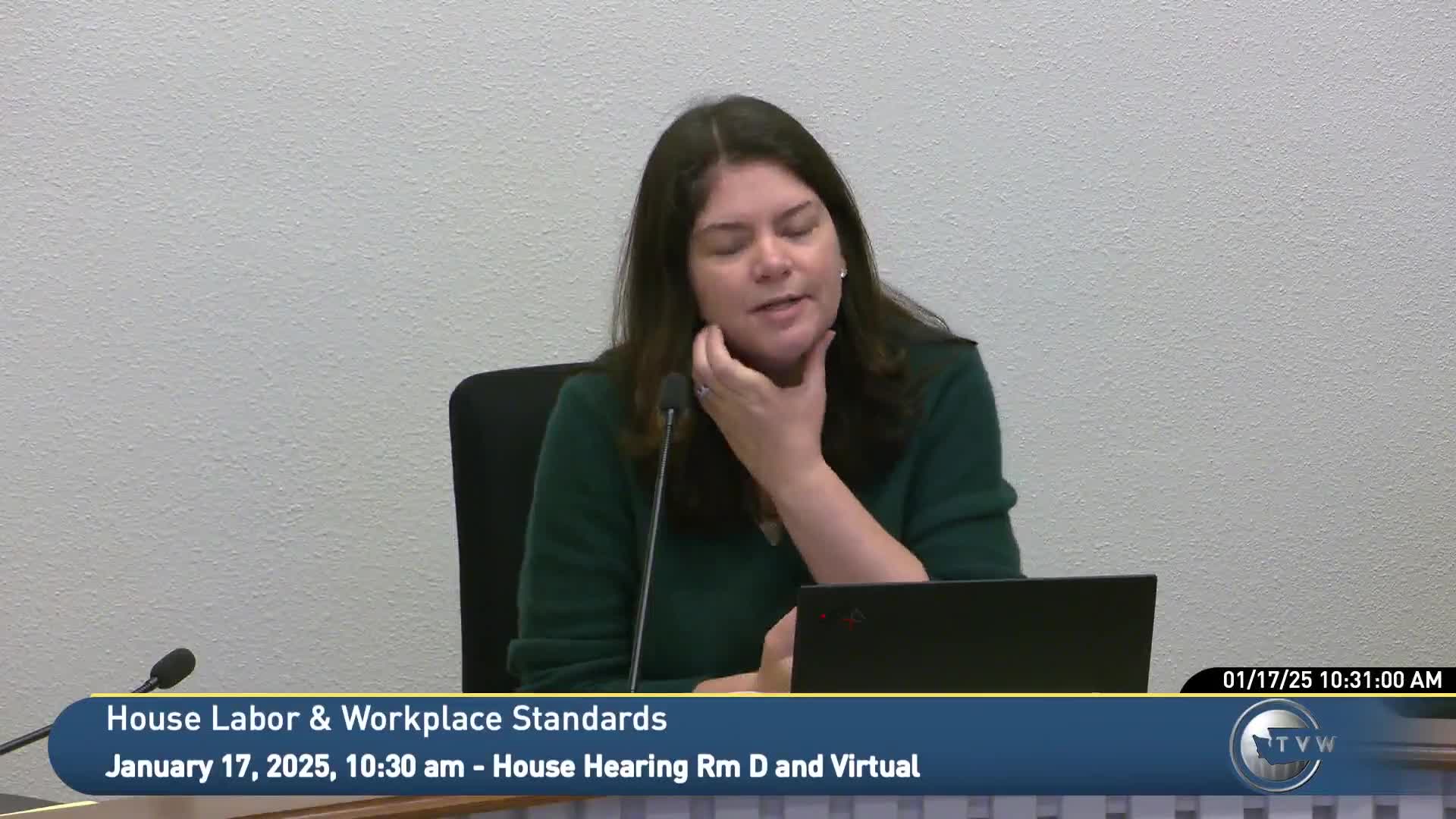
Committee hears bill to allow PTSD workers’‑comp claims for county coroners, medical examiner staff
Summary
Labor & Workplace Standards Committee heard testimony on HB 1002, which would allow county coroners and medical‑examiner personnel to file workers’ compensation occupational‑disease claims for post‑traumatic stress disorder, with a pre‑employment screening requirement for hires after Jan. 1, 2026.
The Labor & Workplace Standards Committee on Friday heard testimony on House Bill 1002, which would allow county coroners and medical‑examiner personnel to file occupational‑disease workers’ compensation claims for post‑traumatic stress disorder and, for employees hired after Jan. 1, 2026, make coverage contingent on an employer‑provided pre‑employment psychological exam that rules out preexisting PTSD.
Committee staff summarized current law and the bill, and county coroners and medical‑examiner personnel and their associations urged lawmakers to extend coverage to the group while business groups and small‑business representatives warned of cost pressures for the state fund.
Ben McCarthy, staff to the committee, said Washington law already makes PTSD an occupational disease in limited first‑responder roles and that HB 1002 “would extend this exemption…to county coroners and medical examiner personnel.” The bill copies parts of existing statutes for firefighters and law enforcement by permitting occupational‑disease claims based on PTSD for coroner and medical‑examiner staff. McCarthy also noted the bill’s conditional rule for hires after Jan. 1, 2026: the exemption applies only if the employer provides a pre‑employment psychological exam; if an employer does not provide an exam, the exception applies regardless.
Prime sponsor Rep. Peter Barno (R‑20) told the committee the bill responds to repeated requests from coroners across the state, especially in rural counties, who routinely investigate violent, sudden or otherwise traumatic deaths. “These people are their friends and neighbors,” Barno said, arguing coroners’ repeated exposure to traumatic death is similar to exposures that led earlier legislatures to include firefighters and law enforcement in PTSD statutes.
Department of Labor & Industries officials briefed the committee on the state workers’ compensation system and trends for PTSD claims. Brenda Heilman, assistant director for L&I’s Insurance Services Division, described the state fund as one of the nation’s largest insurers and said L&I receives roughly 100,000 claims a year. On PTSD claims, Heilman said the department saw a spike in filings in 2021 and 2022 and noted that “about 80% of claims are allowed” while roughly 20% are denied for reasons such as an alternative diagnosis or incomplete documentation. Heilman also said roughly 1 in 5 workers with allowed PTSD claims end up with a pension outcome: “It’s 20% of workers who are having a pension outcome,” she said, adding L&I is studying why return‑to‑work rates lag.
County coroners and their associations testified in favor. Lewis County Coroner Warren McLeod described prolonged exposure to death investigations and post‑investigation duties, saying, “Every call we handle involves a death and can have a profound emotional impact on coroner ME personnel.” Timothy Grisham of the Washington Association of County Officials said the bill would create parity with other first responders and reported the fiscal note projects that roughly 80 individuals statewide might be covered and estimates 1.8–2.5 claims over five years.
Business and employer groups raised cost and sustainability concerns. Rose Gunderson of the Washington Retail Association said the state fund’s long‑term disability rate has risen and urged policy changes that avoid cross‑subsidization across risk classes; Patrick Connor of NFIB warned that PTSD pension claims can be expensive, saying “those claims that do go to pension are costing the system more than $1,000,000 each.” Both called for stronger front‑end prevention and treatment to reduce long‑term costs.
Workers’ advocates and workers’‑comp attorneys supported the bill. Doug Palmer, representing the Washington State Association for Justice, and Barry Peterson, a King County autopsy technician, described the nature of repeated on‑the‑job trauma and the difficulties workers face accessing timely treatment when coverage is delayed.
L&I staff told the committee they have provisional funding to hire an independent researcher and that a jurisdictional review and survey of best practices will be completed by June 30 (the department’s stated target). L&I also said its Industrial Insurance Medical Advisory Committee is drafting PTSD treatment guidelines aimed for publication next fall.
No formal vote on HB 1002 was recorded during the hearing; the committee suspended and later resumed the session for other bills.
Lede closing: HB 1002 remains under consideration; the committee took testimony from labor officials, county coroner representatives, employer groups and insurers and heard L&I staff describe trends and planned follow‑up work.