Get Full Government Meeting Transcripts, Videos, & Alerts Forever!
Get email alerts on the Legislative Veto Challenge topic
No spam. Unsubscribe anytime.
Wisconsin Supreme Court weighs challenge to legislative veto powers over agency rules
Summary
At oral argument in 23 AP 2020, petitioner attorneys asked the court to strike five statutory provisions that allow legislative committees to pause or block administrative rules without full bicameral passage and presentment; the court probed separation-of-powers, stare decisis and real-world effects including pauses of a conversion-therapy rule.
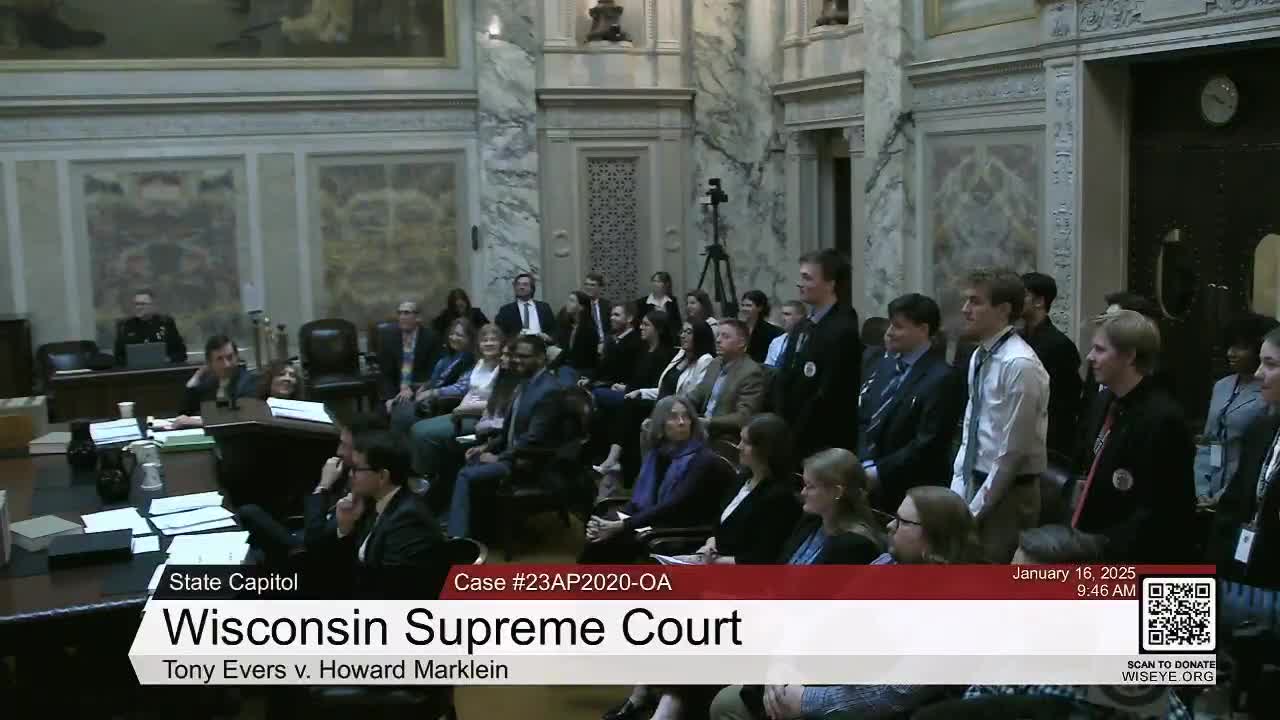
The Wisconsin Supreme Court heard argument in 23 AP 2020, Tony Evers v. Mark Klein, a case testing whether five statutory provisions that let legislative committees delay or block administrative rules violate the state constitution's requirements for bicameral passage and presentment.
Petitioners' counsel argued the challenged provisions amount to lawmaking outside the constitutionally prescribed process and asked the court to strike the statutes as facially unconstitutional. "We think all 5 statutes are facially unconstitutional under both doctrines," counsel told the court, urging the justices to overrule Martinez and related authority that the petitioners said permit the committee controls at issue.
Those defending the statutes — including counsel for the Legislature — told the court the provisions largely create a temporary "waiting period" that allows the legislative branch to exercise its constitutionally authorized power to repeal or modify rules by bicameral passage and presentment, not a substitute legislative veto. "Those provisions are not a legislative veto at all," one respondent attorney said, arguing that four of the five provisions survive existing precedent and practical reliance.
Much of oral argument focused on doctrine and precedent. Petitioners urged the court to resolve the case on bicameralism and presentment grounds alone, and, alternatively, on separation-of-powers principles that would treat at least some rulemaking as a core executive function once adopted by agencies. Several justices pressed whether the two arguments are analytically distinct, and whether adopting petitioners' positions would require overruling a line of Wisconsin decisions including Martinez and SEIU that have permitted similar legislative review mechanisms.
Justices repeatedly raised practical consequences and stare-decisis concerns. Several asked whether overturning Martinez and related paragraphs in SEIU would disrupt long-standing government practice and what limiting principle the court could adopt instead of an all-or-nothing approach. Petitioners offered possible narrow paths — for example, treating indefinite or "permanent" objections differently from short-term pauses — while urging the court to clarify the line between permissible legislative oversight and unconstitutional lawmaking.
Argument also returned repeatedly to real-world impacts. Several justices cited the conversion-therapy rule proposed in 2020 as an example: that rule spent months paused under the contested provisions — including multi-month pauses and a 15-month suspension at one point — before later proceedings. Some justices framed that sequence as evidence the statutory mechanisms can produce prolonged delays affecting regulated parties and public health; others said the record shows the statutes can be applied as temporary delays and that as-applied challenges remain available.
Counsel debated standing, mootness and the appropriate standard for facial challenges. Petitioners told the court the issues are not moot because committees can resuspend rules under the statutes at issue, and they urged the court to apply a standard that recognizes the structural injury to executive power. Respondents emphasized reliance interests and unanimous Wisconsin precedent that has permitted committee review in similar form.
The court heard extensive questioning but did not announce a decision. Several justices asked for additional conference consideration. The court adjourned after the argument.