Get Full Government Meeting Transcripts, Videos, & Alerts Forever!
Get email alerts on the Oig Background Fraud topic
No spam. Unsubscribe anytime.
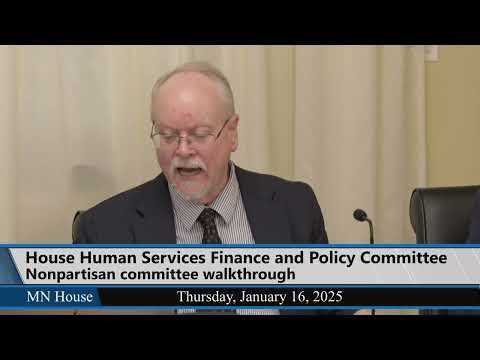
DHS Office of Inspector General: licensing, background studies and fraud prevention work explained
Summary
The committee heard from House Research staff about DHS licensing activity, the Office of Inspector General’s investigative and fraud‑prevention role, the NETStudy 2.0 background study system, and recent workload statistics including 507,517 background study requests in 2023.
House Research and House Fiscal staff briefed the committee on the Department of Human Services Office of Inspector General (OIG), which oversees licensing, background studies and program‑integrity work.
Staff explained that DHS directly licenses or certifies roughly 20,000 programs and providers at any time, including childcare centers, children’s residential facilities, SUD treatment and detox programs, home‑and‑community‑based service providers and certain direct care and treatment programs. Many child‑care and foster‑care licensing functions are delegated to counties, and some private agencies are authorized to perform licensing tasks for child placement and foster care.
DHS licensing sanctions and correction orders are issued under Minnesota Statutes chapter 245A, staff said. DHS also receives and investigates reports of maltreatment that occur in licensed programs; the majority of DHS maltreatment reports concern vulnerable adults rather than children, the presentation noted.
On fraud prevention, staff described the OIG’s provider investigations, audits and audits contracts, the Surveillance and Integrity Review Section (SIRS), Minnesota Care audits and Child Care Assistance Program (CCAP) provider investigations, and efforts to reduce recipient fraud (including the Minnesota restricted recipient program). Staff noted that the restricted recipient program typically reduces costs by about $5,000–$6,000 per year per restricted recipient (as stated in the presentation).
Background studies: staff described NETStudy 2.0, the DHS background‑study system that requires fingerprints and photographs and searches criminal and licensing records, predatory‑offender registries and substantiated maltreatment records. The presentation cited 507,517 background‑study application requests in calendar year 2023 to illustrate volume.
Committee members asked why investigations sometimes take a long time; staff said active investigation data is classified under chapter 13 as private data and recommended speaking directly to OIG for procedural details.
Staff provided links to House Research publications, House Fiscal materials and DHS websites for additional data.