Get Full Government Meeting Transcripts, Videos, & Alerts Forever!
Get email alerts on the Committee Orientation Jurisdiction topic
No spam. Unsubscribe anytime.
House Judiciary Finance and Civil Law committee holds orientation on jurisdiction, budgets and data practices
Summary
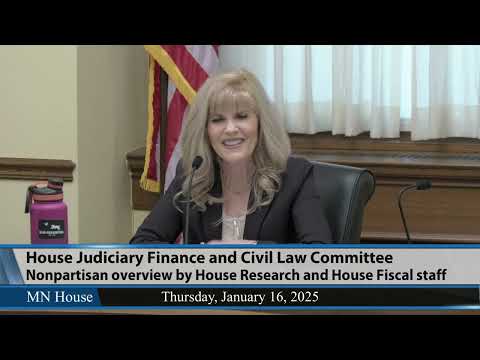
At an organizational meeting, House committee staff reviewed the panel's budget accounts, how fiscal notes are prepared, the committee's role on government data practices, and the function of the Competency Restoration Board, Chair Rep. Peggy Scott said.
Rep. Peggy Scott, chair of the House Committee on Judiciary Finance and Civil Law, opened an orientation meeting where nonpartisan staff outlined the panel’s jurisdiction, the agencies and accounts the committee oversees, and routine processes for fiscal notes and appropriations.
House fiscal staff member John Walls walked members through the committee’s spreadsheet of agencies and base budgets, identifying the Supreme Court, court of appeals, district courts and multiple boards and commissions as the units under the panel’s jurisdiction. Walls said the committee’s annual base for judiciary finance in the current biennium is about $696.9 million and described how decision items from the governor’s budget or member bills will appear under each agency line on the spreadsheet.
Nathan Hopkins of the House Research Department described the committee’s civil-law jurisdiction and its role in government data practices. “The Minnesota Government Data Practices Act is codified at chapter 13 of Minnesota statutes,” Hopkins said, and he explained that chapter 13 governs how government entities classify and share data, with separate transparency and privacy aspects. He said the committee receives mandatory referrals for bills that substantially affect government data practices and that the chair decides whether a referral is required.
Ben Johnson, also with House Research, described his role drafting the committee’s appropriation language and riders during the budget process and said the panel will handle policy changes that affect courts and related entities while respecting separation-of-powers limits. On the Competency Restoration Board, Johnson summarized the board’s purpose: to coordinate services statewide for people charged with crimes who have been found incompetent to proceed, and to identify placements or services intended to restore competency so criminal proceedings can continue. He said the board formed after legislation passed a few years ago (he said he believed it was 2022) and that it remains an evolving entity.
Walls explained the fiscal-note process to new members: staff monitor bill introductions, request fiscal notes when a bill appears to have costs (a typical turnaround is about two weeks), and produce either single-agency or consolidated fiscal notes that list expected changes in expenditures, revenues and local impact. He showed a past fiscal note as an example, noting it summarized changes across categories such as expenditures, fees, tax revenue and IT impacts.
Committee members asked clarifying questions about the Competency Restoration Board’s staffing and budget; Walls said older fiscal notes contain line-item details and offered to provide that information to members who request it. Chair Scott encouraged members to contact the House Research staff (Hopkins, Ben Johnson and Mary Davis) for questions about jurisdictional or policy matters and noted an upcoming Law School for Legislators program being offered by outside organizers by Zoom.
With no formal votes or actions taken at the session, the meeting closed after the orientation and staff remarks.