Get Full Government Meeting Transcripts, Videos, & Alerts Forever!
Get email alerts on the Paid Family Medical Leave topic
No spam. Unsubscribe anytime.
Minn. workforce committee hears broad concerns over paid leave, sick‑time mandates and staffing
Summary
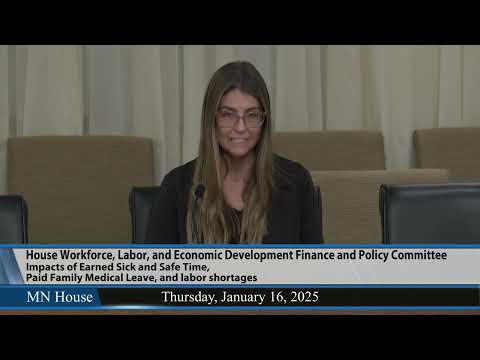
At its first official meeting, the Minnesota House Workforce, Labor and Economic Development Committee heard business groups and local governments urge changes to Minnesota's Earned Sick and Safe Time and Paid Family and Medical Leave laws, saying the mandates are creating administrative burdens, cost uncertainty and operational challenges for employers and for core public services.
At its first official meeting, the Minnesota House Workforce, Labor and Economic Development Committee heard business groups and local governments urge changes to Minnesota's Earned Sick and Safe Time (ESST) and Paid Family and Medical Leave (PFML) laws, saying the mandates are creating administrative burdens, added costs and risks to critical public services.
Lauren Schadhorst, director of workplace management and workforce development policy for the Minnesota Chamber of Commerce, told the panel the business community is worried "about some upcoming mandates and some things that have been passed in the last couple of years." She said Minnesotans are seeing businesses move or expand outside the state and urged lawmakers to "use this economic data to have an honest assessment of the state's headwinds."
The testimony collected a range of concerns that committee members said merit further study. Local government representatives said the laws were enacted outside collective bargaining and can require negotiations or arbitration to reconcile with already bargained benefits. Matt Hilgert of the Association of Minnesota Counties said the new programs "were created and mandated outside the collective bargaining process" and noted counties could face meaningful payroll costs when the PFML payroll contribution is fully implemented. Owen Wirth of the League of Minnesota Cities said cities are "navigating a complicated network of leave policies" and highlighted limits the statute places on employers' ability to monitor leave use for essential personnel.
Why it matters: Witnesses said the laws affect a wide range of employers and public services and require clearer statutory language or administrative guidance before full implementation. Testifiers pressed for answers on the PFML premium split between employers and employees, exemptions or clarifications for short‑term workers (for example, election judges), the private‑plan exemption process, seasonal definitions, and how ESST interacts with existing sick‑bank and paid‑time‑off systems.
Key technical and policy points raised
- Premium split and cost estimates: Multiple witnesses urged statutory clarity that employers and employees each pay 50% of the PFML premium. County and city witnesses said uncertainty about how the other half of the premium is funded exposes local governments to potential bargaining or arbitration. Legislative staff cited a local‑impact table estimating employer premium amounts for cities, counties, schools and townships at roughly $106.8 million in 2026 and $110.1 million in 2027 (table described as "total employer premium amount").
- Interaction with collective bargaining and existing leave banks: Hilgert and Wirth said many public employers negotiated generous leave banks over decades (examples cited included employees with 500, 880 or 1,900 hours in various counties). Those negotiated banks, they said, cannot be unilaterally reduced and the state mandates do not automatically recognize or allow employers to require use of those preexisting banks.
- Private‑plan exemptions and rulemaking timelines: County and city witnesses asked whether private plans that offer greater or different benefits will qualify for exemption, whether employers must meet a long list of criteria to qualify, and how quickly employers will receive responses so they can budget and set levies. Hilgert asked for a guaranteed response timeframe for exemption requests submitted in late summer because levy decisions follow a calendar schedule.
- Seasonal, short‑term and nontraditional workers: Hospitality Minnesota asked that the "150 day" seasonal employee threshold be changed to 180 days to match other seasonal definitions and prevent a 30‑day coverage gap. Counties and cities asked that short‑term election officials and similar intermittent workers be excluded from PFML premium collection or eligibility.
- Operational concerns for 24‑hour and emergency services: Counties, cities and townships emphasized the need for clear rules for "critical essential personnel" (dispatchers, corrections, child protection, snow and road crews) so core public services remain available during weather events and other emergencies. Hilgert said current law requires a memorandum of understanding in some cases, which he described as an insufficient clarification.
- Administrative burden and small businesses: Small‑business witnesses (NFIB, Minnesota Chamber and Business Partnership) said many employers lack HR capacity to manage accrual tracking, exemption paperwork or private plan approvals. The Chamber estimated the PFML will raise combined payroll taxes by at least 0.88 percentage points and described it as a nearly $2 billion annual payroll tax on Minnesota workers when fully implemented (as stated by the Chamber witness); NFIB and Hospitality Minnesota told the committee that the one‑size‑fits‑all design is particularly difficult for seasonal, part‑time and very small employers.
Representative and public Q&A: Committee members asked witnesses for quantification of local fiscal impacts. Witnesses said precise figures vary widely by jurisdiction and employer size, but provided illustrative ranges: county PFML premiums can be roughly calculated by applying 0.44% or 0.88% to payroll; one county example cited potential payroll impacts ranging from roughly $80,000 up to several million dollars depending on payroll size. Witnesses and a legislative staff member said more detailed fiscal work is available or in progress and should be provided to the committee for policy decisions.
Direct quotes from witnesses (selected)
"These new benefits... are added to our current employee benefit systems, irrespective of their duplicative nature," Matt Hilgert, Association of Minnesota Counties.
"The creation of the two new leave mandates has left cities navigating a complicated network of leave policies," Owen Wirth, League of Minnesota Cities.
"Finding qualified workers remains a significant challenge for small businesses throughout the state," John Beshey, state director, National Federation of Independent Business in Minnesota.
"The notice of intent to take leave is critical to the hospitality industry," Hannah Zinn, Director of Government Relations, Hospitality Minnesota.
What the committee will do next: Chair Baker said the committee will continue listening sessions around the state and examine fiscal notes and rule‑making questions from state agencies. No formal action or votes were taken at the meeting. The committee announced a subsequent meeting for Tuesday at 8:15 a.m.; the agenda was not finalized at adjournment.
Ending: Witnesses uniformly urged clearer statutory language, faster administrative guidance from state agencies and legislative fixes to reduce unintended consequences for small employers, seasonal operations and local governments. Committee members signaled interest in more detailed fiscal estimates and follow‑up testimony before pursuing statutory changes.