Get Full Government Meeting Transcripts, Videos, & Alerts Forever!
House staff brief committee on state bonding rules, debt capacity and grant practices
Summary
Nonpartisan House Research and House Fiscal staff gave the Capital Investment Committee an overview of state general obligation (GO) bonding authority, statutory limits, reimbursement rules, project requirements and Minnesota Management and Budget debt guidelines; staff committed to follow up with lists and links requested by members.
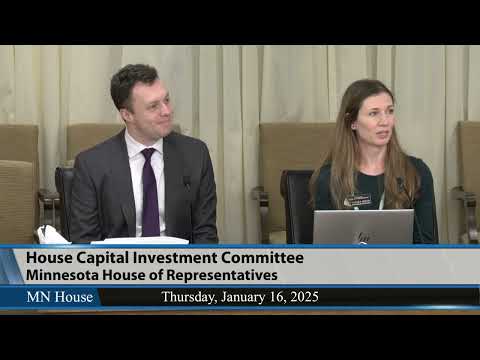
House Research and House Fiscal nonpartisan staff briefed the Minnesota House Capital Investment Committee on Jan. 16, 2025, laying out constitutional and statutory constraints on state general obligation bonding, the use of bond proceeds, and the state's debt-management guidelines.
Chelsea Griffin, a legislative analyst with House Research, and Andrew Lee of House Fiscal Staff explained how GO bonds are authorized and structured, cited the constitutional and statutory sources of authority, and described program and grant practices that commonly appear in omnibus capital investment bills.
The presentation explained that state GO bonds draw authority from the Minnesota Constitution (Article 11), implementing statutes (chiefly chapter 16A) and related statutory provisions for local bonding (chapter 475). "The state may contract public debts for which its full faith credit and taxing powers may be pledged," Griffin said, quoting Article 11; she added that Article 11 also provides a list of eligible GO bond purposes. Griffin summarized the four constitutional requirements for state GO bond proceeds: that proceeds be used for a public purpose, that the purpose be authorized in the constitution, that the use be specified in law (with detailed project descriptions, grantees and locations), and that bonds mature in no more than 20 years.
Griffin also reviewed several…
Already have an account? Log in
Subscribe to keep reading
Unlock the rest of this article — and every article on Citizen Portal.
- Unlimited articles
- AI-powered breakdowns of topics, speakers, decisions, and budgets
- Instant alerts when your location has a new meeting
- Follow topics and more locations
- 1,000 AI Insights / month, plus AI Chat