Get Full Government Meeting Transcripts, Videos, & Alerts Forever!
Get email alerts on the State Bonding topic
No spam. Unsubscribe anytime.
House staff brief committee on state bonding rules, debt capacity and grant practices
Summary
Nonpartisan House Research and House Fiscal staff gave the Capital Investment Committee an overview of state general obligation (GO) bonding authority, statutory limits, reimbursement rules, project requirements and Minnesota Management and Budget debt guidelines; staff committed to follow up with lists and links requested by members.
House Research and House Fiscal nonpartisan staff briefed the Minnesota House Capital Investment Committee on Jan. 16, 2025, laying out constitutional and statutory constraints on state general obligation bonding, the use of bond proceeds, and the state's debt-management guidelines.
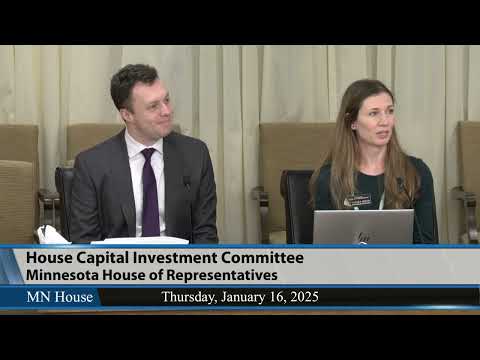
Chelsea Griffin, a legislative analyst with House Research, and Andrew Lee of House Fiscal Staff explained how GO bonds are authorized and structured, cited the constitutional and statutory sources of authority, and described program and grant practices that commonly appear in omnibus capital investment bills.
The presentation explained that state GO bonds draw authority from the Minnesota Constitution (Article 11), implementing statutes (chiefly chapter 16A) and related statutory provisions for local bonding (chapter 475). "The state may contract public debts for which its full faith credit and taxing powers may be pledged," Griffin said, quoting Article 11; she added that Article 11 also provides a list of eligible GO bond purposes. Griffin summarized the four constitutional requirements for state GO bond proceeds: that proceeds be used for a public purpose, that the purpose be authorized in the constitution, that the use be specified in law (with detailed project descriptions, grantees and locations), and that bonds mature in no more than 20 years.
Griffin also reviewed several recurring limitations and practices: bond-financed property carries recorded use restrictions while the state's financing stake remains (a duration tied to useful life), state GO bond proceeds generally cannot reimburse work already paid for, and the legislature commonly requires project descriptions that show full funding (statutory citation: 16A.502). She said there is an "expectation" in statute (16A.86) that local government will provide about half of a project's financing but that the legislature or the governor may authorize a larger state share.
Andrew Lee walked members through typical capital investment spreadsheets and past appropriations so committee members could see how projects and grant lines appear in omnibus bills. He illustrated major recipient agencies and programs (University of Minnesota, Minnesota State system, Department of Natural Resources, Metropolitan Council, Department of Transportation, Public Facilities Authority and others) and noted how funding types are identified on the spreadsheet (for example, GO for general obligation, and GOUF for user financing).
Lee described the difference between appropriations or certificates that carry the state's full-faith-and-credit pledge (GO bonds) and other debt products (appropriation bonds or certificates of participation) that lack that pledge and therefore can carry higher interest costs. He said GO bonds typically have the lowest interest cost because of the constitutional pledge and described how earlier transactions (for example, certificates of participation for state office buildings) can yield different market pricing.
On debt capacity, Lee summarized the Department of Management and Budget (MMB) debt-management guidelines the state uses as policy: (1) total principal outstanding not to exceed 3.25% of state personal income; (2) authorized-and-unissued debt plus principal outstanding not to exceed 6% of personal income; and (3) rapid amortization guidelines (40% of GO principal paid off within five years and 70% within 10 years). Lee emphasized the guidelines are MMB policy (not constitutional or statutory) and that MMB's current modeling limits the near-term amount the state can authorize while remaining within guideline 3. He said MMB's working assumption for planning included a roughly $790 million GO authorization in the current session and about $1.1 billion in an assumed 2026 authorization; he also cited annual debt-service levels in the hundreds of millions and noted about $1.5 billion of net GO impact on a recent sheet shown to members.
Members asked detailed questions about the statutory sources Griffin referenced (she pointed members to Article 11 and chapter 16A), the practical effect of funding only design phases for projects, the treatment of nonprofit grants (whether a nonprofit can be the GO bond grantee), and how trunk highway bonds interact with the state's debt guidelines. Griffin and Lee answered that design-only appropriations may proceed on the funded phase while other phases stall if full funding is not achieved; that GO bond-funded capital assets must be publicly owned (so GO funds go to a government entity), while the general fund can fund nonprofit-owned capital; and that trunk highway bonds, even when authorized in transportation bills, are counted alongside GO debt when MMB calculates capacity and guideline compliance.
Staff noted several follow-ups requested by members: Lee agreed to provide a historical list of nonprofit projects funded from the general fund, to follow up on where the 2020 electric-vehicle infrastructure funding was placed, and to provide additional detail on the local road wetland-replacement program. Griffin said she would circulate the updated House Research publication "Capital Investment and State Bonding" when it posts and would provide the capital grants manual and MMB resource links shared during the presentation.
The committee did not take formal action during the briefing. Chair Mary Fransen closed the session by directing members to the Capital Investment Committee webpage for the meeting materials and announced the committee will meet again the following week.